People vanished, shuffling and scraping their feet like pensioners in starched clothes and stiff old shoes. Someone materialized out of nowhere — a red-black-and-gold frock coat with a lace collar, striped riding breeches, women’s buckled shoes on his feet. Or maybe it wasn’t him.
I was wrung out and warped, like a toothpaste tube after a week of «I’ll buy a new one today» promises.
— Not all is lost.
A familiar voice… where had I heard it? I remembered! That baritone had warned me this was the place of suffering.
The voice turned out to be right. And I turned out to be a fool, a puppy stuffed with hormones.
— Follow me.
I got up and trudged after the red-black-and-gold back.
We walked down a corridor, climbed a dark staircase, and ended up at an iron door.
The stranger pulled the handle, opened the door, and let me go first.
I stepped outside… onto a village street. Took a step. The door closed behind me. I looked back. An ordinary wooden door out of an apartment block.
Hm.
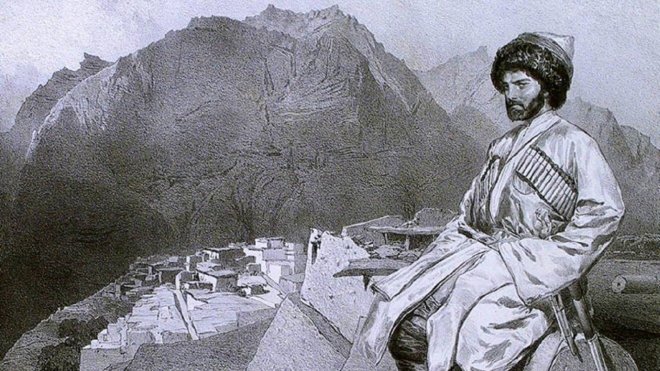
I stood among gray little houses like the saklyas I had seen in illustrations to Hadji Murat. There were no mountains. There was a plain of gentle hills built up with little houses along lines – parallel and perpendicular – stretching to the horizons. A staggering picture, as in a nightmare before a drafting exam. People wandered the streets... I looked closer... they were not wandering but trudging in a single direction. It seemed a muster of foot-plodders had been called…
What was I supposed to do?
Walked a bit, stood a bit. Came back…
I was overwhelmed, torn up from inside by the urge to get back to the girl. Through which door, though? No clue or hint would come to mind. All the doors looked identical.
I pushed the first one I came to. Locked. Pushed the second. The third… the tenth door flew open. A fist shot out of the darkness. I went down.
Looks like I blacked out.
Looks like I’d become someone’s slave: when I came to, a collar was crushing my neck, and my hands jangled with shackles.
— So we meet again, countryman. Hi there!
I turned my head and saw Anton. Recognized him by his peeling nose and vest. Vera peeked out from behind the vest.
Uh—uhhh?
Uhhhh!!!
I blinked, sniffled… couldn’t manage to say anything. Pushed my two front teeth out through my lips and started coughing.
Vera and Anton, old acquaintances, practically family by now, watched me with a jackal’s interest. Something about me displeased them. Vera summed it up:
— Totally wrecked. We won’t get anything for him. What’s the point of this headache?
— Don’t sweat it, sweetheart. We’ve sold worse-looking monkeys than this, — Anton objected.
— If you say so, — Vera agreed, then ordered: — Why are you sprawled out there, sweetie? Get up!
What monkeys they’d sold, and why sweetheart didn’t need to sweat, I couldn’t begin to figure out. I put all my strength into getting up. Didn’t want another one to the mug and lose the rest of my teeth.
I stood. Leaned against the wall, watching Anton strap a bulletproof vest onto Vera. My head cleared, and it sank into my ringing skull: «The girl turned out to be no pushover. Didn’t die of thirst. Didn’t fall into Mityai’s hands. Running with Anton now. How?»
Vera gave orders. Anton carried them out. Loaded pistols, hung himself with grenades, got out a light machine gun, laced up Vera’s boots, tucked a pistol into her holster. Both were preparing for combat like Schwarzenegger the commando out of an action movie. At the end of the preparations Anton, at Vera’s direction, clipped a leash to my collar and pushed me toward the door. I stepped outside and stopped, squinting in the bright light. The thought of how to get back to the girl was gone.
The change in status — from free Roman to nameless slave — called up a different set of concerns.
I was interested in the terrain I’d ended up in, and in the people living there. I sized up possible sources of danger. A collar around my neck had made me sharper. If only I’d been like that from the start…
I saw citizens of the most varied appearance, from the contemporaries of Romulus to our own day. Someone tugged at my collar and we fell into the stream.
Half an hour later, the houses ran out. Beyond them, two mountain ranges stretched toward the horizon, separated by a valley about as wide as the Luzhniki football pitch.
I turned my gaze to the people walking alongside me. Some were armed: assault rifles, rifles, pistols, light machine guns, rocket launchers. The rest, roughly three-quarters, were unarmed and looked miserable. Actually, no one’s happy with a collar around their neck and handcuffs or shackles on their wrists. Right. Most of the locals had it rough, which meant I wasn’t alone in my misery.