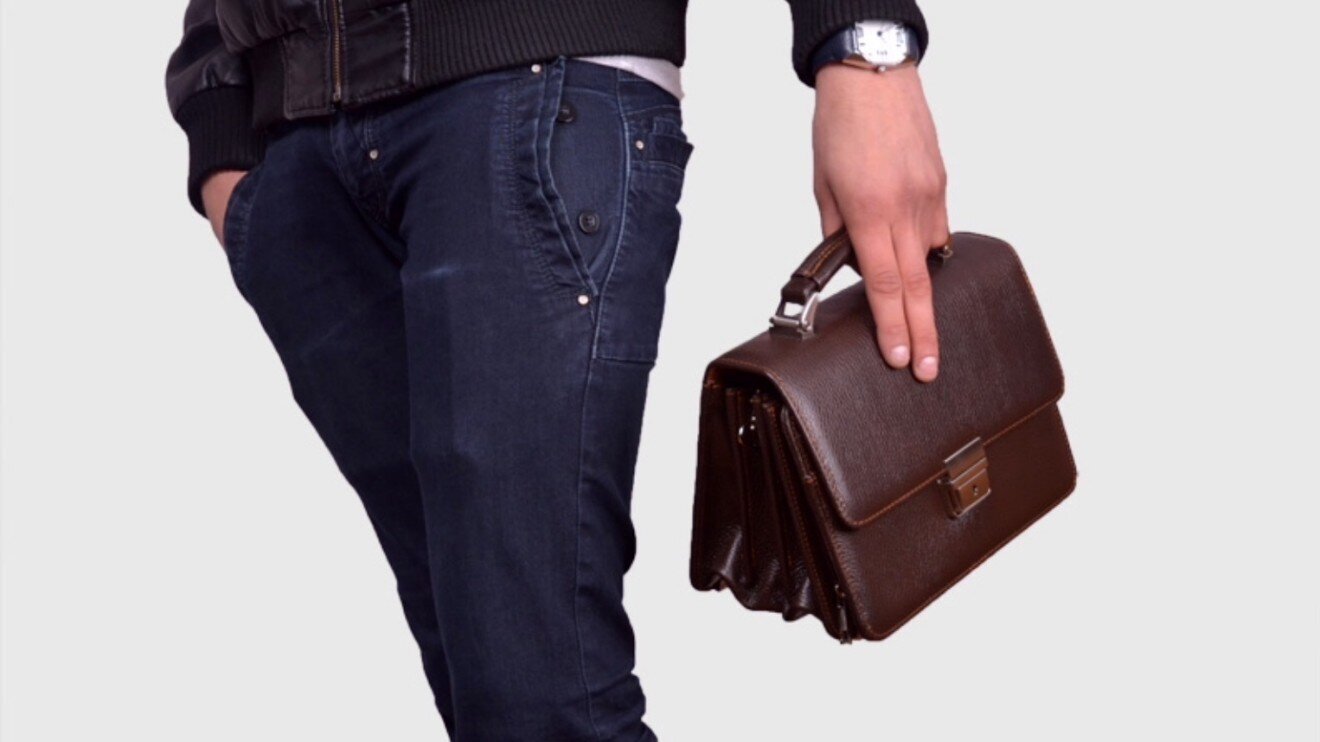
In 1990s Russia, the barsetka (also often called a "borsetka") became more than an accessory — it was a genuine symbol of status and of belonging to a particular social class. This small leather handled pouch-briefcase entered the everyday life of Russian men in the early 1990s and quickly became a cult object, one without which no successful businessman or criminal boss of the time was complete.
The name "barsetka" comes from the Italian word borsa (bag). These items were originally imported from Italy and other European countries, which lent them extra prestige in consumers' eyes. A classic barsetka was a small rectangular bag of genuine leather, black or brown, with a short handle and a zipper closure.
Why did the barsetka become a cult object?
The popularity of barsetki in 1990s Russia can be explained by several factors:
- Displaying status. In the era of primary capital accumulation and the formation of the "New Russian" class, the barsetka became a visual marker of belonging to the ranks of the successful. Items from well-known brands were especially prized.
- Practical necessity. As business and private entrepreneurship developed, there arose a need to carry cash, documents, business cards, and other everyday essentials for a businessperson.
- A criminal dimension. Amid the high crime rates of the 1990s, the barsetka let its owner keep valuables on their person at all times, under their own control. It often carried large sums of cash, documents, and even weapons.
The barsetka in Russia's criminal world
The barsetka quickly became an attribute not only of legitimate businessmen but of the criminal underworld as well. A specific crime even emerged — "barsetka theft," and the thieves who specialized in it, "barsetochniki." These criminals specialized in stealing these bags, knowing they often held significant sums of cash and valuable documents.
A typical scheme worked like this: while a car's owner was distracted (changing a punctured tire, which accomplices might have deliberately damaged, for instance), a thief would open the car door and grab the barsetka from the passenger seat. Such crimes became so widespread that specific safety recommendations were issued for barsetka owners.
Sociocultural significance
In popular culture, the image of a man with a barsetka became so recognizable that it turned into a visual cliche of the 1990s era. The barsetka appeared in jokes, cartoons, films, and television programs as an inseparable part of the "New Russian" image, alongside the crimson blazer, the gold chain, and the brick-sized mobile phone.
Over time, the barsetka went from a prestige item to more of an attribute of a particular social type, and by the late 1990s and early 2000s its popularity among the business elite began to decline. In popular culture, however, it remained one of the most vivid symbols of Russia's "wild nineties."
The evolution and decline of the barsetka era
By the mid-2000s, the barsetka had ceased to be an obligatory attribute of a successful man. It was replaced by more restrained, functional accessories — wallets, billfolds, business briefcases, and laptop bags. This owed both to changing fashion and business etiquette, and to a transformation of economic realities — the shift away from cash transactions toward bank cards and electronic payments.
Today the barsetka is viewed more as an anachronism, evoking the particular aesthetic of the 1990s. It remains in history as a vivid cultural phenomenon, characteristic of an entire era of Russian history.