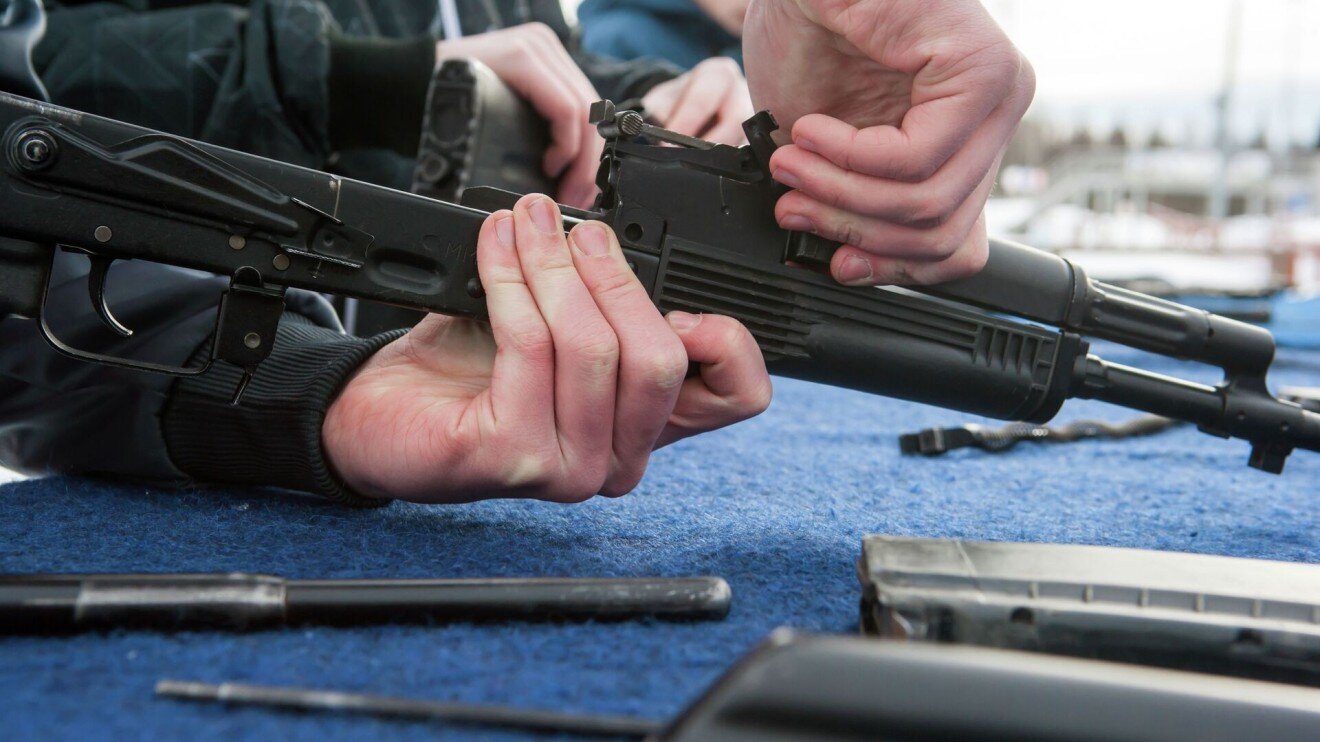
Basic Military Training (initial military training, NVP), also known as pre-conscription training, was a mandatory subject in the Soviet education system designed to prepare young people for service in the USSR Armed Forces. The course was an integral part of secondary education from 1967 until the early 1990s, when the program was effectively wound down during perestroika.
Goals and Objectives of NVP
The main goal of basic military training was to give the younger generation basic knowledge of military service and military affairs before conscription. The NVP program addressed several important tasks:
- Giving students an understanding of the structure of the USSR Armed Forces, its branches, and military ranks
- Teaching practical skills in handling small arms, primarily the Kalashnikov rifle
- Learning to use personal protective equipment such as gas masks and respirators
- Basic first-aid skills for wounds and injuries
- Fundamentals of survival and orienteering in the field
- Preparation for military field camps and subsequent conscription
NVP was seen as one of the important components of the state’s mobilization capacity. In the event of a military conflict, draftees who had completed basic military training could adapt more quickly to military service conditions and begin carrying out combat tasks sooner.
Historical Development of Pre-Conscription Training
The history of military training for young people in Russia has deep roots reaching back to the first years of Soviet power. As early as April 22, 1918, the All-Russian Central Executive Committee (VTsIK) issued the decree «On Compulsory Training in Military Affairs,» the first step toward a system of pre-conscription training.
Under this decree, special training centers were opened for students aged 15 to 17. Citizens aged 18 to 20 underwent a 96-hour military training program, after which they were enrolled in reserve unit rosters. This system allowed a trained reserve to be mobilized quickly under the conditions of the Civil War.
After the Great Patriotic War ended, in 1947, pre-conscription training was abolished for all non-student youth. In 1962 the abolition extended to senior-class students as well. But the situation changed again five years later.
In 1967 a new edition of the «USSR Law on Universal Military Duty» was adopted, reviving the system of pre-conscription training under a new name — «Basic Military Training.» The NVP program became mandatory for all senior secondary school students, as well as students at vocational schools and specialized secondary institutions.
How NVP Was Organized in Schools
Structure of Instruction
In the Soviet Union, basic military training was conducted in every general secondary, vocational, and specialized secondary institution alongside regular studies. Both young men of pre-conscription and conscription age and young women were required to take the course, though the program differed somewhat for each.
In general secondary schools, the NVP course began in the 9th grade under the ten-year system. The schedule usually allotted two hours a week, taught back-to-back on the same day. This made it possible to organize practical lessons that required setting up training equipment.
Military Instructors
NVP was taught by reserve officers who had completed active military service and retired after their term of years. Before taking up the post, they underwent special training in teaching military affairs at schools. They picked up the unofficial title «voenruk» — military instructor.
Voenruks worked in military uniform, underscoring the seriousness and special status of the subject. On the day of NVP classes, students often followed a special dress code: military-style khaki shirts were added to the regular school uniform, creating a semi-militarized classroom atmosphere.
Facilities and Equipment
To properly teach the subject, schools, vocational colleges, and specialized secondary institutions were equipped with appropriate training resources. Every institution had a dedicated NVP classroom where training aids were kept and theory classes were held.
The training base included:
- Training posters and models illustrating weapon design, tactics, and protective equipment
- Personal protective gear: various types of respirators, gas masks for adults and children, combined-arms protective suits (OZK)
- Radiation and chemical reconnaissance instruments: dosimeters for measuring radiation background, gas analyzers for detecting toxic agents
- Training weapons: training-model Kalashnikov rifles, dummy F-1 and RGD-5 hand grenades
- Air rifles and small-bore rifles for teaching the basics of marksmanship
- Training films and filmstrips on military subjects
- Topographic maps and compasses for orienteering practice
Special attention was paid to equipping dedicated weapons-storage rooms. These rooms were always fitted with alarms and kept under strict control. Many institutions built shooting ranges in their basements for small-bore rifle practice, allowing students to get hands-on shooting experience without leaving the school.
The NVP Curriculum
Introduction to Military Affairs
The program’s opening stage gave students fundamental knowledge of the structure of the armed forces. Students learned about the main tasks, composition, and organizational structure of the USSR Armed Forces. Special attention went to the system of military ranks — from private to marshal — and the corresponding insignia on shoulder boards and collar tabs.
Students were walked through the process of military service: from receiving a summons from the recruitment office to demobilization. This knowledge was important for understanding what awaited young people after they finished school.
Drill Training
Drill training took up a significant part of the NVP program. Students were taught drill movements in place and on the march: turning right, left, about-face, executing the commands «Attention!» and «At ease!» Special attention was paid to correct posture and the position of the arms and legs.
Students learned to form up in various formations: single file, double file, columns of one, two, or three. They practiced marching in formation, keeping dress and interval, and executing maneuvers. Marching in step was drilled with a sharp foot strike and correct arm position.
These skills not only prepared young people for army service but also instilled discipline, focus, and the ability to act in sync as a group.
Marksmanship Training
Marksmanship was one of the sections of NVP that students found most interesting. The program included a detailed study of the Kalashnikov rifle — the standard weapon of the Soviet army. Students studied the AK’s construction, its tactical and technical characteristics, and how its automatic action worked.
Special attention went to the practical skill of field-stripping and reassembling the rifle. Students had to learn to quickly and correctly break the weapon down into its main parts: the receiver with barrel, the bolt carrier with gas piston, the bolt, the return mechanism, the gas tube with handguard, the magazine, and the receiver cover. Many students held contests among themselves for the fastest strip-and-reassembly time.
Hand grenades were also studied — the F-1 fragmentation grenade (defensive, with a fragment radius of up to 200 meters) and the RGD-5 (offensive, with a smaller kill radius). Students were taught the proper grip, throwing technique, and the procedure for removing the fuse and pulling the safety pin.
Marksmanship theory covered the bullet’s trajectory, the concepts of direct fire, sighting range, and trajectory rise. Students were taught the correct firing positions: prone, kneeling, standing. An important element was learning to aim — correctly aligning the front sight with the rear sight notch and choosing the point of aim.
Live-fire practice was carried out in the school range with small-bore rifles or at military firing ranges. During field camps, young men had the chance to fire a combat Kalashnikov with live ammunition.
Tactical Training
In tactical training, students received basic knowledge of combined-arms combat. They studied key tactical concepts: offense, defense, meeting engagement, withdrawal. Students learned about the organization of a motorized rifle squad — the basic tactical unit, made up of a squad leader and nine soldiers.
Special attention went to a soldier’s actions in combat: moving under enemy fire (by rushes and by crawling), choosing cover, and firing from various positions. They studied ways of overcoming obstacles in combat, and the procedures for artillery bombardment and air raids.
Students learned the basics of camouflage: how to use terrain features, vegetation, and improvised materials to avoid enemy observation. Simple methods of engineering field positions were also covered.
Protection Against Weapons of Mass Destruction
The section «Protection Against Weapons of Mass Destruction» (ZOMP) carried particular weight in the Cold War context. Students studied the destructive factors of nuclear weapons: the shock wave, thermal radiation, penetrating radiation, radioactive contamination of the terrain, and the electromagnetic pulse.
Personal protective equipment was studied in detail. Special attention went to the gas mask — every student had to be able to put one on quickly on the command «Gas!» (the standard was 7 seconds). Students learned the gas mask’s design, how to fit one to size, how to check it for serviceability, and how to care for and store it.
Besides the gas mask, students learned about various types of respirators, protective stockings and gloves, and the combined-arms protective suit (OZK) — a cape, stockings, and gloves made of rubberized fabric.
Radiation and chemical reconnaissance instruments were also studied: dosimeters for measuring radiation levels, and the army chemical reconnaissance device (VPKhR) for detecting toxic agents. Students learned to use these instruments and read their readings.
This section also gave a surface-level introduction to civil defense: public warning signals, procedures in the event of a threatened WMD attack, and the design of shelters.
Medical Training
Medical training gave students basic first-aid skills for wounds and injuries. Students studied types of bleeding (arterial, venous, capillary) and how to stop them: applying a tourniquet, a pressure bandage, or finger compression of an artery.
Practical skills were drilled in applying various types of bandages: to the head, limbs, and chest. Students learned the contents of the individual field dressing kit and the personal first-aid kit (AI-2).
They studied the signs and first aid for fractures, methods of transport immobilization using improvised means and standard splints, and how to respond to burns, frostbite, and electric shock.
Special attention went to first aid for WMD injuries — radiation exposure and chemical agent poisoning. Students learned the contents of the AI-2 kit, designed for self-aid and buddy-aid under conditions of WMD use.
Study of Military Regulations
An important part of the program was studying the core provisions of the General Military Regulations of the USSR Armed Forces. Students learned about servicemembers’ rights and duties, the basics of relations between servicemembers, and military discipline.
From the Internal Service Regulations, they studied the daily routine in a military unit, the duties of the company duty officer, the arrangement of personnel, and the rules for wearing the uniform and insignia.
From the Disciplinary Regulations, they covered the types of rewards and punishments and the procedure for applying them. From the Garrison and Guard Service Regulations — the basics of organizing guard duty and a sentry’s responsibilities.
This knowledge helped future draftees get acquainted in advance with the principles of army life and avoid many problems stemming from ignorance of regulatory requirements.
Topographic Training
Topographic training gave students orienteering skills. They learned how to determine cardinal directions using a compass, the sun, the stars, and local landmarks. They practiced moving along azimuths — set directions given in degrees.
Topographic maps of various scales and their conventional symbols were studied in detail. Students learned to read a map: to determine the character of the terrain, the steepness of slopes from contour lines, and to locate various objects on the map. They practiced determining distances both on the map and on the ground.
They studied methods of target designation: by grid squares, from a landmark, by azimuth. These skills had educational value beyond the purely military, developing spatial reasoning and the ability to orient oneself.
Engineering Training
In engineering training, students gained basic knowledge of equipping and camouflaging positions. They studied the design of various types of field fortifications: individual firing pits for prone, kneeling, and standing positions, squad trenches, full-profile trenches, and anti-tank ditches.
Students learned the sequence for digging a trench: from a shallow prone-firing scrape (10–15 cm deep) to a full standing-firing trench 110 cm deep, complete with parapet, drainage ditches, and ammunition niches.
The main types of mines were studied — anti-personnel and anti-tank — along with their construction and operating principle. They covered methods of laying minefields and clearing lanes through them. Students were introduced to non-explosive obstacles: barbed-wire fences, «hedgehogs,» and anti-tank barriers.
Special attention went to camouflage: the use of camouflage netting, improvised materials, and natural cover. Students learned to assess terrain in terms of how convenient it was for setting up positions and camouflage.
Military Field Camps
The final stage of the basic military training program was the military field camp, usually held for young men in the graduating class. These camps lasted one week and were held on the grounds of active military units stationed in the region.
During the camps, students lived by the army daily routine: reveille, morning exercises, morning inspection, military training classes, political briefings, evening roll call, lights out. They were housed in barracks alongside conscript soldiers, or in separate quarters, and ate in the army mess hall.
The camp program included:
- Getting acquainted with the daily life of conscript soldiers and the unit’s routine
- Learning about guard duty organization, with a chance to stand a training watch
- Getting acquainted with internal service organization: the duties of the company duty officer and the orderly
- Inspecting samples of the unit’s weapons and equipment
- Intensive drill training under the guidance of career military personnel
- Practical marksmanship training, including live-fire shooting with the AK
- Elements of tactical training: movement on the battlefield, actions as part of a squad
- Practical digging of individual firing pits for prone and kneeling positions
- Physical training: cross-country runs, obstacle-course drills
- Drilling the standards for putting on a gas mask and protective suit
- Military medical training with hands-on skills practice
The field camps gave students a real sense of what awaited them in the army. Many young men felt more confident and prepared for their coming conscription after the camp. The camps also served as a kind of career guidance: some graduates decided after the camp to make the military their life and enrolled in military academies.
The Role of DOSAAF in the Pre-Conscription System
Besides the mandatory NVP program at schools and vocational colleges, an important role in preparing young people for military service was played by the voluntary organization DOSAAF — the Voluntary Society for Cooperation with the Army, Aviation, and Navy.
DOSAAF gave young men and women who wanted extra training before conscription the chance to train, free of charge, in various military-applied specialties. The DOSAAF system included technical military schools, flying clubs, motor clubs, shooting-sports clubs, and other training organizations across the country.
DOSAAF’s training programs were quite varied:
- Motorcycle driving instruction and motorcycle sport
- Category-C truck driving courses
- Tracked-vehicle driving courses — tracked tractors
- Radio-telegraph operator courses — Morse code and working with radio stations
- Radio direction-finding sport — combining running with locating hidden transmitters
- Radio engineering — the basics of electronics
- Technical modeling: aircraft, ship, car, and rocket modeling
- Parachute jump training and parachute sport
- Sport-aircraft piloting instruction
- Scuba diving and diving trade
- Shooting sport with various types of weapons
DOSAAF course graduates received not only valuable skills but also certificates that gave them an advantage during conscription. A young man with a truck driver’s license, for instance, could count on serving in the motor transport troops. Those who had completed parachute training often ended up in the airborne troops. Radio operators were sent to the signal corps.
DOSAAF was also active in military-patriotic education for young people. It organized military-sports games, competitions in military-applied sports, meetings with war veterans, and excursions to military units and museums of military glory.
DOSAAF’s work with young men planning to enter higher military academies was especially important. Special preparatory courses were held for them, with in-depth study of relevant subjects and intensive physical training.
The Significance of NVP for Soviet Society
Basic military training played an important role not only in preparing young people for military service, but also in shaping a certain type of Soviet citizen. The NVP program helped instill discipline, responsibility, and readiness to defend the Motherland.
From a practical standpoint, NVP significantly eased draftees’ adaptation to army life. Young men who had completed the course arrived in the army already equipped with basic knowledge and skills. They knew the Kalashnikov’s construction, could strip and reassemble it, had a sense of drill movements and combat tactics, and could use a gas mask and compass.
This let unit commanders move faster into in-depth training of draftees in their military specialties, without wasting time on the basics of military affairs. Service in the Soviet Army lasted two years in the ground forces and three in the navy, and basic military training helped make the most of that time.
NVP and State Security
From a state-security standpoint, the NVP system ensured a substantial trained reserve. In case mobilization was needed, the state could count on drafting not simply citizens of conscription age, but people with basic military training. This raised the country’s mobilization capacity and was seen as an important element of national defense.
In the Cold War, with the standoff between the USSR and NATO countries a reality, universal military training for young people was considered a necessary measure. The NVP program included elements of preparation for a possible war involving weapons of mass destruction, reflecting the realities of the time.
The Social Dimension
NVP also had important social significance. For many young men, military training classes were their first experience handling equipment, weapons, and communications gear. This helped with career orientation: some decided after NVP to tie their lives to the army, others chose technical specialties.
Joint NVP classes, especially the field camps, fostered friendships, taught teamwork, and instilled a sense of mutual support. Overcoming difficulties, meeting standards, taking part in training shoots — all of this created vivid memories of youth.
Features of NVP Instruction
Teaching Methods
Teaching basic military training required voenruks to have not only knowledge of military affairs but also pedagogical skill. Classes were structured with the students’ age in mind and with gradually increasing difficulty.
Theory classes were usually held in the classroom using posters, diagrams, and training aids. The voenruk explained the material and demonstrated techniques on models and sample weapons. Training films were widely used to help illustrate various aspects of military affairs.
Practical classes were held in specially equipped rooms or outdoors. Drill training took place on the school parade ground or sports field. Tactical training classes were often taken out into the field, where movement, camouflage, and orienteering could be practiced.
Testing Knowledge
Students’ knowledge and skills were tested regularly. There were oral quizzes on theory, written tests, and practical exams on meeting standards. Particular importance was given to drilling practical skills: timed rifle strip-and-reassembly, putting on a gas mask, and executing drill movements.
At the end of the NVP course, students took an exam, which could include both a theoretical part (question cards) and a practical one (demonstrating skills). The NVP grade went into the school-leaving certificate or the vocational-school diploma.
Working with Girls
Although the NVP program was mandatory for girls too, the content of their training had certain differences. Girls did not take part in some of the physically demanding activities, such as digging trenches during field camps.
For girls, greater emphasis was placed on medical training. They studied first-aid procedures, care of the wounded, and the basics of sanitation and hygiene in more depth. In some institutions, girls were taught military-medical training instead of the full NVP course.
Nevertheless, girls also studied the basics of protection against weapons of mass destruction, learned to use gas masks and other personal protective equipment, and were introduced to the basics of civil defense. This knowledge was considered necessary for any citizen, regardless of gender.
NVP Materials and Textbooks
Specially developed textbooks and training aids were used to teach basic military training. The main textbook was «Basic Military Training,» published by the «Prosveshcheniye» publishing house and regularly reissued to reflect changes in the program and in army equipment.
The textbook contained sections on all the main NVP disciplines and was illustrated with diagrams, drawings, and photographs. It included the tactical and technical specifications of weapons, diagrams of the rifle and grenades, tables of standards, and excerpts from the regulations.
Besides the main textbook, various reference books and manuals were used: pocket handbooks for soldiers and sergeants, small-arms manuals, topography guides, and civil defense reference books. Voenruks received lesson plans prepared by military-pedagogical institutes.
Visual aids played an important role: posters showing weapon components, protective equipment, and tactical diagrams. These posters were hung in NVP classrooms and helped students absorb the material.
Problems and Criticism of the NVP System
Despite the generally positive assessment of NVP’s role in preparing young people for military service, the system was not without its flaws and drew a certain amount of criticism.
Facilities and Equipment
One of the main problems was uneven equipment across schools and colleges. In large cities, institutions generally had a good training base: equipped classrooms, ranges, and enough training weapons and protective gear.
But in rural schools and small towns, the situation was often considerably worse. There weren’t enough training weapons, gas masks in the right sizes, or visual aids. Shooting ranges were far from universal. As a result, the quality of student training varied significantly by region.
Instructor Qualifications
The quality of instruction depended a great deal on the individual voenruk. Experienced officers with a talent for teaching could make NVP classes interesting and useful. But there were also formal approaches, where a voenruk limited himself to reading from the textbook without properly organizing practical exercises.
Another problem was the relatively low pay for NVP instructors compared to officers in active service, which didn’t always attract the most qualified military specialists to schools.
Student Attitudes
Students’ own attitudes toward NVP were mixed. Many young men took a keen interest in the classes, especially marksmanship and live-fire practice. The practical sessions — holding a rifle, shooting at the range — sparked enthusiasm.
But the theoretical part, studying the regulations, and drill training were sometimes seen as boring and unnecessary. Some students treated NVP formally, as just another mandatory subject, without engaging deeply with the content.
Questions of Relevance
By the late 1980s, during perestroika, criticism of the militarization of education grew louder. Some argued that mandatory military training in schools no longer suited the times, that it instilled a militaristic mindset in young people.
Critics pointed out that the time spent on NVP could be used for other, more relevant subjects. Proposals were made to make military training voluntary or to remove it from the school curriculum entirely.
The End of the NVP Era
In October 1990, Order No. 62 of the RSFSR Ministry of Education effectively abolished basic military training in Russian schools. In place of regular NVP lessons, it was decided that pre-conscription training should be carried out at training field camps in defense-sports health camps.
This decision came amid the broader democratic reforms of the time, the rejection of many Soviet practices, and a drive toward demilitarizing public life. But it also meant the loss of a system of basic military training for young people that had existed for more than twenty years.
With the collapse of the USSR in 1991, the NVP system ceased to exist across most of the former Soviet space. In Russia itself, despite the 1998 Law «On Military Duty and Military Service,» which called for NVP within the education system, the subject was never actually revived in schools.
In place of NVP, Russian schools introduced the subject «Fundamentals of Life Safety» (OBZh), which included some elements of military training but in a much smaller volume and with different emphases. OBZh was oriented more toward civil defense and everyday safety than toward military training as such.
NVP in Other Post-Soviet States
After the USSR’s collapse, various post-Soviet states took different approaches to youth military training. Some kept and continued the NVP system, others abandoned it.
In Belarus, the pre-conscription training system was preserved. Secondary schools and vocational institutions teach the subjects «Pre-Conscription Training for Young Men» and «Medical Training» for young women. The program largely retains the content of Soviet-era NVP, adapted to modern conditions.
In Ukraine, after a long break, NVP was reinstated in September 2014 amid the armed conflict in the country’s east. The program covers the basics of military affairs, marksmanship, tactics, and topography.
Kazakhstan, Kyrgyzstan, Uzbekistan, Azerbaijan, and Armenia also have basic military training programs in their secondary education systems, though the content and scope vary.
The Legacy of NVP
Basic military training left a noticeable mark on the memory of several generations of Soviet citizens. For millions of people, NVP classes became part of their school memories, tied to mastering «grown-up» skills in handling weapons, drill training, and field camps at military units.
Many of the skills learned in NVP classes proved useful not only in the army but in civilian life. The ability to navigate terrain, provide first aid, and act in emergencies all had practical value.
From a purely military standpoint, NVP genuinely did ease draftees’ adaptation to army service. Unit commanders noted that young men who had completed basic military training at school settled into the army faster, understood the regulations’ requirements better, and had initial weapons-handling skills.
In modern Russia, discussions occasionally arise about the need to revive NVP in schools. Supporters point to the importance of military-patriotic education for young people and the need to prepare for possible army service. Opponents object, citing the militarization of education and the irrelevance of military skills in modern society.
Conclusion
Basic military training was an important part of the Soviet education system for more than twenty years. It addressed the tasks of preparing young people for military service, shaping certain personal qualities, and ensuring the state’s mobilization capacity.
The NVP program covered a wide range of disciplines — from drill and marksmanship training to the study of protection against weapons of mass destruction and the basics of first aid. Classes were held in both theoretical and practical form, with the training culminating in field camps at active military units.
Despite its shortcomings and problems, the NVP system generally accomplished its tasks. It provided basic military training to millions of young men and women, many of whom used the knowledge and skills gained both during army service and in civilian life.
The experience of the Soviet system of basic military training remains a subject of study and debate, a source of both positive examples of how to organize pre-conscription training and an understanding of the possible problems and limits of this approach to the military education of young people.