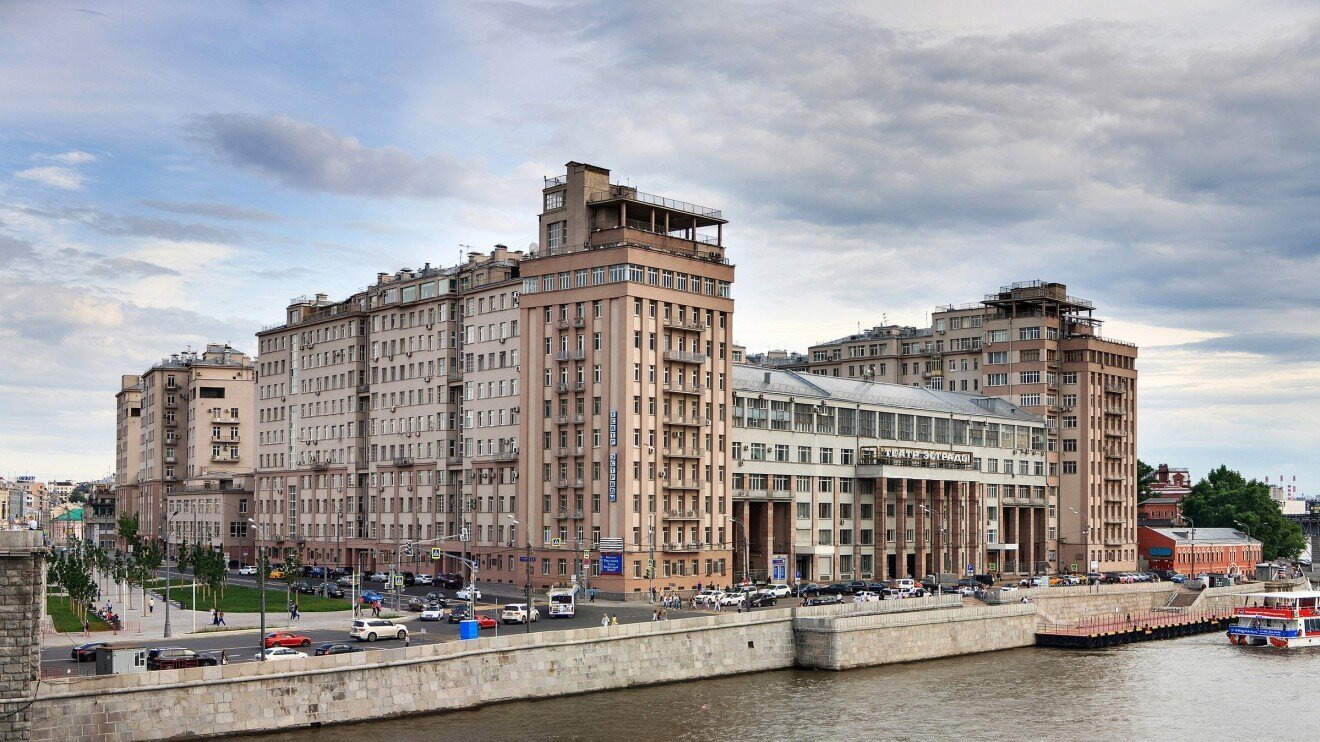
The House on the Embankment (officially, the House of Government) is a famous residential complex on the Bersenevskaya Embankment of the Moskva River, built in 1931 to a design by architect Boris Iofan. This monumental building in the Constructivist style became a symbol of the Soviet era and one of the grimmest monuments of the Stalin period.
Architecture and Layout
The grandiose complex sits on Bolotny Island and covers 3.3 hectares. The building consists of 8 blocks, ranging from 9 to 11 stories, containing 505 apartments across 25 entrances. Until 1952, it was the tallest residential building in Moscow.
The apartments were luxurious beyond anything seen at the time: they ranged from one to seven rooms, 40 to 300 square meters, with 3.7-meter ceilings. The units had hot running water (which wasn’t even available in the Kremlin), gas stoves, telephones, radio points, and trash chutes. Oak parquet covered the floors, while the ceilings featured molding and painted scenes designed by Hermitage restorers.
The complex was equipped with all necessary infrastructure: a laundry, a medical clinic, a nursery and kindergarten, a library, a gymnasium, tennis courts, and a rationed goods store. A particular point of pride was the 1,500-seat Udarnik cinema, with its retractable roof, and the Alexei Rykov Club.
The Building’s Residents
Starting in 1931, the Soviet elite received apartments in the building: senior party and government officials, Civil War heroes, writers, and Comintern staff. Among the residents were Joseph Stalin’s children, Svetlana Alliluyeva and Vasily Stalin; statesmen Alexei Rykov, Lavrentiy Beria, and Nikita Khrushchev; poet Demyan Bedny; aircraft designer Artem Mikoyan; pilots Mikhail Vodopyanov and Nikolai Kamanin; and writer Alexander Serafimovich.
The most prestigious were entrances 1 and 12, with windows facing the Kremlin. Life in the building was strictly regulated: guests had to be reported to the building superintendents in advance, all celebrations had to end by 11 p.m., and the courtyards were patrolled by guards with dogs.
The Years of Terror
The building gained its tragic notoriety during the Great Terror (1937–1938). More than 700 of its residents were repressed, including Marshals Mikhail Tukhachevsky and Vasily Blyukher, Alexei Rykov, and party officials Pavel Postyshev and Osip Pyatnitsky. Some apartments changed hands five times over; entire entrances stood sealed.
This period gave the building its grim popular nicknames: «the casemate on Bersenevskaya,» «the Gulag transit point,» «the Bolshevik trap,» «the pretrial detention house,» «Stalin’s smile,» «the mass grave.»
The Postwar Years
During the Great Patriotic War, the building was rigged with explosives in case Moscow fell. Around 400 residents went off to the front, 35 of whom became Heroes of the Soviet Union. After the war, prominent military commanders lived in the building, including Marshals Georgy Zhukov, Ivan Bagramyan, and Ivan Konev.
In the 1970s, renovations began: multi-room apartments were split into several two-room units, and historic interior elements were removed. In 1976, Yuri Trifonov’s novella «The House on the Embankment» was published, and the name stuck to the building for good.
Cultural Significance
The building has repeatedly become the subject of literary works. Besides Trifonov’s classic novella, it appears in the works of contemporary authors as well. In 1989, a museum called «The House on the Embankment» opened inside the building, telling the story of its history and the fates of its residents.
Today, the building is protected by the state as a cultural heritage site and remains one of the most famous and recognizable buildings in Moscow — a symbol of the contradictions of the Soviet era, embodying both the luxury of nomenklatura life and the tragedy of Stalinist repression.