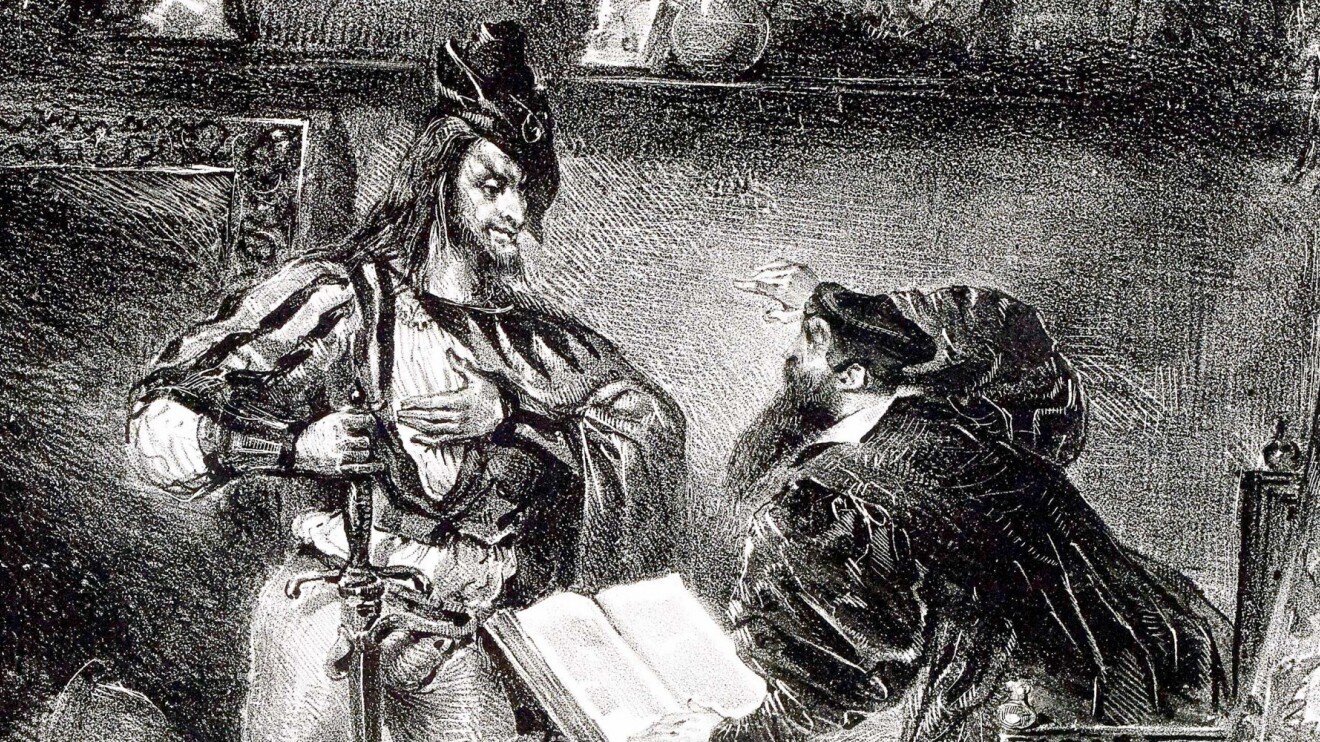
Johann Wolfgang von Goethe (1749-1832) was a German poet, statesman, thinker, and natural scientist — one of the greatest figures in world literature and a key figure of the German Enlightenment.
About the tragedy "Faust"
"Faust" is Goethe's principal work, on which he labored for nearly his entire life. Part One of the tragedy was published in 1808; Part Two, posthumously, in 1832.
The plot
The story is based on an old German legend about Dr. Faust, who made a pact with the devil. The protagonist is Faust, a scholar disillusioned with knowledge and life. Mephistopheles (the devil) makes a wager with him: if Mephistopheles can make Faust say to a passing moment, "Stay, thou art so fair!", then Faust's soul will belong to him.
In Part One, Mephistopheles rejuvenates Faust and introduces him to a life of pleasure. Faust falls in love with the young Margarete (Gretchen), but their love ends in tragedy: Gretchen kills the child she bears him and is imprisoned for it. Faust tries to save her, but she refuses to flee and dies.
In Part Two, Faust goes through numerous adventures, engages in affairs of state, and finds true happiness in creative labor for the benefit of others. In the end, Faust utters the fateful words not in response to a moment of pleasure, but to a moment of socially useful work. Even so, angels save his soul, explaining: "Whoever strives with all his being, that man we can redeem."
Philosophical meaning
"Faust" is a philosophical tragedy about the meaning of human life, knowledge, and self-knowledge. Goethe explores eternal themes: the search for truth, the relationship between good and evil, the purpose of human existence, and the possibility of understanding the world.
The work's core philosophical ideas:
- The meaning of life lies in constant striving and the pursuit of knowledge
- A person must pass through mistakes and sin toward redemption
- True happiness lies in creative labor for the benefit of others
- Faith in human salvation through active effort and tireless striving
"Faust" is traditionally studied in the upper grades of Russian schools (grades 10-11) as one of the most important works of world literature.
- Author: Johann Wolfgang von Goethe
- Lived: 1749-1832
- Published: Part I (1808), Part II (1832)
- Genre: philosophical tragedy
- Main characters: Faust, Mephistopheles, Margarete (Gretchen)
"Stay, thou art so fair!"
"He who seeks must wander"
"Grey, dear friend, is all theory, and green the golden tree of life"