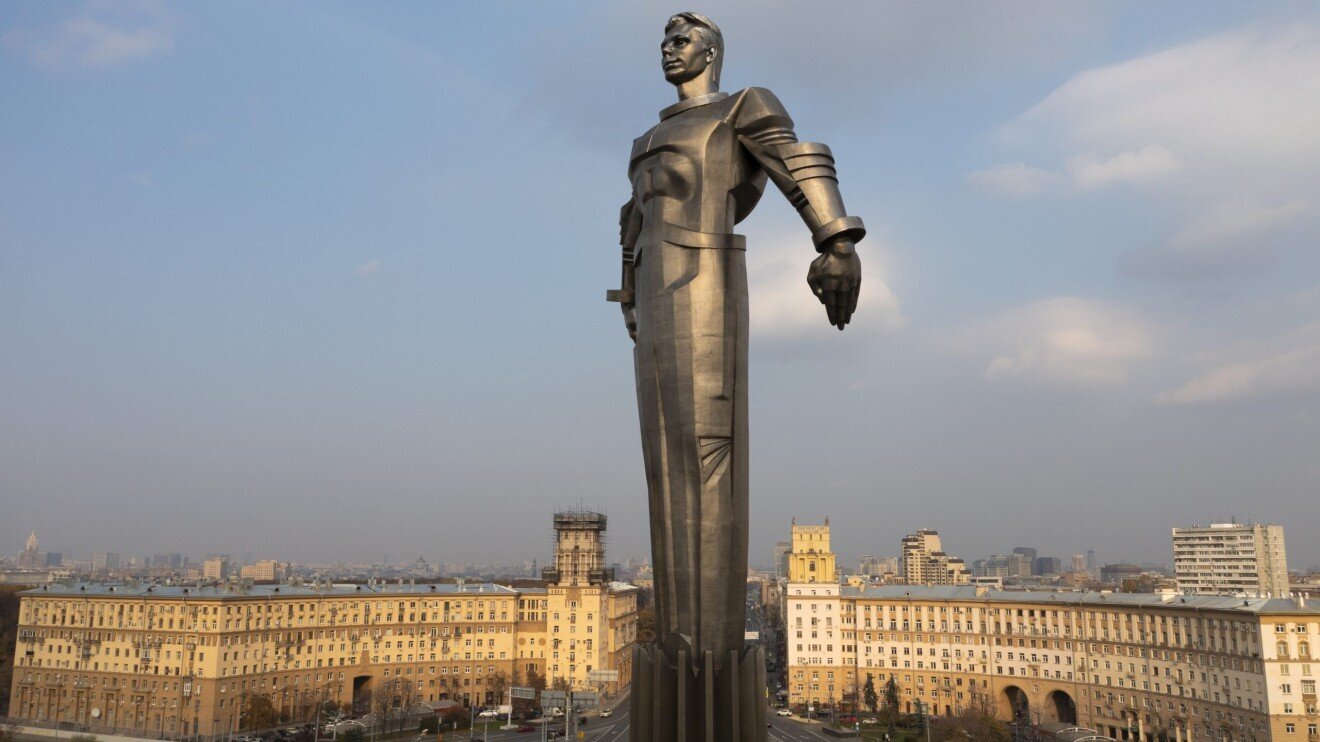
The «Soviet idol» mentioned in the text is the monument to Earth’s first cosmonaut, Yuri Alekseyevich Gagarin, standing on Gagarin Square along Leninsky Prospekt in Moscow. The monument was unveiled on July 4, 1980, ahead of the Moscow Olympics, and became one of the most recognizable symbols of Soviet achievements in space.
Creation History and Its Creators
The monument was created by sculptor Pavel Bondarenko, architects Yakov Belopolsky and Fyodor Gazhevsky, and engineer Alexander Sudakov. Building the monument was a genuine feat of engineering — it was the world’s first large-scale monument cast entirely in titanium.
Technical Features
The monument stands 42.5 meters tall, with a total mass of 12 tons. The sculpture is made from VT5L titanium casting alloy, chosen by specialists at the All-Union Scientific Research Institute of Aviation Materials (VIAM) for its workability, its glossy surface, and its fitting tone of color. The choice of titanium was symbolic — the metal is used in the construction of spacecraft.
The titanium sculpture was assembled from 238 cast segments, joined by bolts and welding. Production took place at the Balashikha Foundry and Machine Plant on an extremely tight schedule — work on the commission only began in 1979. The greatest technical difficulties arose in casting the cosmonaut’s face — that segment weighed 300 kg, far exceeding the allowable mass for a single pour in a vacuum furnace.
Composition and Symbolism
Gagarin’s figure is shown reaching upward, symbolizing humanity’s aspiration toward the stars. The tall, ribbed pedestal is an important part of the composition, representing a stylized image of a spacecraft launch. At the foot of the monument sits a replica of the descent module of the Vostok spacecraft, in which Gagarin made his historic flight on April 12, 1961.
An inscription is engraved on the monument: «On April 12, 1961, the Soviet spacecraft Vostok, carrying a man aboard, made a flight around the globe. The first man to venture into space was a citizen of the Union of Soviet Socialist Republics, Yuri Alekseyevich Gagarin.»
Choosing the Site
The monument’s location was no accident. It was along Leninsky Prospekt that Yuri Gagarin entered Moscow from Vnukovo Airport after his historic flight, on his way to report to the Central Committee of the CPSU on the results of the first spaceflight. Until 1960, Gagarin Square marked the boundary of Moscow. The architects designed the monument to be visible from as far away as the Moscow Ring Road (MKAD), and it’s said that shifting the monument in any direction would disrupt the creators’ original design intent.
The monument holds the status of an identified cultural heritage site and is one of the most significant monuments of the Soviet era dedicated to the conquest of space.