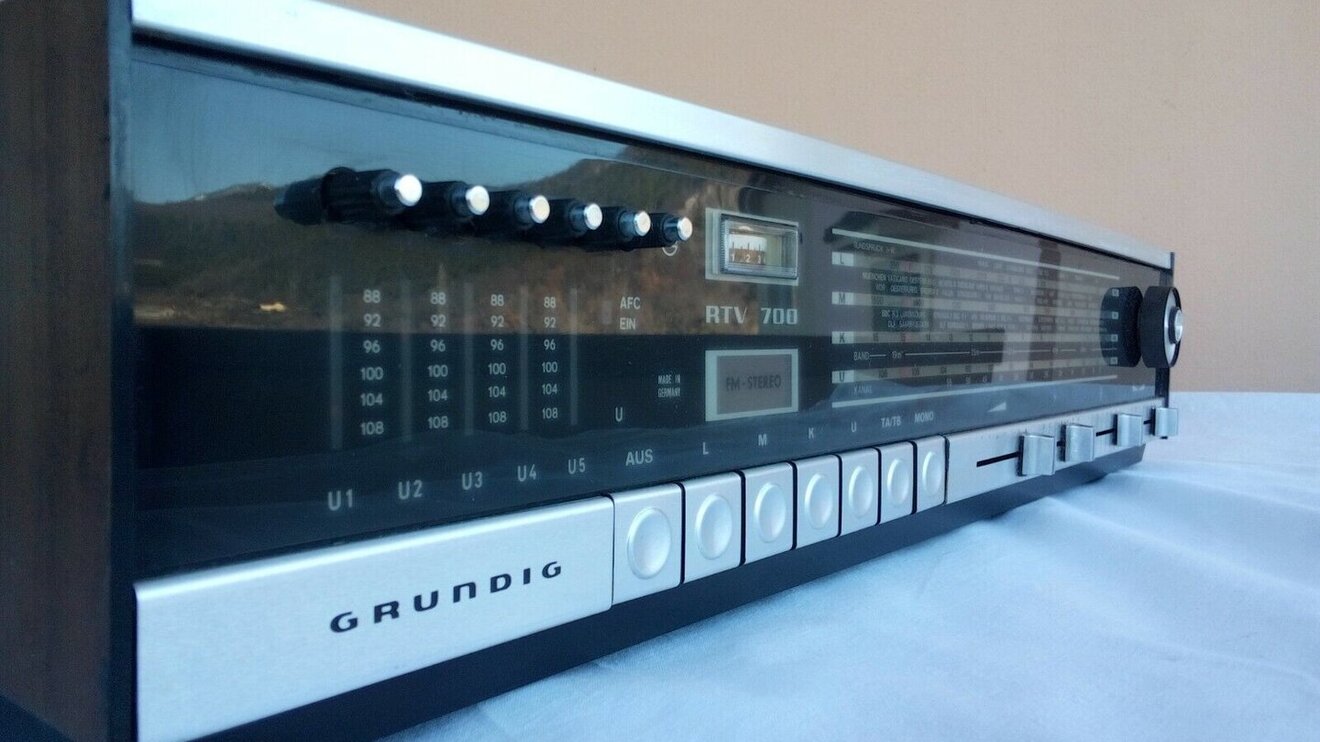
In the early 1990s, a large-screen "Grundig" television with the ability to receive satellite broadcasts was a symbol of prestige and technological progress in Russia.
The history of the Grundig company
The Grundig company traces its history back to 1945, when Max Grundig founded the enterprise in the Bavarian town of Furth. The company was originally called Furth, Grundig & Wurzer, and specialized in manufacturing transformers. During the Second World War, the enterprise, like many German firms of the time, used the labor of prisoners of war, though it did pay them.
In the postwar years, the company shifted toward repairing radio equipment, and in 1947 it rebranded, gaining worldwide fame as Grundig GmbH. By this point the enterprise had begun producing radio-receiver kits, the most famous of which was the portable Grundig Boy radio, released in 1949.
Grundig's products were known for traditional German quality and attention to innovation. It was under the Grundig brand that the first West German television set was released in 1953. Televisions, car radios, and other electronics from the brand secured a strong position in the West German market and became widespread far beyond Germany's borders.
Grundig in the USSR and Russia
In the Soviet Union, Grundig equipment was sold for Vneshposyltorg vouchers (a hard-currency-equivalent scheme for foreign goods) and was considered a symbol of prestige. In the 1970s, the word "Grundig" in Russia was unambiguously associated with the idea of "prestigious imported equipment." Owning a television or tape recorder of this brand was a mark of high social status.
By the early 1990s, the company was going through a difficult period. One of Europe's oldest consumer electronics manufacturers, it struggled to compete with Asian manufacturers. In 1993, Grundig AG came under the control of the Dutch company Philips, which also specialized in consumer electronics.
Around this time, Grundig's Russian representative office opened in 1994, with the Moscow firm Ascad becoming its official representative in Russia. It traded mainly in consumer electronics, in particular the largest televisions in Moscow, with a 95 cm screen, priced at around $3,050.
Large-screen televisions
In the early 1990s, a television with a one-meter screen (about 40 inches) was a genuine technological marvel. Most Soviet televisions had screens of 37 to 51 cm (14 to 20 inches), so a one-meter screen made a stunning impression. Such televisions were affordable only to very wealthy people, and served as a vivid symbol of a new era and its newly opened possibilities.
Grundig's German quality, combined with a large screen, made such televisions a special point of pride for their owners. They not only delivered a high-quality picture, but underscored their owner's social status.
The rise of satellite television
The history of satellite television began back in 1945, when the British science-fiction writer Arthur C. Clarke proposed a worldwide communication system based on three satellites evenly distributed in Earth orbit. The first signal transmission from Europe to North America took place via the Telstar satellite on July 23, 1962.
The first geostationary commercial satellite for intercontinental television communication was Intelsat I, launched on April 6, 1965. In the USSR, the "Orbita" relay satellite system was created in October 1967, allowing central television broadcasts from Moscow to be regularly received across Siberia and the Far East.
The development of satellite TV in the 1980s
In the 1980s, satellite television systems were actively installed by consumers, aided by falling installation costs. In the US alone, 500,000 systems priced at $2,000 or less were sold in 1984. The signal was unencrypted, so buying a system meant free access to every channel.
In the USSR, the first system transmitting a signal for individual users was the satellite "Ekran 1," launched on October 26, 1976. In 1979, the "Moskva" system was developed and launched, using "Gorizont" satellites in geostationary orbit.
On December 11, 1988, the company SES put the Astra 1A satellite into orbit, targeting Western Europe. It was one of the first medium-power satellites to broadcast in the Ku-band, and made it possible to use smaller dishes — just 90 cm across.
Satellite television in early-1990s Russia
On April 1, 1991, the first domestic satellite television operator, "Kosmos TV," began operating in the USSR, and then Russia. The first truly affordable, mass-market operator, "NTV Plus," however, did not begin service until September 1, 1996.
In the early 1990s, satellite television in Russia was accessible only to a very narrow circle of people. Receiving the signal required expensive satellite dishes and special equipment. The ability to watch foreign news live via satellite was a genuine luxury.
Technical aspects of satellite reception
Receiving satellite television in the early 1990s required parabolic dishes ranging from 90 cm to several meters in diameter, depending on the satellite's power and geographic location. The signal was received in the C-band (3.7–4.2 GHz) or the Ku-band (10.7–12.75 GHz).
Satellite receivers of the time were complex, expensive devices. Many channels were broadcast in analog format, though the first digital broadcasts were already beginning to appear. Setting up and maintaining a satellite system required specialized knowledge and skill.
A symbol of status and prestige
In the context of Russia in 1993, a large-screen Grundig television with satellite reception represented the height of technological luxury. Such equipment could be afforded only by very wealthy people — successful businessmen, high-ranking officials, or members of criminal organizations.
The ability to watch foreign news in real time via satellite was not just a mark of wealth, but a symbol of openness to the world, of a striving toward a Western way of life. This mattered especially during a period of radical political and economic change in the country.
Conclusion
A large-screen Grundig television with satellite reception, in 1993, was not simply a piece of consumer electronics, but a symbol of a new era. It represented the breaking down of an information barrier, the ability to receive news from abroad without censorship or restriction. For its time, it was a genuine "wonder of wonders," accessible only to the chosen few, and a mark of their special status in a society in transition.