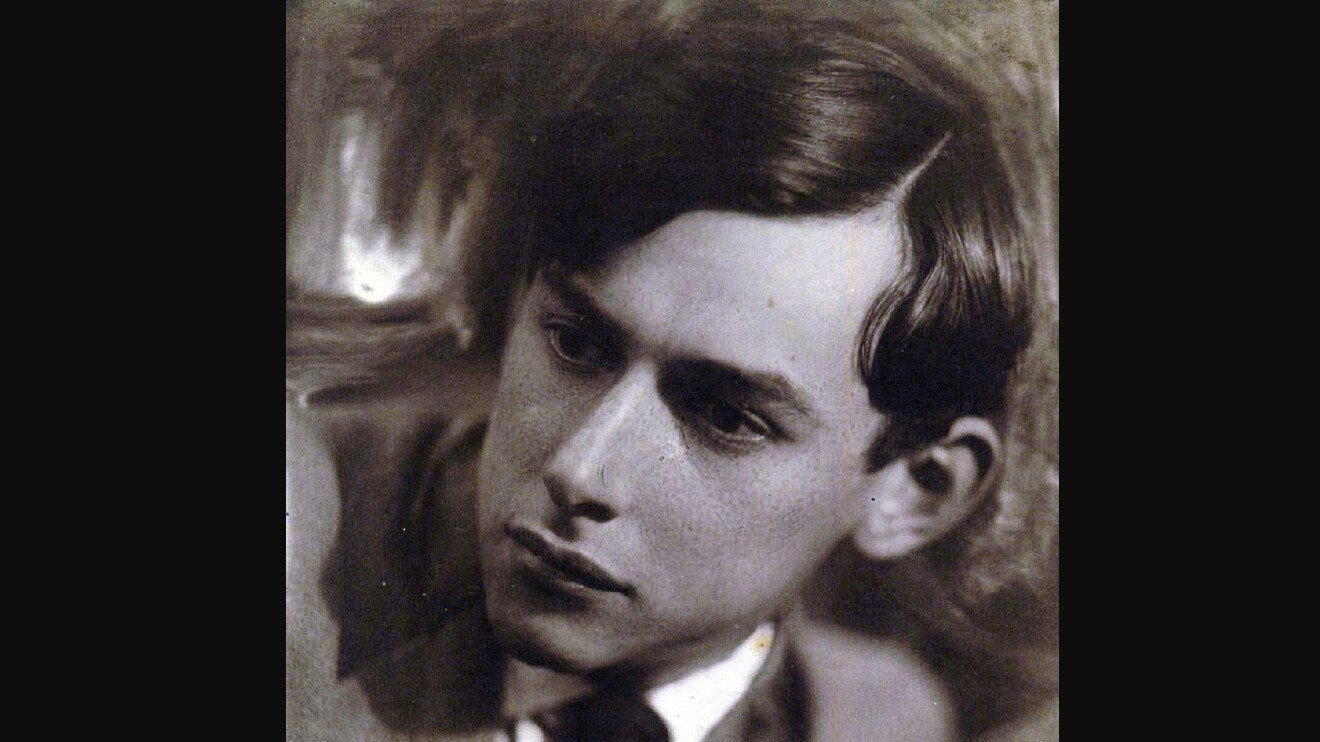
The lines «Whirlwind, strike the lyre, lyre, howl like a wolf, chaos widens, wider, Lord, grant rest» belong to Konstantin Konstantinovich Vaginov (until 1915, Vagengeim) — a Russian poet and prose writer of the Silver Age, little known to the general public but highly regarded in literary circles.
Vaginov was born October 3, 1899, in Petersburg, into the family of a gendarme captain. In 1915, amid anti-German sentiment in Russia, the Vagengeim family was granted the highest permission to take the name Vaginov. Educated at Ya. Gurevich's gymnasium, Konstantin entered the law faculty of Petrograd University in 1917, but was soon mobilized into the Red Army. After demobilization in 1921, he returned to Petrograd, where he threw himself into the city's literary life.
Vaginov's literary legacy includes both poetry and prose. He began writing poems back in gymnasium, imitating Baudelaire's "Flowers of Evil." The image of Petersburg holds a central place in his poetry. Vaginov's early lyric work is a vivid example of modernist poetry, with its characteristic motifs of decay, chaos, and hopelessness. His style is marked by rich imagery, philosophical depth, and refined form.
In 1921, Vaginov was accepted into Nikolai Gumilyov's "Guild of Poets," and together with N. Tikhonov, P. Volkov, and S. Kolbasyev founded the group "Ostrovityane" ("The Islanders"). That September, the group's first typewritten poetry collection was published, featuring Vaginov's poems for the first time. In late 1921, Vaginov's first book of poems, "A Journey into Chaos," was published.
In 1924, the poet met Mikhail Bakhtin, who thought highly of his work. Through Bakhtin's circle, Vaginov also met I.I. Sollertinsky, M.V. Yudina, P.N. Medvedev, and L.V. Pumpyansky. In 1928, Vaginov, together with Daniil Kharms, Alexander Vvedensky, and Nikolai Zabolotsky, took part in the famous OBERIU evening, "Three Left Hours."
Vaginov's greatest fame came from his modernist novels: "The Goat Song," "The Works and Days of Svistonov," "Bambochada," and "Harpagoniana." His prose shows influences from Gogol's and Dostoevsky's Petersburg tales, the works of Andrei Bely, the ancient novel and Renaissance novellas, and the 18th-century picaresque novel.
Beyond his literary work, Vaginov had a passion for numismatics and was a collector, gathering and studying literature on ancient history and archaeology.
Vaginov's work went largely unrecognized during his lifetime. After his death from tuberculosis on April 26, 1934, his work remained largely forgotten for decades. Only in the 1960s, thanks to a revival of interest in the OBERIU poets, did attention turn to Vaginov as well. The first "Collected Poems" appeared in Germany in 1982, and reissues and new publications in the USSR only came in 1989, during Perestroika.
Konstantin Vaginov's work, invoked by the novel's character, reflects the atmosphere of early-20th-century cultural rupture and echoes the spiritual searching and aesthetic experimentation of the 1990s intelligentsia, who were themselves witnessing another historic upheaval.