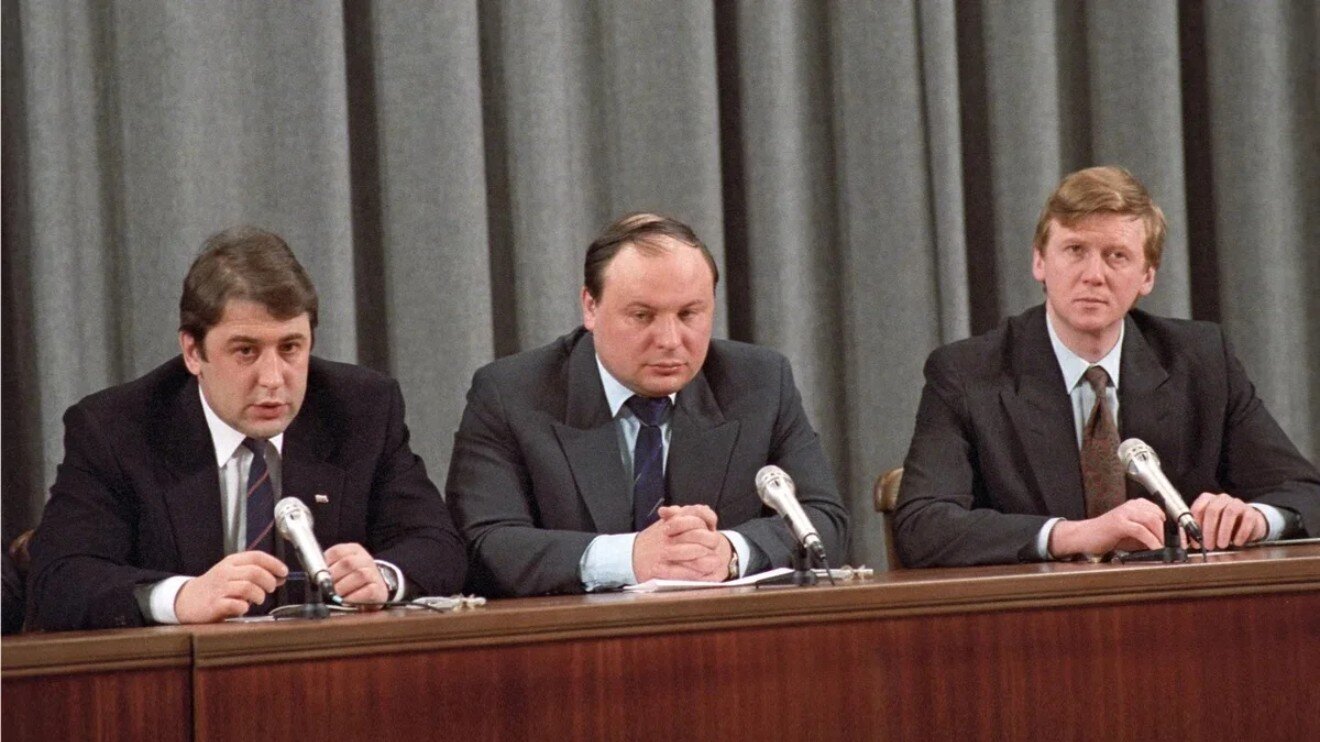
The catchphrase "boys in pink pants" became firmly established in Russia's political vocabulary of the early 1990s, becoming one of the most vivid examples of political polemic in an era of radical economic reform.
Origin of the phrase
Authorship of this phrase belongs to Russian Federation Vice President Alexander Rutskoy. He first uttered this catchphrase in early December 1991, during a speech in Barnaul, characterizing in this way the team of young reformist economists led by Yegor Gaidar.
The expression quickly gained popularity and came to be used not just for Gaidar's specific team, but for liberal economists in general. In the political vocabulary of the time, it became fixed as an ironic label for the group of reformers whom critics accused of inexperience and being out of touch with the country's real life.
Historical context
By early 1992, Russia's economic situation was critical. The country stood on the brink of a food crisis: retail meat and fish inventories had shrunk to a 10-day supply, and in 60 of Russia's 89 regions, grain reserves were nearly exhausted. In many places, bread production ran "hand to mouth," directly off newly imported grain.
Under these conditions, the Yeltsin-Gaidar government decided on a radical liberalization of prices, which began on January 2, 1992. This measure was meant, in the reformers' thinking, to encourage producers to bring goods to market and overcome the total shortages.
The substance of Rutskoy's criticism
In a series of speeches around the turn of 1991–1992, Alexander Rutskoy sharply criticized the members of Yegor Gaidar's cabinet. The vice president's main grievances boiled down to the following:
- Runaway price growth — the result of liberalization exceeded every expectation
- Total impoverishment of the population — the reforms dealt a painful blow to citizens' standard of living
- A worsening production slump — instead of growth, the economy showed a catastrophic decline
- The collapse of the military-industrial complex — a sector critical to the country was in crisis
Rutskoy characterized all of these processes as a consequence of the young reformers' disregard for Russia's national interests.
"When Gaidar proposed starting off with price liberalization, I made a scene and warned that this was a road to poverty. And where did we end up? Salaries and pensions weren't being paid, officers had to work as taxi drivers, as porters. There was chaos in the country!"
Criticism of their professional background
Rutskoy was especially unhappy with what he saw as a shortage of practical specialists in Yeltsin's government, and a surplus of academic economists. The vice president stressed the reformers' lack of real management experience.
A characteristic example of this criticism was Rutskoy's remark about Yegor Gaidar: "Just imagine: Gaidar's last job before joining the government was head of the economics department at the newspaper Pravda. That's the level we're talking about, huh?!"
In Rutskoy's view, the reformers were "not economists, but a bunch of hooligans," which is what led to the catastrophic consequences of their policy.
An alternative program
Rutskoy did not limit himself to criticism, but proposed alternative solutions:
- Gradual privatization instead of shock therapy
- Price controls to prevent sharp spikes
- Preserving Gosplan as a tool of economic planning
- A more cautious approach to economic reform
The vice president insisted: "There must be planning in the economy. I always told Yeltsin that."
The results of the 1992 reforms
By the end of 1992, when Gaidar was removed from office, the results of the reforms really had proven contradictory. On one hand, the shortages had been overcome and market mechanisms had been set in motion. On the other, prices rose 26-fold over the course of 1992, wiping out the value of wages, incomes, and savings.
According to economists, wages and pensions often went unpaid, and many officers really were forced to moonlight as taxi drivers and porters. At many enterprises, "red directors" set up commercial entities and funneled all output through relatives at cost price.
The phrase's political significance
"Boys in pink pants" became a symbol of the conflict between pragmatists demanding a more cautious approach to reform, and radical liberals insisting on the need for shock therapy. It reflected a widely held view in society that the young reformist economists, for all their theoretical knowledge, lacked the life experience needed to run the country through a period of crisis.
The expression underscored the contrast between the harsh reality of the transitional period and what critics saw as the reformers' naive notions of how the economy's transformation should unfold.
What came next
After Gaidar's dismissal in December 1992, the conflict between Rutskoy and the team of liberal reformers only intensified. This standoff became one of the factors leading to the constitutional crisis of 1993 and the tragic events of that October.
The phrase "boys in pink pants" outlived those who coined it, and is still used today in Russian political commentary to describe young or inexperienced politicians and economists of a liberal bent.
Historical note
In the context of a novel set in 1993, the mention of "liberals in little pink pants" reflects public sentiment of the time, when the first results of Gaidar's reforms were already apparent, and their reception in society was highly contradictory.