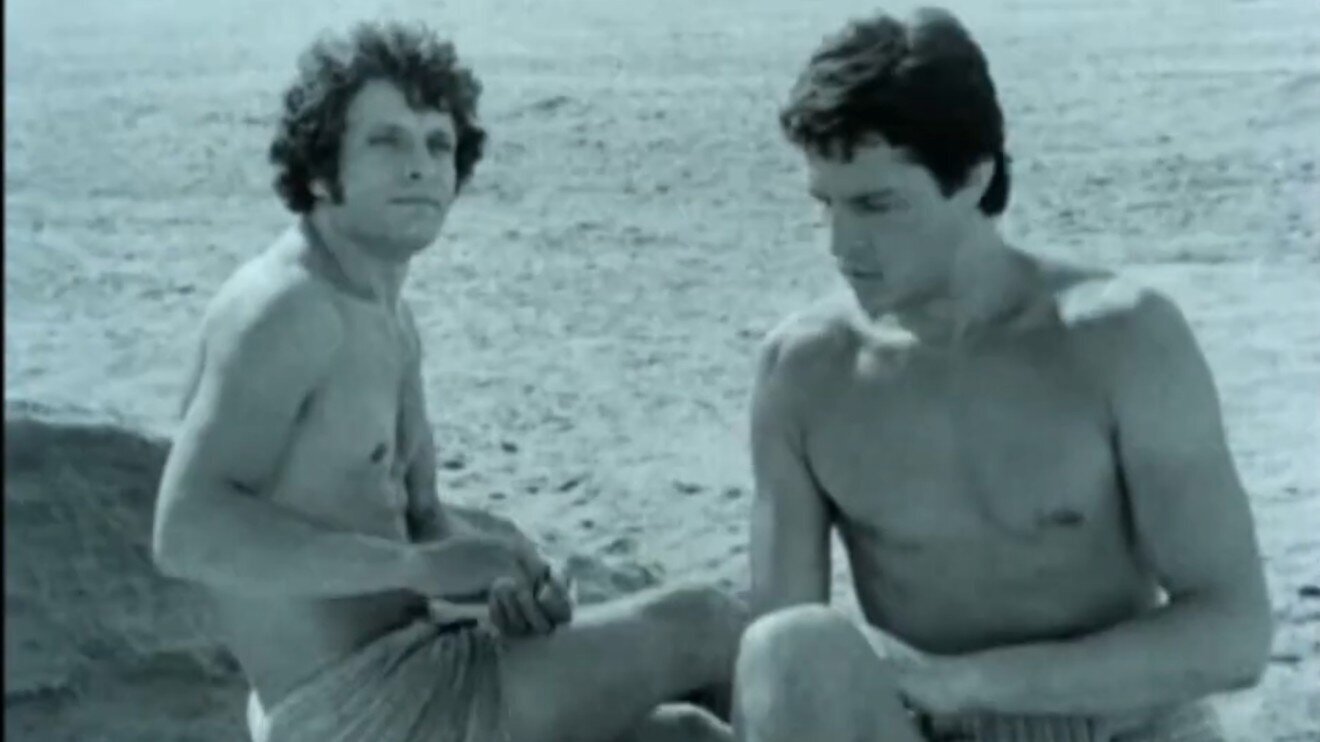
"Little Tragedies" is a three-part television film, directed by Mikhail Schweitzer at the Mosfilm studio in 1979. The framing story is a free interpretation of Pushkin's unfinished novella "Egyptian Nights." The "Little Tragedies" themselves appear as the spontaneous creations of an Improviser, working on themes proposed by the audience from within "Egyptian Nights."
About the director
Mikhail Abramovich Schweitzer (1920–2000) was an outstanding Soviet film director and screenwriter, a People's Artist of the USSR. He made his name adapting classic literature for the screen. Among his well-known works: "The Golden Calf," "Dead Souls," "The Flight of Mr. McKinley." "Little Tragedies" was created in collaboration with his wife, director Sofia Milkina.
How it was made
The film was made to mark the 180th anniversary of Pushkin's birth. Filming took place in 1979 in Leningrad, Tallinn, and Lviv. For maximum authenticity, some scenes were shot in genuine historical interiors.
A distinctive feature of the film was its brilliant cast — nearly every leading actor of Soviet cinema at the time took part in the production. Vladimir Vysotsky played two roles at once — Don Guan and the Chairman in "A Feast in Time of Plague."
The film's structure
The film has three parts, adapting the following works:
- Part one: "A Scene from Faust" (used as a prologue), with an insertion from "Sketches for a Faust Concept," "Egyptian Nights," "Mozart and Salieri," "The Undertaker."
- Part two: "The Miserly Knight," "Egyptian Nights," "The Stone Guest," "Guests Were Gathering at the Dacha...," "On the Corner of a Small Square...," "We Spent an Evening at the Dacha...," "I'm Here, Inezilla."
- Part three: "The Stone Guest," "A Feast in Time of Plague," "There Lived a Poor Knight."
The line "I'm bored, demon"
The famous line "I'm bored, demon" is heard in the first part of the film, in the "Scene from Faust" segment. This role was brilliantly played by Nikolai Kochegarov as Mephistopheles, with Ivars Kalniņš as Faust. In Pushkin's original work, "A Scene from Faust" (1825), this line is Faust's first line, addressed to Mephistopheles.
It's worth noting that this short line embodies one of the central themes of Pushkin's work — the theme of boredom, of being sated with life, the inner emptiness of a man who has achieved everything and tasted everything.
Its popularity
After its release in 1979, the film became enormously popular. Its television broadcasts drew audiences in the millions across the USSR. Vladimir Vysotsky's performance as Don Guan was especially acclaimed — it was one of his last film roles (Vysotsky died in 1980).
The film was broadcast regularly on central television throughout the 1980s and 1990s. "Little Tragedies" is considered one of the finest screen adaptations of Pushkin's work in the history of Soviet cinema, and a model of high-quality television filmmaking.
The film was awarded the USSR State Prize for 1983 in literature, art, and architecture.
The text of the scene
THE SEASHORE. FAUST AND MEPHISTOPHELES.
Faust
I'm bored, demon.
Mephistopheles
What's to be done, Faust?
Such is the limit set for you,
And no one has ever crossed it.
Every rational creature grows bored:
One from idleness, another from toil;
One believes, another has lost his faith;
One never got the chance to taste pleasure,
Another tasted it to excess,
And each one yawns, and yet goes on living —
And the grave awaits you all, yawning too.
So yawn, you too.Faust
A dry sort of joke!
Find me some way, somehow,
To be distracted.Mephistopheles
Be content
With this proof of good sense.
Write it down in your notebook:
Fastidium est quies — boredom
Is the resting place of the soul.
I'm a psychologist… now there's a science!..
Tell me, when were you never bored?
Think, search for it. Was it then,
When you dozed over Virgil,
While the birch rod stirred your wits?
Or then, when you crowned with roses
The favor of willing maidens
And in loud revelry gave them
The fire of an evening's aftertaste?
Or then, when you sank
Into noble musings,
Into the dark depths of learning?
But — I recall — it was then, from boredom,
Like some harlequin, out of the fire
You finally summoned me forth.
I writhed about like a petty demon,
Tried my best to cheer you,
Carried you off to witches and to spirits,
And what came of it? All trifles.
You wished for fame — and won it, —
Wished to fall in love — and fell in love.
You took from life whatever tribute it could give,
But were you happy?Faust
Enough,
Don't reopen my secret wound.
In deep learning there is no life —
I've cursed the false light of knowledge,
And fame… its fleeting ray
Cannot be caught. Worldly honor
Is meaningless, like a dream… But there is
One true good: the union
Of two souls…Mephistopheles
And the first meeting,
Isn't that so? But might I ask
Whom you mean to invoke —
Not Gretchen, is it?Faust
O wondrous dream!
O pure flame of love!
There, there — where the shade is, where the trees rustle,
Where the streams ring out sweetly —
There, upon her lovely breast,
Resting my languid head,
I was happy…Mephistopheles
Heavenly Creator!
You're raving, Faust, wide awake!
You deceive yourself
With an obliging memory.
Was it not I, through my own effort,
Who brought you that miracle of beauty?
And in the depths of midnight
Brought her together with you? Meanwhile
I amused myself, alone,
With the fruits of my own labor,
Just as the two of you did — I remember it all.
When your beauty
Was in rapture, in ecstasy,
Your restless soul
Was already sinking into reflection
(And you and I have proven
That reflection is the seed of boredom).
And do you know, my philosopher,
What you were thinking at such a time,
When no one else is thinking of anything?
Shall I tell you?Faust
Speak. Well, what?
Mephistopheles
You were thinking: my obedient little lamb!
How greedily I desired you!
How cunningly, in that guileless maiden,
I stirred the dreams of her heart! —
To an involuntary, selfless love
She gave herself, all innocence…
So why is my breast now full
Of hateful longing and boredom?..
At the victim of my own whim
I gaze, having drunk my fill of pleasure,
With irresistible revulsion:
Just as a reckless fool,
Having rashly resolved on some evil deed,
And having knifed a beggar in the woods,
Curses the tattered corpse; —
Just as, having hastily glutted itself
On some bought beauty,
Vice glances back at it in timid disgust…
And then, from all of this,
You drew but a single conclusion…Faust
Vanish, hellish creature!
Flee from my sight!Mephistopheles
As you wish. Only set me some task:
Without work, you know,
I dare not stray far from you —
I never waste my time for nothing.Faust
What's that gleaming white out there? Speak.
Mephistopheles
A three-masted Spanish ship,
About to make land in Holland:
Aboard it, some three hundred scoundrels,
Two monkeys, casks of gold,
And a rich cargo of chocolate,
And a fashionable disease: it was
Given to you not long ago.Faust
Sink it all.
Mephistopheles
At once.
(Vanishes.)