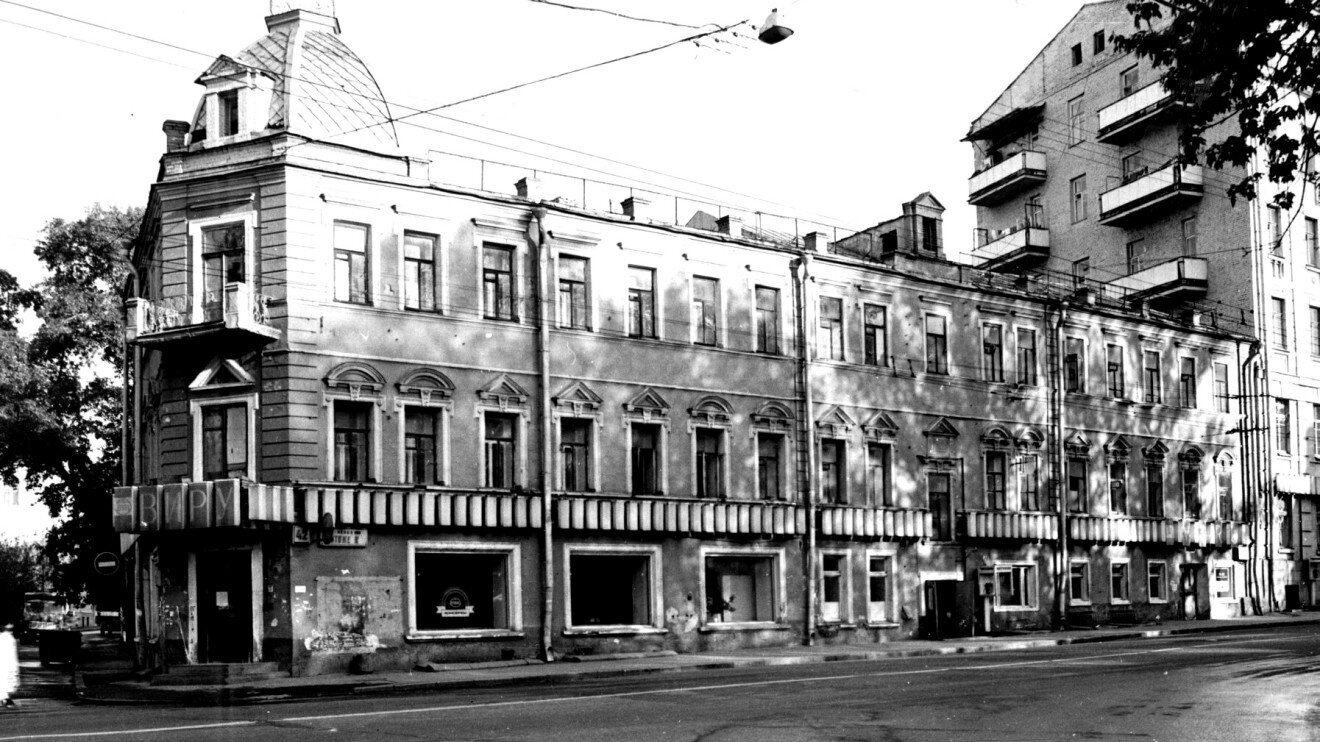
The novel mentions Metrostroyevskaya Street — the historical name of present-day Ostozhenka, which it carried from 1935 to 1986. It is one of Moscow's central streets, and during the period the novel depicts, it was home to spots that mattered a great deal to young people.
The history of its name and renaming
Ostozhenka Street received its original name back in the 17th century, after the old Ostozhye area — a low-lying floodplain on the bank of the Moskva River. Royal meadows and hayfields were located here, and haystacks were a common feature of the landscape, which is how the area got its name, Ostozhye (from "stog," meaning "haystack").
In 1935 the street was renamed Metrostroyevskaya, in connection with the open-cut construction here of a section of the first line of the Moscow Metro. This name lasted until 1986, when Ostozhenka became the first Moscow street to have its historical name restored.
By 1993, then, when the events of the novel take place, the street had already been called Ostozhenka for seven years, but people still remembered its former name, especially old-timers and those with memories tied to it from the Soviet era.
Moscow State Linguistic University (InYaz)
On Ostozhenka, at building No. 38, stands the Moscow State Linguistic University, popularly known as "InYaz" (short for "Institute of Foreign Languages"). The university building has a rich history — it is the former Yeropkin House, dating to the late 18th century, built to a design by architect Matvei Kazakov, and a protected cultural landmark.
In 1806, the building was acquired for the Moscow Commercial School, and it later housed the Pedagogical Institute of Foreign Languages. From 1964 to 1990, the institute bore the name of the prominent international communist figure Maurice Thorez, and was known as MGPIIYA imeni Morisa Toreza.
By the early 1990s, the institute was one of the country's strongest language universities. In 1971, a new seven-story building was put into service, with modern teaching and research laboratories, including a spoken-language laboratory with audio rooms for 180 students, tape-recorder classrooms, and classrooms for teaching simultaneous interpretation.
In the 1972–1973 academic year, the institute enrolled more than 5,500 students and employed over 750 faculty. By 1974 it had 44 departments and 6 research laboratories, and its library held more than 200,000 items.
The name "Maurice Thorez Moscow InYaz" became an international brand, and the institute was known well beyond the USSR's borders as a leading center for training interpreters, translators, and foreign-language teachers. In 1980, the institute was awarded the Order of Friendship of Peoples.
The Viru shop and cafe
During Perestroika, a "specialty" shop called "Viru" opened on Metrostroyevskaya Street (not yet renamed back to Ostozhenka at the time), which became a landmark spot for local young people. The shop was located at building No. 42 — a historic building known as the M.V. Golubitskaya apartment house.
This building has an interesting architectural history: the first two-story stone house in the Empire style was built here in 1842 for Princess Zoya Mikhailovna Volkonskaya. In 1891, the property passed to M.V. Golubitskaya, for whom architect Nikolai Strukov rebuilt the structure, merging three periods of its construction into a single building and unifying its facades.
The "Viru" shop sold Estonian goods, a great rarity in the Soviet era. Especially popular among teenagers were its drinks and sweets section. Here one could buy the soft drinks "Buratino" and "Belosnezhka" (a Soviet answer to Sprite), and the most prestigious of all, "Extra Sitro," for 25 kopecks (not counting the bottle deposit).
A genuine delicacy were the "Kama" soy-based chocolate bars and "Kalevala" pillow-shaped chewing gum, filled with orange syrup or cola flavor, which cost 25 kopecks for a pack of 5. Goods like these could not be found anywhere else in Moscow.
A cafeteria operated inside the shop, becoming a place of pilgrimage for Moscow youth, especially students from the nearby InYaz. Visiting the "Viru" cafe became a kind of ritual — people stopped in either before or after classes, depending on their schedule.
For the generation born in the 1970s, the "Viru" shop and cafe became a symbol of an era when scarce imported goods felt like a window into another world. The very word "Viru" (from the name of an Estonian town) took on a nostalgic tinge for those who remembered the place.
The neighborhood's atmosphere in the early 1990s
By 1993, Ostozhenka was already beginning to turn into one of Moscow's most prestigious streets, though the process was only just starting. The neighborhood retained the intimate atmosphere typical of central Moscow streets, where historic mansions stood alongside Soviet-era institutions.
Its proximity to the city center, the presence of the "Park Kultury" and "Kropotkinskaya" metro stations, and the presence of a prestigious language university made this street attractive to young people. InYaz students made up a significant part of the local "population," creating a distinctive intellectual atmosphere.
The cafe at the "Viru" shop became one of the few places where one could not only get a coffee, but try drinks and sweets that were relatively exotic for the time. This made it a popular meeting spot, especially for those wanting to impress a date or show off their familiarity with "imported" goods.
Memories of visiting places like the "Viru" cafe became part of the collective memory of the generation that witnessed the final years of the USSR and the first years of the new Russia, a time when the old had not yet disappeared and the new was only just beginning to emerge.