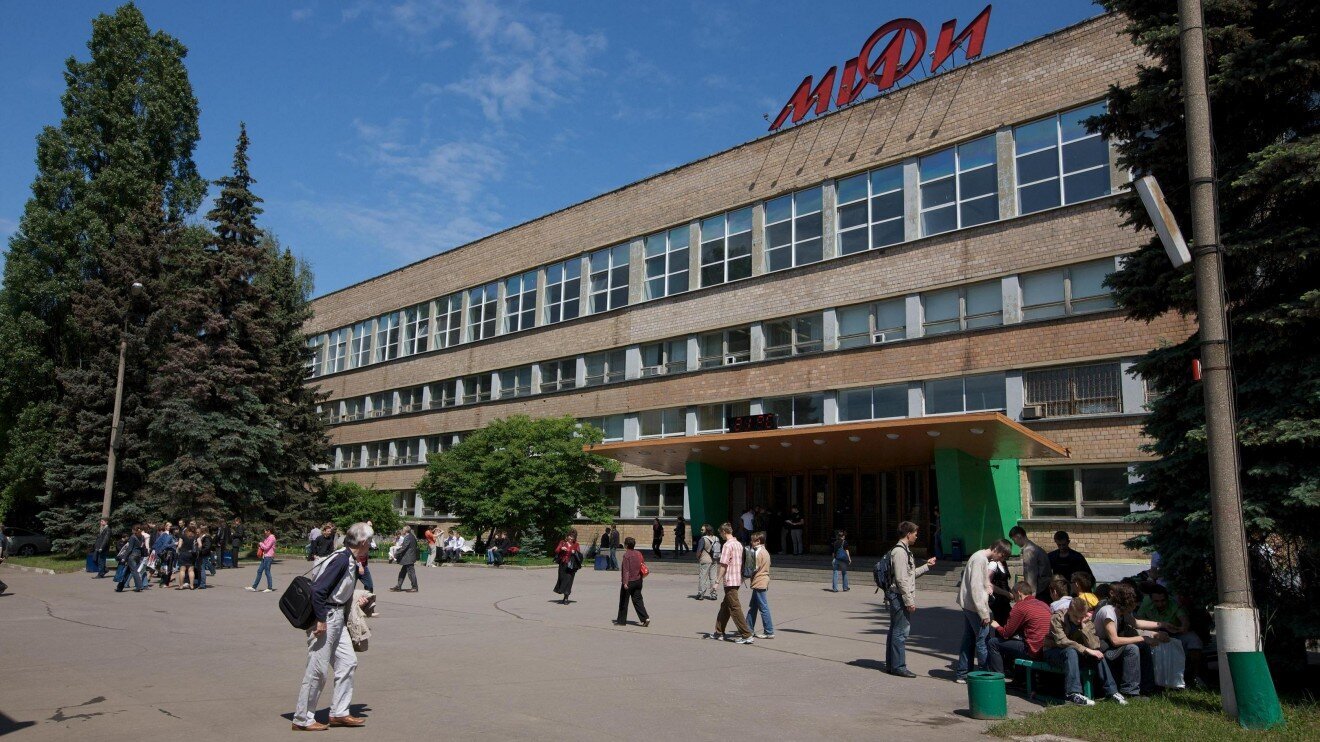
The Moscow Engineering Physics Institute is one of Russia’s most prestigious technical universities, specializing in training specialists for the nuclear industry, nuclear physics, and high technology.
History
MEPhI traces its history to November 23, 1942, when the Moscow Mechanical Institute of Munitions (MMIB) was founded. The institute’s creation was driven by wartime needs — the necessity of training specialists for the defense industry. Classes began on January 1, 1943, in the building of the evacuated Moscow Polygraphic Institute on Kirov Street (now Myasnitskaya), in the famous Yushkov House.
In the harsh conditions of wartime, the institute began its work under extremely difficult circumstances: the premises had no heating, running water, or sewage, and electricity was supplied for only 4 hours a day. Nevertheless, by 1943 three faculties and 21 departments had already been organized, with a total teaching staff of 101 people.
The first renaming took place in 1945, when MMIB became the Moscow Mechanical Institute (MMI). The final name — the Moscow Engineering Physics Institute (MEPhI) — was fixed on October 28, 1953.
Role in the USSR’s Atomic Project
MEPhI took on special significance in connection with the development of the Soviet atomic project. In 1952, by resolution of the USSR government, the first four branches were established in the closed cities of Ozyorsk, Novouralsk, Lesnoy, and Sarov. These branches trained personnel for nuclear industry facilities directly on site.
The institute became the country’s main university for training specialists for the nuclear program. Many outstanding scientists who contributed to the development of nuclear science and technology worked and studied here. It is no accident that in 2017 an Alley of Nobel Laureates was laid out on MEPhI’s grounds in memory of six Nobel laureates who studied or worked within the institute’s walls: N.G. Basov, N.N. Semyonov, P.A. Cherenkov, I.E. Tamm, A.D. Sakharov, and I.M. Frank.
Postwar Development
In 1962 a new complex of MEPhI buildings opened on Kashirskoye Highway, which became the institute’s main campus. In 1967 the MEPhI research reactor was launched — scientific research equipment unique among Soviet universities, which made it possible to conduct serious research in nuclear physics.
The complex of buildings, constructed in the 1960s, forms a system of interconnected academic, administrative, and research blocks. The main building is connected by a system of corridors to blocks “A,” “B,” “V,” “E,” and “D,” each with its own specialization: physics laboratories, computer classrooms, electrical engineering labs.
Prestige and Competition in the 1980s
By the 1980s MEPhI had become one of the most prestigious technical universities in the USSR. Competition for admission was extremely high — in some faculties it reached 8-10 applicants per place with dormitory housing, and the passing score reached 17 out of 20 possible points.
Such fierce competition was explained by several factors. First, MEPhI graduates were guaranteed employment at prestigious defense-industry enterprises with high salaries by Soviet standards. Second, the quality of education at the institute was exceptionally high — leading scientists in the country taught here, and the material and technical base surpassed most other universities.
Admission to MEPhI in 1989 required serious preparation. Applicants took exams in mathematics, physics, and Russian language. The math and physics exams were especially difficult, requiring not just knowledge of the school curriculum but the ability to solve unconventional problems of increased difficulty.
Features of Instruction
Instruction at MEPhI was marked by high intensity and depth in the study of fundamental disciplines. Students studied advanced mathematics, theoretical physics, and nuclear physics at a level comparable to the world’s leading universities. Special attention was paid to practical work in laboratories equipped with, for their time, modern equipment.
The Faculty of Automation and Computer Engineering, which the novel’s hero entered in 1989, trained specialists in process automation, computer technology, and control systems. This field was especially in demand amid the scientific and technological revolution of the 1970s-1980s.
Research Activity
MEPhI was always famous not only for the quality of its education but also for its serious research work. A pool-type research nuclear reactor was located on the university grounds, making unique research in nuclear physics and reactor technology possible.
The institute’s library, established in 1943, held one of the country’s best collections of literature on the natural sciences. Its holdings preserved the first editions of classic physics textbooks by V.M. Galitsky, I.E. Irodov, and I.V. Savelyev, on mathematical physics by A.V. Bitsadze, and on mathematics by A.N. Tikhonov, on which several generations of students were trained.
Architectural Features
An interesting feature of MEPhI’s main building is its unique mosaic panels, created in 1963 by artists M.M. Shvartsman and G.A. Dauman. These works of monumental art, executed in a technique the artists called “ieratura,” reflect the specifics of the institute. The best known panel, “The Taming of Atomic Energy,” depicts a man’s hand holding an atomic horse by the bridle — this image later became part of MEPhI’s emblem.
Ties to the Defense Industry
MEPhI worked closely with defense-industry enterprises. Students did their practical training at classified facilities, and thesis topics were often tied to real production problems. Many graduates were assigned to the flagship enterprises of the closed nuclear cities, where they went on to build successful careers.
Current Status
In 2009 the institute received the status of a national research university and was renamed the “National Research Nuclear University ‘MEPhI’” (NRNU MEPhI). Today it is one of Russia’s leading technical universities, appearing in various international rankings and preserving its tradition of training highly qualified specialists.
NRNU MEPhI is a flagship university of the state corporations Rosatom and Roscosmos, continuing to train personnel for the nuclear and space industries. In 2024, after a long hiatus, the research nuclear reactor was restarted, confirming that the university has preserved its research potential.
Reputation and Recognition
To this day MEPhI remains one of the most respected technical universities in Russia. Its graduates are highly valued in the labor market, and many hold leading positions in science, engineering, and business. The quality of an education received at MEPhI is recognized not only in Russia but abroad as well.
The university ranks in the world’s top 100 in physics and astronomy according to the QS rankings, and holds high positions in the U.S. News & World Report physics rankings, evidence that it has maintained a high scientific level and international recognition.
Traditions and Culture
MEPhI is famous for its traditions and its particular atmosphere. Student life was always eventful — alongside studies, scientific clubs, sports sections, and creative groups flourished. The institute cultivated not just specialists but a particular type of person — a thinking engineer, capable of solving complex technical problems.
Faculty played a special role in shaping this corporate culture — many were not only outstanding scientists but also teachers capable of drawing students into science. The bond between generations of teachers and graduates remains strong to this day.
In the novel “Roman Peskov,” MEPhI is portrayed as the place that shaped the main character, where he gained not only professional knowledge but the life experience that would determine his fate in the turbulent 1990s.