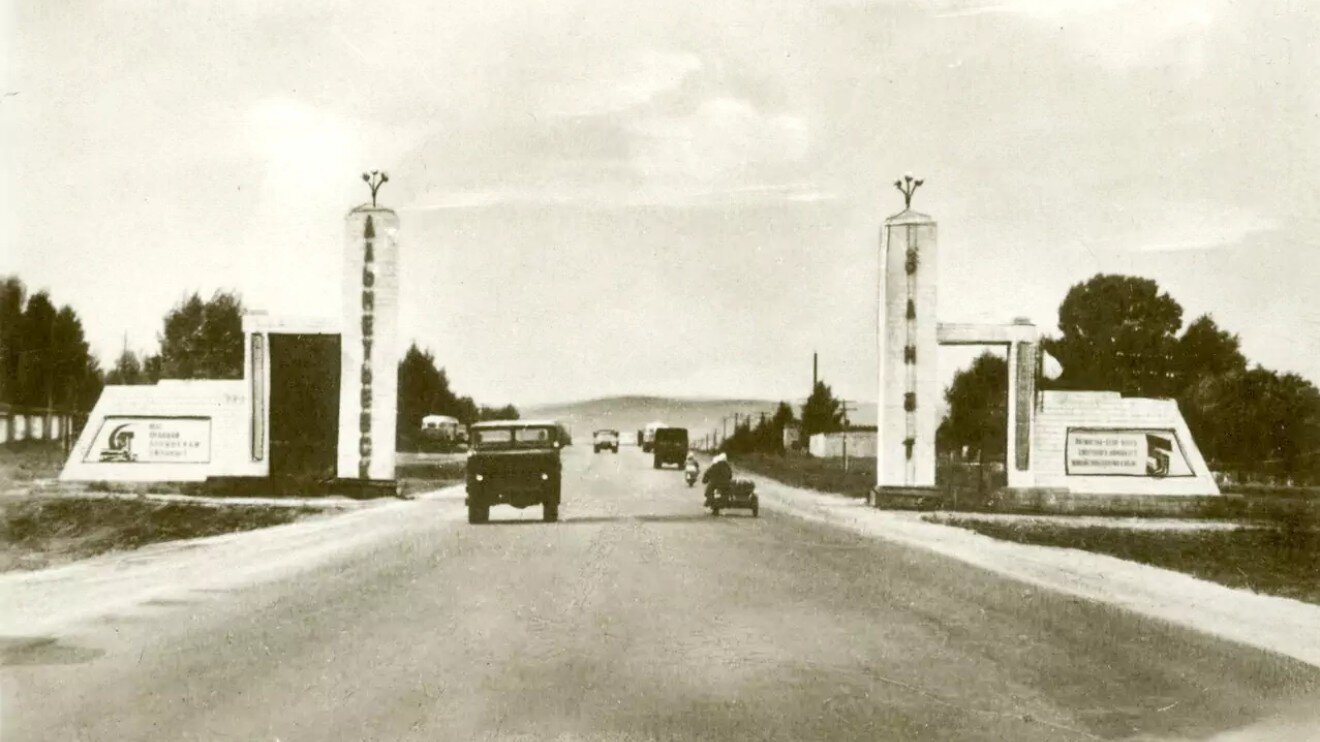
Three cities in Tatarstan — Naberezhnye Chelny, Nizhnekamsk, and Almetyevsk — were, in the 1990s, the republic’s largest industrial centers, each specializing in a particular branch of heavy industry.
Naberezhnye Chelny — the Automotive Capital
Naberezhnye Chelny (Tatar: Yar Chally) was, by the mid-1990s, Tatarstan’s second-most populous city, with roughly half a million residents. It gained city status in 1930, but its true boom began in the early 1970s, with the construction of the giant Kama Automobile Plant (KamAZ).
From 1982 to 1988, the city was named Brezhnev, in honor of the Soviet leader under whom KamAZ was built. The historical name was restored in January 1988.
By 1996, Naberezhnye Chelny was a classic single-industry town, its economy entirely dependent on the auto plant. In the post-Soviet period, the city faced serious hardship: an overall industrial downturn, a major 1993 fire that completely destroyed the KamAZ engine plant, high crime rates, and social tension.
Nizhnekamsk — the Petrochemical Giant
Nizhnekamsk (Tatar: Tübən Kama) is the youngest of the three cities, gaining city status only in 1966. It arose in the early 1960s as a settlement built around the construction of the Nizhnekamsk petrochemical plant.
Nizhnekamsk was designed as an experimental site for testing new urban-planning techniques. A defining feature was strict functional zoning: residential districts were placed several kilometers away from the chemical plant’s industrial zone.
By the mid-1990s, the city was home to the largest petrochemical complex in Europe — the production association Nizhnekamskneftekhim, specializing in synthetic rubber, plastics, and other petrochemical products.
«Courage Conquers Cities» — a song by A. Pakhmutova and N. Dobronravov, dedicated to the builders of Nizhnekamsk, capturing the enthusiasm of the era when new industrial cities were being founded.
Almetyevsk — the Oil Capital
Almetyevsk (Tatar: Ǝlmət) is Tatarstan’s fourth-most populous city, gaining city status in 1953. Unlike the other two cities, Almetyevsk has a longer history: the village of Almetyevo was founded in the early 18th century.
The city sits right next to the massive Romashkino oil field, part of the Volga-Ural oil-and-gas province. By 1996, Almetyevsk was the center of Tatarstan’s oil-extraction industry and headquarters of the oil company Tatneft.
Unlike Naberezhnye Chelny and Nizhnekamsk, Almetyevsk felt relatively stable through the 1990s, thanks to strong demand for oil and oil products.
Naberezhnye Chelny
Specialty: automobile manufacturing
- • KamAZ
- • 500,000 residents
- • 1990s crisis
Nizhnekamsk
Specialty: petrochemicals
- • Nizhnekamskneftekhim
- • 250,000 residents
- • European leader
Almetyevsk
Specialty: oil extraction
- • Tatneft
- • Romashkino field
- • Relative stability
Crime in the 1990s
All three cities, in the 1990s, faced a sharp rise in crime, typical of major industrial centers across the post-Soviet space. The situation was especially acute in Naberezhnye Chelny, where economic crisis, unemployment, and uncertainty over KamAZ’s future created fertile ground for criminal gangs.
Youth gangs, racketeering, and territorial turf wars were all part of the reality of provincial Tatarstan cities in the mid-1990s. The cities’ geographic proximity to one another helped local criminal groups build ties across city lines.