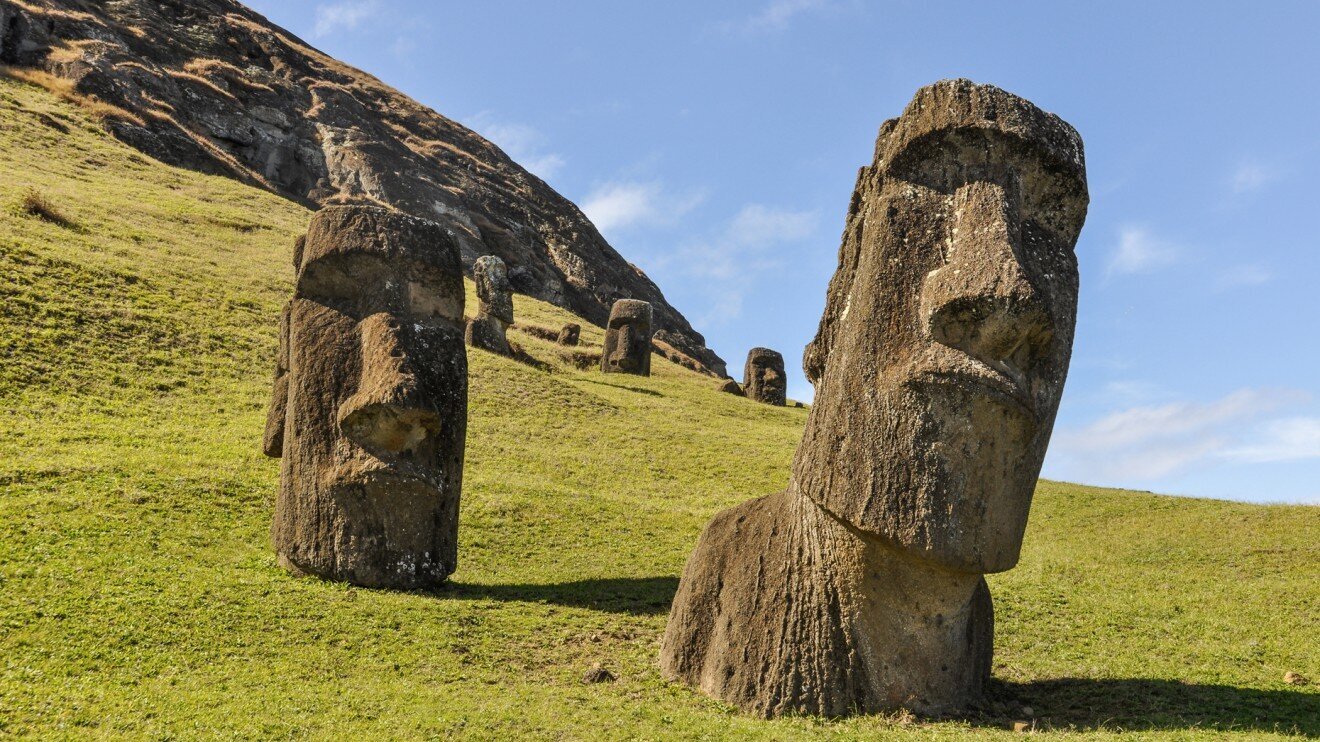
Easter Island, or Rapa Nui, is one of the most mysterious and remote inhabited islands in the world, famous for its gigantic stone moai statues, which have drawn the attention of researchers and travelers from around the globe for centuries.
Geography and Location
Easter Island lies in the southeastern Pacific Ocean and is a territory of Chile. This triangular scrap of land, 163.6 km² in area, sits 3,514 km from the coast of South America and 2,075 km from the nearest inhabited island, Pitcairn, making it one of the most isolated inhabited places on Earth.
The island is of volcanic origin, formed by three extinct volcanoes: Rano Kau (324 m), Puakatiki (377 m), and Terevaka (539 m — the island’s highest point). The climate is tropical, with an average annual temperature of 21.8°C. The island’s unique geographic position, its remoteness from continents and other inhabited lands, created special conditions for the development of a singular culture.
The History of Its Discovery and Name
The island was opened to the European world by the Dutch navigator Jacob Roggeveen on April 5, 1722, Easter Sunday, which is where its name comes from. But the island has many other names: locals call it Rapa Nui, meaning “Great Rapa.” Also encountered are the names Te Pito o te Henua (“the navel of the world”) and Mata ki te Rangi (“eyes looking to the sky”).
The first Polynesian settlers presumably arrived on the island sometime between 300 and 900 CE, though some research points to a later period, around 1200. According to legend, the first colonists arrived on two large canoes led by King Hotu Matu’a.
The Enigmatic Moai Statues
The island’s main attraction and mystery are the moai — monumental stone statues representing human heads and torsos, cut off roughly at waist level. The island has about 1,000 statues of various sizes, from small ones to giants up to 20 meters tall.
Appearance and Features
The moai are carved from compressed volcanic ash (tuff) and are marked by recognizable features: elongated faces, protruding brow ridges, long noses, and pursed lips. Contrary to popular belief, the statues do not face the ocean but look inland, as if guarding the island’s inhabitants.
Many moai are topped with red stone “hats” — pukao — made from red volcanic scoria quarried at Puna Pau. These cylindrical headpieces can weigh up to 12 tons and, in researchers’ view, symbolized high social status or the headgear of chiefs.
Carving and Transport
The main site where the moai were carved was the quarry at the Rano Raraku volcano, where about 400 statues in various stages of completion still stand today. It appears work on the statues was abruptly halted — many moai were left unfinished right in the quarry.
One of the island’s greatest mysteries remains how these multi-ton statues were transported from the quarry to the coast, where they were erected on ceremonial platforms called ahu. According to local legend, the statues “walked” to their places on their own. Modern researchers have put forward various theories: the use of wooden rollers, sledges, ropes, and rocking techniques.
Norwegian explorer Thor Heyerdahl experimentally proved in the 1950s that it was possible to transport and erect the statues using traditional methods, employing only wooden levers, ropes, and manpower.
The Ceremonial Ahu Platforms
The moai statues were erected on massive stone platforms — ahu — which served not only as pedestals but also as burial grounds and religious shrines. The island has about 300 such platforms, the most impressive being Ahu Tongariki, with 15 statues of various sizes standing on it.
The ahu are complex engineering structures made of carefully fitted stone blocks. Some researchers have noted a resemblance to Inca construction techniques, giving rise to hypotheses about possible contact between the two cultures.
Cultural and Religious Significance
According to Rapa Nui beliefs, the moai statues contained the supernatural power of the ancestors — mana. The statues embodied deceased chiefs and nobles, who continued to protect their clans even after death. This is precisely why the moai do not look out to sea but inward, over the island — they guard their descendants from internal threats.
Creating the statues was not only a religious act but also a way for the island’s various clans to display power and status. The bigger and grander a clan’s moai, the higher its prestige in society.
Ecological Catastrophe and the Civilization’s Decline
The moai culture flourished from roughly the 10th to the 17th century, when the island’s population numbered between 10,000 and 15,000. However, intensive deforestation for construction, statue transport, and land clearing for agriculture led to an ecological catastrophe.
By 1600 the island had been completely deforested, which brought wind erosion of the soil, a decline in fishing due to a lack of material for building boats, mass famine, and internecine wars. The island’s population fell several times over, and by the time Europeans arrived it numbered only 2,000-3,000 people.
The Birdman Cult
After the decline of the moai culture, a new religious cult arose on the island — the cult of the birdman (tangata manu), dedicated to Makemake, the god of fertility. The ceremonial village of Orongo, next to the Rano Kau volcano, became the center of the cult.
Every year, dangerous competitions were held between the clans: representatives had to swim to the islet of Motu Nui and bring back the first egg of the sooty tern. The winner became “birdman of the year” and gained the right to control the island’s resources. This tradition lasted until 1867.
The Rongorongo Script
Easter Island is the only place in the Pacific where an original writing system — rongorongo — was developed. Texts were recorded in pictograms about a centimeter in size on wooden tablets, using boustrophedon (lines read alternately left to right and right to left).
Twenty-five tablets bearing rongorongo writing survive today, but they have not yet been fully deciphered. The symbols depict people, animals, plants, astronomical objects, and various items. The last speakers of this writing system disappeared in the 19th century amid the tragic events tied to the slave trade.
The Tragedy of the 19th Century
In 1862 catastrophe struck the island: Peruvian slave traders captured between 1,000 and 2,000 Rapa Nui to work the guano plantations. Among the captives were the island’s king and most of the keepers of local culture and writing. Of those taken, only about a hundred survived, and just 15 managed to return home, bringing smallpox and tuberculosis with them.
Epidemics, famine, and internal strife reduced the population to 111 people by 1877. A significant portion of traditional knowledge was lost, including the ability to read rongorongo and many historical legends.
Modern Status
In 1888 the island was annexed by Chile, and in 1995 Rapa Nui National Park became a UNESCO World Heritage Site. Today about 7,750 people live on the island, roughly half of them of Rapa Nui descent.
The island lives mainly off tourism. Regular flights connect it to mainland Chile and Peru. Work continues on restoring and conserving its archaeological monuments and studying the island’s history and culture.
Scientific Research and Theories
Easter Island continues to draw the attention of scientists worldwide. Modern archaeological and anthropological research is helping to reconstruct a picture of the ancient Rapa Nui’s life. Geological studies confirm the theory that the island was never part of a larger continent, but formed as a result of volcanic activity.
Genetic research shows the Polynesian origin of the island’s indigenous population, though traces of contact with South American peoples have also been found, supporting the possibility of ancient transoceanic voyages.
Mysteries That Remain
Despite extensive research, Easter Island still holds many secrets. It is still not known precisely how the multi-ton statues were transported, the rongorongo script has not been fully deciphered, and questions remain about the exact dates of the island’s settlement and the reasons the construction of moai suddenly stopped.
Every new expedition uncovers new facts about this remarkable civilization, but this small island in the Pacific keeps its secrets, remaining one of the most enigmatic places on Earth.
Symbolic Significance
Today the moai statues have become a symbol not just of Easter Island but of all Polynesia. Their recognizable silhouettes appear in works of art, advertising, and souvenirs. Easter Island serves as a reminder of the fragility of ecosystems and the importance of caring for the natural world.
These majestic stone guardians, frozen in eternity at the edge of the world, continue to amaze and inspire people, symbolizing humanity’s drive to create something eternal, something capable of outliving the ages and millennia.