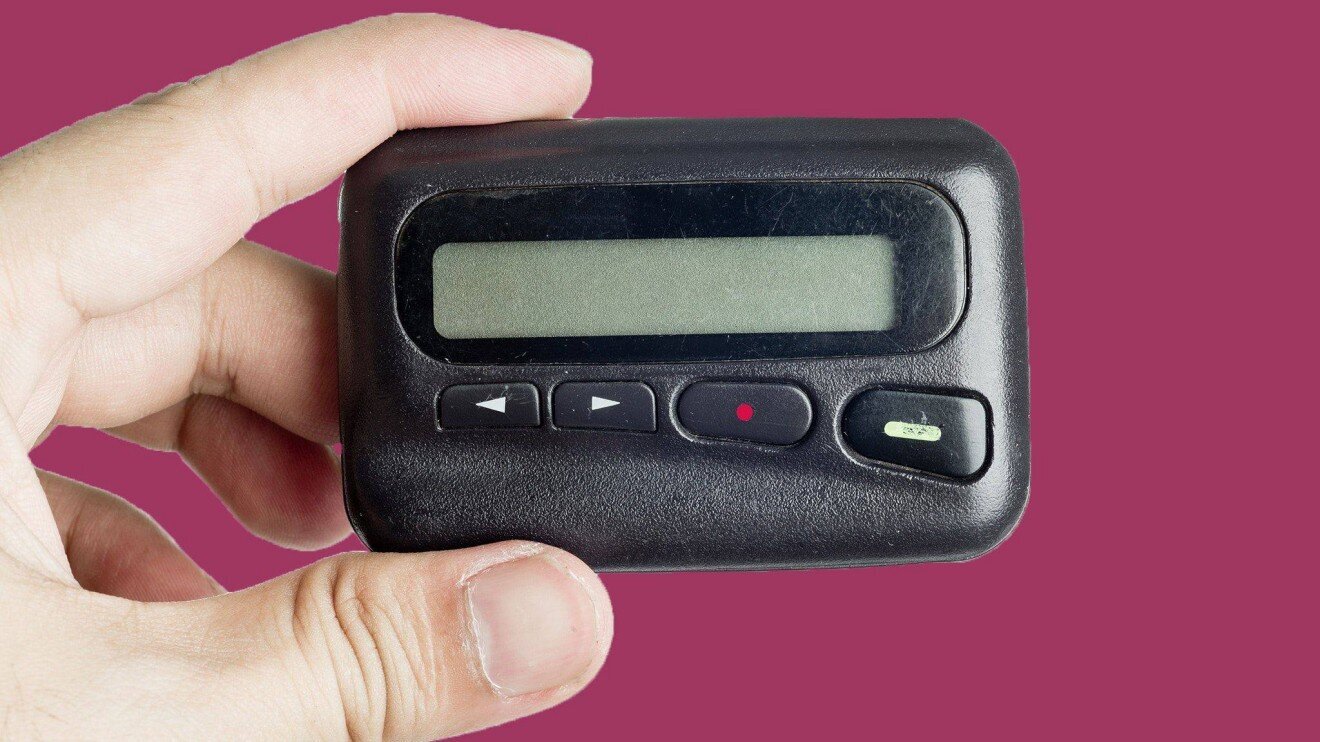
A pager (from the English "to page," itself derived from "page," meaning a young attendant or messenger boy) is a personal paging receiver, a portable wireless communication device for receiving and displaying short text messages.
History
The first patent for a paging system was granted in 1949 to Motorola. However, the first commercial paging system didn’t begin operating until 1950, in New York. It served doctors within a 40-kilometer radius, operating on a frequency of 43 MHz.
The earliest pagers were fairly primitive — all they could do was emit a sound alerting the owner to call the dispatch office. Devices like these were called "tone pagers."
Digital pagers, able to display a callback phone number, appeared in the 1970s, followed by text pagers in the 1980s, which could receive short messages.
How It Worked
Paging service operated on the following principle:
- The sender called the paging company’s central station and dictated a message to an operator, or entered it through an automated system.
- The message was encoded and transmitted to radio transmitters positioned across the service area.
- The transmitters broadcast the signal on a dedicated frequency (typically in the 138-174 MHz or 440-470 MHz range).
- The recipient’s pager, tuned to its own unique code, picked up the signal and decoded the message.
Each pager had its own unique address (a CAP code), allowing the system to route messages to a specific device only.
Spread in the USSR and Russia
Paging arrived in the USSR quite late — only in the late 1980s. The first paging company in Moscow, "MobilCom," began operating in 1990. Pagers became widespread in Russia in the mid-1990s, becoming a symbol of the businessman and of a certain social status.
By 1996-1997, Russia had more than 100 paging companies. The largest operators were "Moscow Cellular Communications," "Neva-Page," "Beeper-One," "Vessolink," and "Multipage." At the peak of their popularity, the country had roughly one million pager subscribers.
The cost of paging service in mid-1990s Russia ranged from $5 to $50 a month depending on the plan, while the pager itself cost between $30 and $200.
Rise and Fall
Pagers reached peak popularity worldwide in the mid-1990s. By 1994, the number of pagers in use worldwide had reached 61 million. Pagers became an integral part of business culture, used by businessmen, doctors, emergency responders, and many other professionals.
In Russia, the paging boom came somewhat later — in 1995-1998. A distinctive slang and a particular culture of pager messaging developed during this period.
The decline of paging began with the spread of mobile phones and SMS messaging. In Russia, a sharp drop-off followed the 1998 financial crisis, when many paging companies went bankrupt and subscribers switched en masse to the now more affordable cellular service.
By 2001, most Russian paging companies had ceased to exist. Worldwide, pagers held on longer in specific niches — among medical staff, emergency services, and businesses that required guaranteed delivery of urgent messages.
Today, paging service has all but disappeared, though small paging networks still exist in some countries for specialized purposes. Pagers remain in history as an important stage in the development of personal mobile communication, forerunners of the modern smartphone.