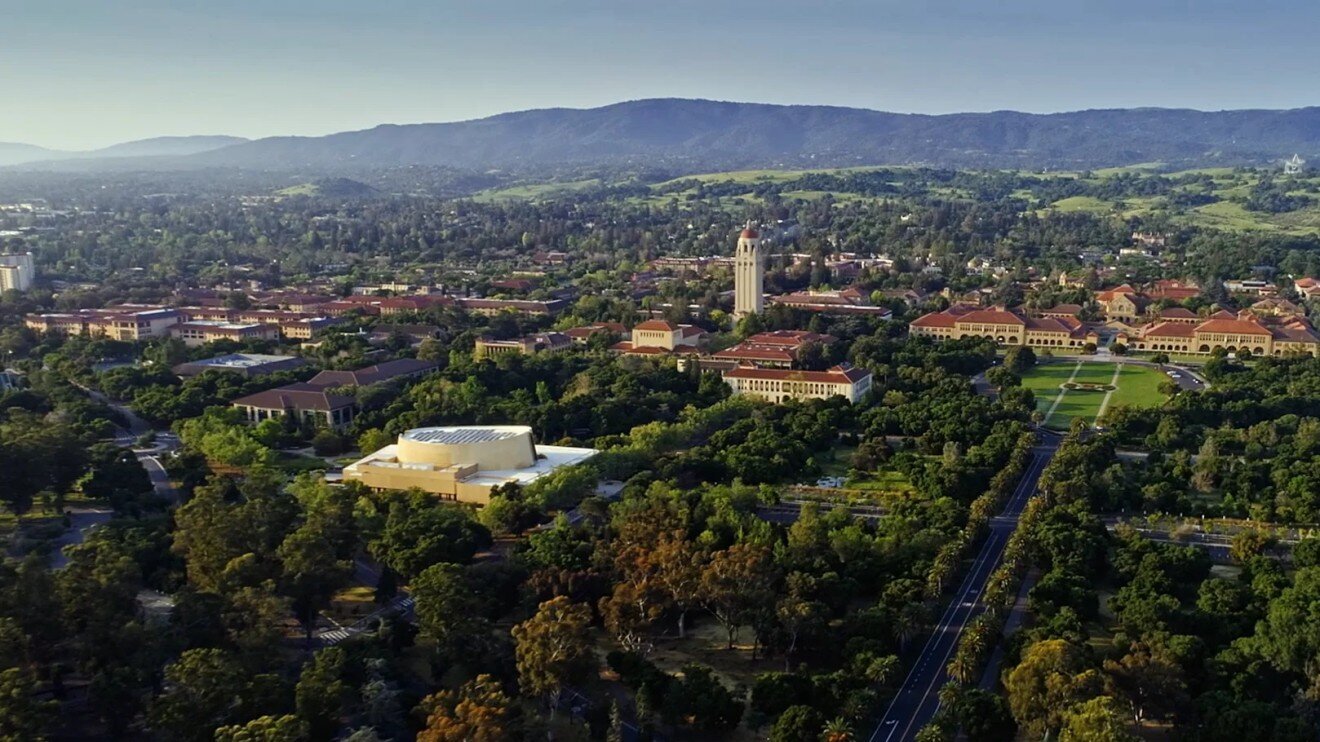
Palo Alto is a city in California, located in the northern part of the famous Silicon Valley, which by 1993 had become one of the most important centers of the high-tech industry in the US and the world.
The city takes its name from a tall redwood, «El Palo Alto» (Spanish for «tall stick»), standing on the banks of San Francisquito Creek. By the early 1990s, Palo Alto had built a reputation as an elite hub of science and technology, owing to its proximity to Stanford University, one of the most prestigious institutions in the US.
Stanford Research Park, founded back in 1951, became a model for technology parks around the world and the cradle of the modern Silicon Valley. By the early 1990s, Palo Alto was already home to many high-tech companies drawing top talent from around the globe with high salaries and a progressive work culture.
Leading Companies in Palo Alto in 1993
Hewlett-Packard (HP) — founded in a Palo Alto garage in 1939, by 1993 it had become one of the largest makers of computers and peripherals, with annual revenue of around $20 billion.
Xerox PARC (Palo Alto Research Center) — a research center known for revolutionary developments including the graphical user interface, the computer mouse, Ethernet, and the laser printer. Though commercialization of these technologies often happened at other companies, PARC remained a hub of innovation.
Sun Microsystems — founded in 1982, by 1993 it was a leading maker of UNIX-based workstations and servers. The company's Java programming language was under development and would soon revolutionize software engineering.
Silicon Graphics (SGI) — a pioneer in 3D graphics and visualization, whose workstations were used to create special effects for Hollywood films including «Terminator 2» and «Jurassic Park.»
Varian Associates — specialized in medical equipment and semiconductor technology.
Adobe Systems — founded in 1982, by 1993 known for PostScript, Adobe Illustrator, and Photoshop, which revolutionized digital graphics and design.
Reasons for Palo Alto's Success
The synergy of academia and business. Close ties to Stanford University provided companies with a steady stream of talented graduates and cutting-edge research.
A culture of innovation and risk. Palo Alto developed a unique culture that encouraged experimentation, risk-taking, and unconventional thinking. Failure was treated not as a catastrophe but as valuable experience.
Venture capital. By 1993, Sand Hill Road in nearby Palo Alto had become home to the largest venture capital funds in the US, ready to invest in promising tech startups.
High salaries. Palo Alto companies offered some of the highest salaries in the industry, letting them attract the best talent. The $30,000-40,000 a year after tax mentioned in the text was a significant sum, especially for foreign specialists, given that the average salary in Russia in 1993 was around $40-50 a month.
A multicultural environment. Palo Alto drew talent from around the world, creating a cosmopolitan atmosphere that fostered the exchange of ideas and unconventional thinking.
Specialization and cooperation. Companies often specialized in narrow niches while also cooperating with other firms in the valley, creating an effective ecosystem.
By 1993, Palo Alto was already considered one of the most expensive US cities to live in, with a median home price of around $500,000 — significantly above the national average. For Russian citizens of the early 1990s, the gap in living standards and pay between their own country and Palo Alto seemed almost fantastical, which made working for American companies extremely attractive.