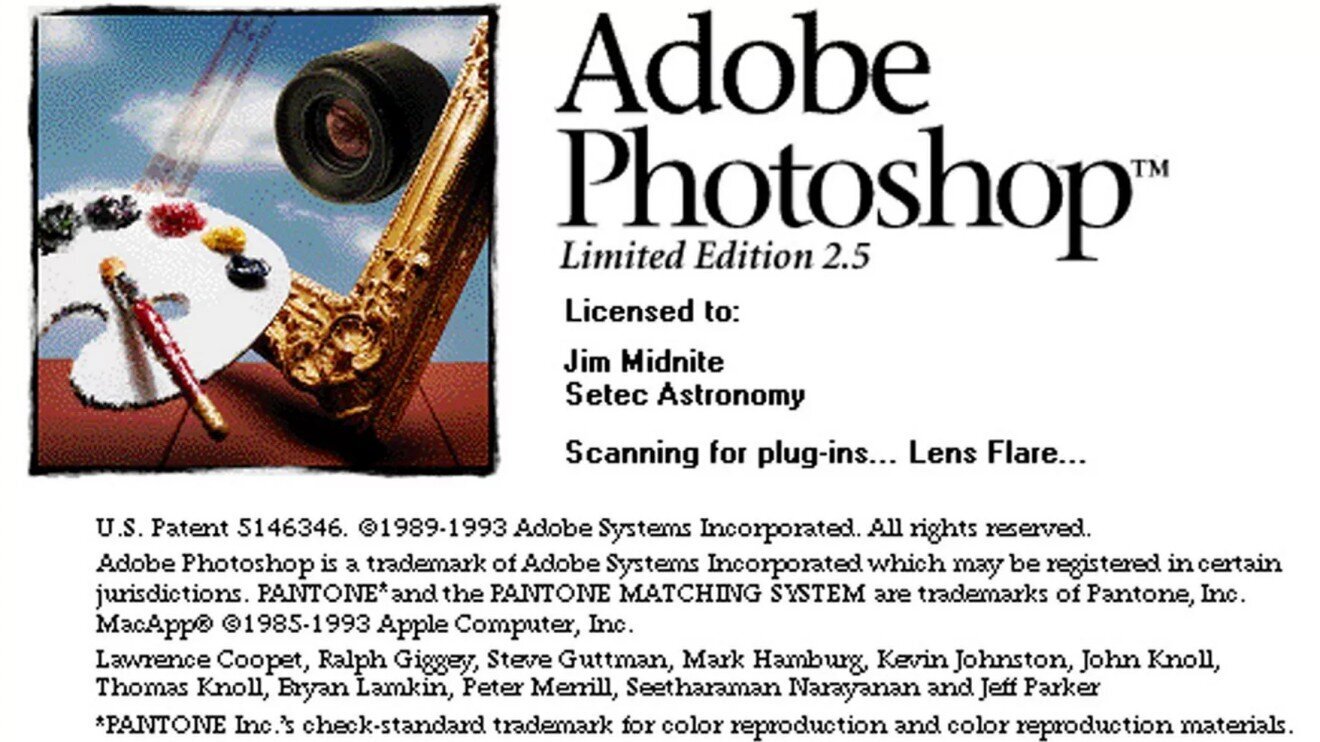
Adobe Photoshop is a graphics editor developed by Adobe Systems. By 1993 the program was already a notable presence in the computing industry, though still early in its path toward becoming the standard for digital image editing.
Origins
Photoshop's history began in 1987, when University of Michigan student Thomas Knoll developed a simple program for displaying graphics on a monochrome monitor. His brother, John Knoll, an employee at the visual-effects studio Industrial Light & Magic, suggested developing it into a full-fledged image editor.
The program, initially called Display, then ImagePro, caught Adobe's attention, and the company acquired distribution rights in 1989. The first version, Adobe Photoshop 1.0, launched in February 1990, exclusively for Macintosh computers.
Development Through 1993
By 1993 several versions of the program had been released:
- Photoshop 1.0 (1990) — the first commercial version
- Photoshop 2.0 (1991) — added paths, CMYK support
- Photoshop 2.5 (1992) — the first Windows version
- Photoshop 2.5.1 (1993) — improved Windows support
In 1993, Photoshop 2.5 was the latest available version, running on both Macintosh and Windows. Version 3.0, launched in September 1994, brought a revolutionary new feature — layers.
Technical Specifications (1993)
In 1993, Photoshop was a fairly resource-demanding piece of software. Running it required:
- A Macintosh with a 68020 processor or better
- For Windows — a 386 processor or better
- A minimum of 4 MB of RAM (8 MB recommended)
- Dozens of megabytes of hard-drive space
- A monitor supporting at least 8-bit color depth (256 colors)
The program cost around $895 at the time, putting it within reach only of professionals and companies.
Capabilities and Uses
Even the 1993 version offered an impressive feature set:
- Working with color channels
- Basic drawing and retouching tools
- Support for RGB and CMYK color models
- Filters for special effects
- Masks and selections
- Paths
In 1993 Russia, Photoshop was known only to a narrow circle of professionals working in printing and design. The software itself, and the computers capable of running it, were accessible only to a handful of companies and enthusiasts, given the high cost and the difficulty of acquiring licensed software in post-Soviet Russia.
Mentioning Photoshop in a 1993 Russian context could signal access to cutting-edge technology and a certain financial standing. Knowing how to use the program was a rare and valuable skill, one that could bring good money in advertising, design, or, as mentioned in the text, document forgery.
In the criminal context of the early 1990s, Photoshop genuinely could be used to create fake documents, though professional forgery also required more than just skill with a graphics editor — specialized printing equipment, the right paper stock, and other materials were needed too.