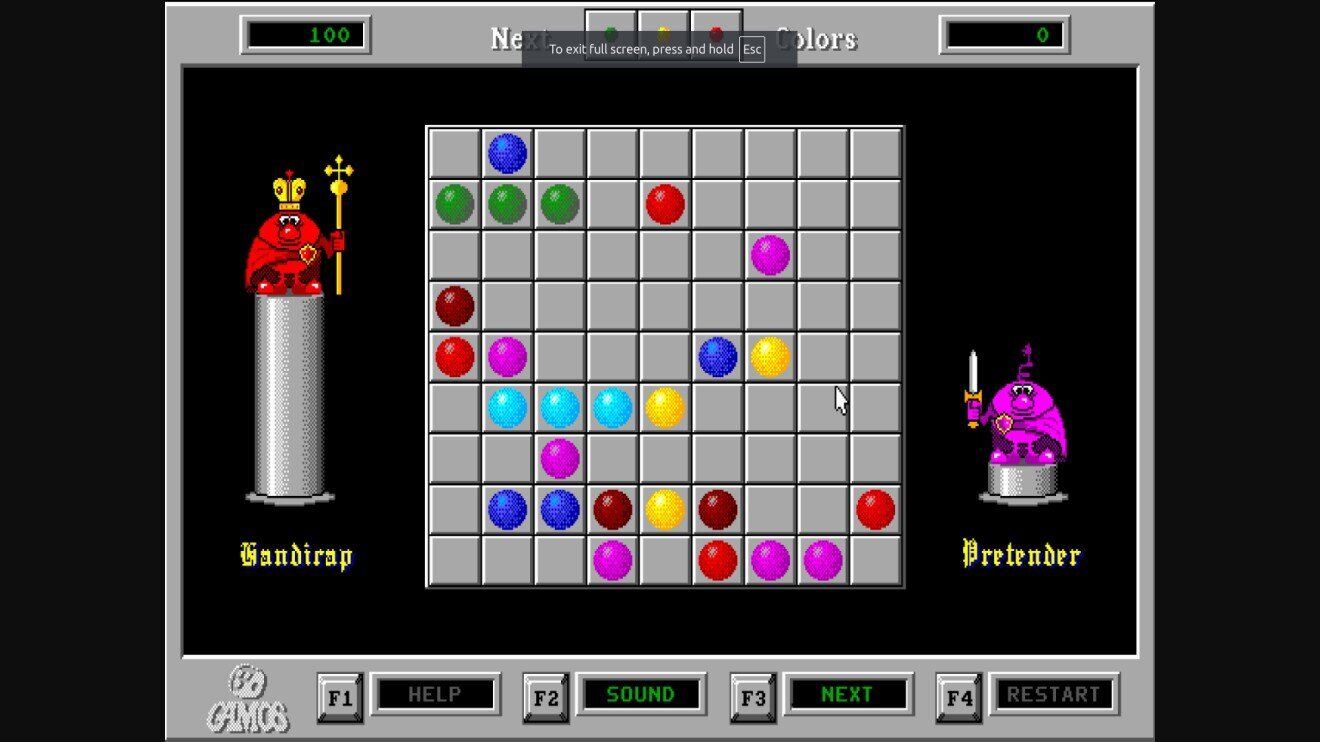
In the early 1990s, the computer games «Tetris» and «Color Lines» (often shortened to «Lines») were enormously popular in Russia and the former USSR, becoming genuine symbols of an emerging computer culture.
Tetris
«Tetris» is the cult computer game created by Soviet programmer Alexey Pajitnov in 1984 while he worked at the Computing Center of the USSR Academy of Sciences. The game’s official release came in 1985.
The game revolves around manipulating falling pieces made of four squares each (tetrominoes). The player rotates and shifts the pieces to form complete horizontal rows with no gaps. When such a row forms, it disappears and the player earns points. The game continues until the playing field fills up to the top.
«Tetris» became the first Soviet computer game to win international recognition. Amid the Cold War and the Iron Curtain, that was a significant cultural breakthrough. By 1993 the game had already been ported to a huge range of platforms, including personal computers, game consoles, and mobile devices.
The DOS and Windows version proved especially popular in Russian offices and institutions of the early 1990s. Between tasks, employees often fired up «Tetris» to unwind or challenge a coworker to an informal contest. Amid the era’s economic upheaval and uncertainty, this simple but absorbing game became a kind of psychological release valve.
Color Lines
«Color Lines» is a logic puzzle game developed by the Russian company Gamos in 1992, created by Oleg Dyomin, Gennady Denisov, and Igor Ivkin.
Gameplay takes place on a square 9×9 grid. At the start of each turn, the computer places three balls of random colors on the board (seven colors in total). The player can move any ball to an empty cell, provided a clear path exists between the start and end points. If a line of five or more balls of the same color forms, horizontally, vertically, or diagonally, they disappear and the player scores points and earns an extra turn. The game continues until the board is completely filled with balls.
By 1993, «Lines» had become one of the most popular computer games in Russia. Unlike the more frantic «Tetris,» «Lines» called for strategic thinking and planning, drawing in puzzle lovers. The game spread under a shareware model and was available for DOS and early versions of Windows.
In the business world of the early 1990s, as computers were just starting to appear in Russian offices, «Lines» and «Tetris» were part of the standard, unofficial software loadout installed on work machines. Office workers, especially younger staff, often spent their downtime on these games, or unwound with them after finishing their main tasks.