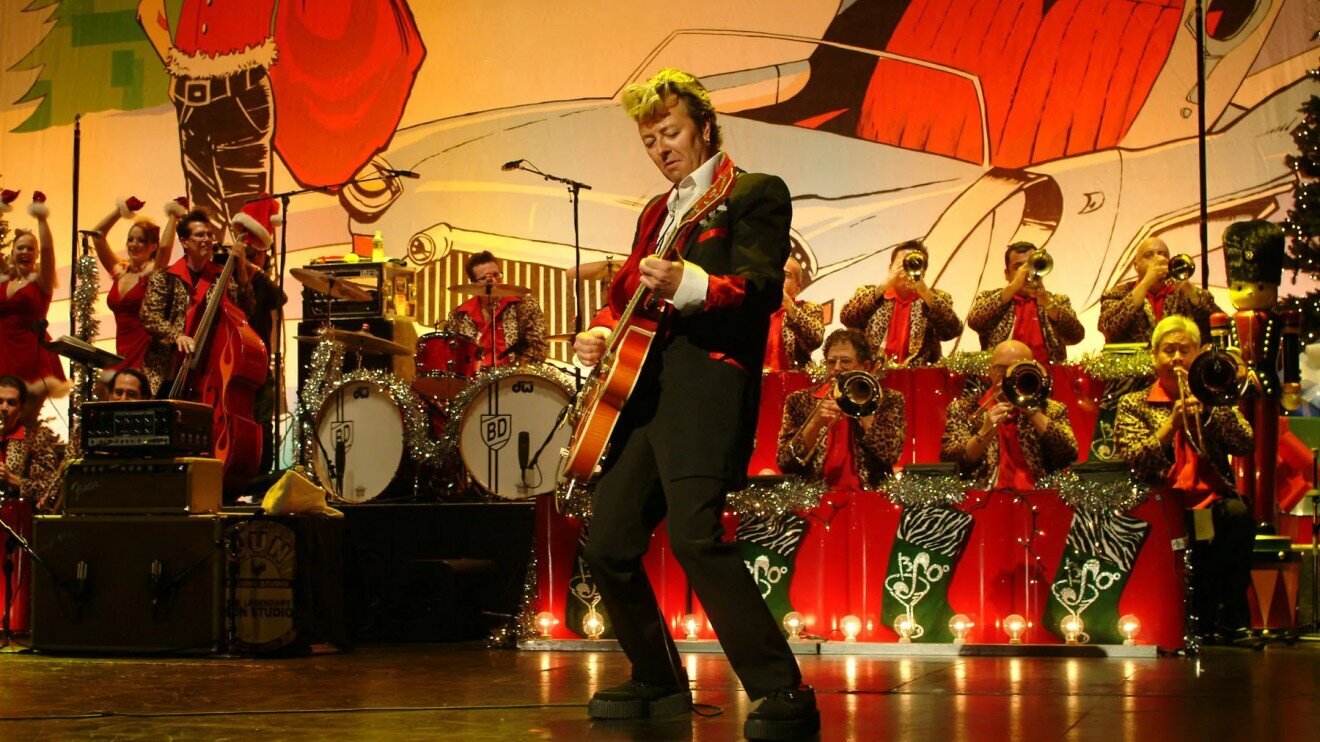
In the middle of the 1990s, when the musical world was absorbed in grunge and alternative rock, the phenomenon of the swing revival appeared out of nowhere. Its chief architect was Brian Setzer, who assembled a seventeen-piece orchestra that brought the sound of the swing-era big bands and the energy of 1950s rockabilly back into the present day.
How the Brian Setzer Orchestra came about
The Brian Setzer Orchestra (sometimes abbreviated BSO) is a swing and jump-blues group founded in 1992 by Stray Cats frontman Brian Setzer. Forming the orchestra was a logical continuation of Setzer’s musical searching; all his life he had balanced between various American musical traditions — from rockabilly to jazz, from blues to big band.
After the Stray Cats broke up in 1984, Setzer spent several years looking for his own path. His solo career included session work and experiments with different styles. In 1994 he released the debut Brian Setzer Orchestra album, which married his rockabilly style to swing, big band and jump blues. It was a bold experiment — to take the energy of rock and roll and place it in the setting of a full orchestra with a horn section.
The orchestra format allowed Setzer to realize his long-standing love of Louis Prima’s music and of the big bands, absorbed in his youth at the legendary Village Vanguard jazz club. At the same time he did not abandon his rockabilly roots, creating a unique hybrid that could have played equally in a 1940s dance hall and at a 1990s rock concert.
«Switchblade 327» — the BSO style distilled
«Switchblade 327» became one of the Brian Setzer Orchestra’s calling cards and a vivid example of their signature sound. The title refers to the switchblade — the flick knife, a symbol of the rebel culture of the 1950s celebrated by rockabilly musicians and reflected in films like Rebel Without a Cause.
The track displays every characteristic feature of the BSO style:
- A powerful horn section creating a dense swing sound
- Virtuoso rockabilly guitar solos from Setzer himself
- An energetic rhythm that makes you dance
- Jazz harmony combined with rock dynamics
- A retro aesthetic filtered through modern recording
The number 327 in the title admits of various readings — from the model number of a car engine (typical of rockabilly culture with its cult of classic American machinery) to simply an enigmatic code adding mystery and rebel spirit to the song.
Musically, «Switchblade 327» is built on the contrast between smooth swinging passages in the horns and sharp, aggressive guitar attacks. It is as if the Count Basie orchestra had met Eddie Cochran at a crossroads in the history of American music. The tempo is kept high, giving the listener the adrenaline characteristic of both jump blues and rockabilly.
The BSO breakthrough: «Jump, Jive an’ Wail» and The Dirty Boogie
Real success came to the orchestra in 1998 with the album The Dirty Boogie. Its centerpiece was a cover of Louis Prima’s «Jump, Jive an’ Wail,» which brought the band wide recognition. The original version had appeared on Prima’s album The Wildest! in 1957, and Setzer paid his dues to one of his principal musical heroes.
The BSO cover became a Billboard hit, and the video, full of blazing swing-era dancing, went into heavy rotation on MTV. The song won a Grammy for Best Pop Performance by a Duo or Group with Vocal, and «Sleep Walk» from the same album took a Grammy for Best Pop Instrumental Performance.
The success of The Dirty Boogie catalyzed the swing revival of the late 1990s. Suddenly, clubs where young people danced the Lindy Hop and the jitterbug were opening all over America. Films like Swingers (1996) with Vince Vaughn popularized the retro aesthetic, and BSO’s music became the soundtrack to that cultural phenomenon.
The orchestra’s next single, «Gettin’ in the Mood» from the album Vavoom!, continued the run, confirming the Brian Setzer Orchestra as the leading swing-revival band of the decade.
Traditions and innovations
The Brian Setzer Orchestra often performs over the December holidays, playing Christmas songs in its own manner. The band regularly plays at the tree-lighting ceremony at Rockefeller Center, becoming part of an American holiday tradition. In 2017 the orchestra ran a large-scale «Christmas Rocks! 2017» tour of 36 concerts from November through December.
Setzer’s melodies were widely used in commercials, which helped introduce a broad audience to his music. The BSO sound was ideal for creating an atmosphere of style, elegance and energy — qualities advertisers wanted associated with their products.
Brian Robert Setzer: a life in music
Early years and musical education
Brian Robert Setzer was born on April 10, 1959 in Massapequa, New York, on Long Island. His musical journey began not with the guitar but with the euphonium — a brass instrument he played in school jazz bands. That early acquaintance with brass instruments and jazz arrangement would later have an enormous influence on his orchestra work.
In the 1970s the young Setzer found a way to attend performances at the Village Vanguard, the legendary jazz club in Greenwich Village, New York. There he absorbed the sound of jazz and of the big bands. At the same time he was drawn to blues, rock, punk and rockabilly. His musical heroes were varied: from the jump blues of Louis Prima and Big Joe Turner to the rock and roll of Elvis Presley, Eddie Cochran, Gene Vincent and Carl Perkins.
That unique combination of influences — jazz, blues, rockabilly and punk energy — shaped Setzer’s musical identity. He was a purist of no single style, but sought to synthesize different American musical traditions into something new and thrilling.
The Stray Cats: rockabilly reborn
Early in his career Setzer played in the bands Bloodless Pharaohs and the Tomcats, the latter founded with his brother Gary. When double bassist Lee Rocker and drummer Slim Jim Phantom joined and Gary left, the Stray Cats were born.
In 1980, reckoning that their chances were better in England than in America, the musicians sold their instruments to buy plane tickets and flew to London. It was a bold decision for young musicians, and it paid off.
After several months of playing in London they met Dave Edmunds, a guitarist and producer who shared their love of rockabilly and 1950s rock and roll. Edmunds produced their debut album Stray Cats, released in Britain in 1981 on Arista, which yielded two hits: «Stray Cat Strut» and «Rock This Town.»
The second album, Gonna Ball, was less successful, but the band returned to America and put out a compilation of the best tracks from the first two records under the title Built for Speed. With the help of music videos on MTV the Stray Cats became popular in America. The album sold a million copies and held second place on the Billboard charts for fifteen weeks.
The next album, Rant n’ Rave with the Stray Cats, produced the hit «(She’s) Sexy + 17.» The Stray Cats became the leaders of the rockabilly revival of the early 1980s, reviving interest in 1950s music among a new generation.
The break-up and the solo years
In 1984 the Stray Cats broke up, though they periodically reunited for records and tours. Musical and personal conflicts began to show in how the members handled their new fame. Phantom married the actress Britt Ekland, while Setzer made guest appearances with stars like Bob Dylan and Stevie Nicks and became the touring guitarist for Robert Plant’s side project the Honeydrippers.
Looking back in 2012, Setzer admitted that breaking up the Stray Cats at the peak of their success had been foolish. At the time, though, he felt the need to move on and explore new musical territory.
After the break-up Setzer began a solo career, including session work. On his first solo album The Knife Feels Like Justice (1986) he moved away from rockabilly toward rhythm and blues and heartland rock in the spirit of John Mellencamp. The album was produced by Don Gehman and featured drummer Kenny Aronoff — both of whom had worked on Mellencamp’s records.
His second studio album, Live Nude Guitars, came out in 1988. Keeping some heartland-rock elements, it found Setzer moving toward straight blues rock comparable to George Thorogood’s style. Later that year he toured with Thorogood.
Back to the roots, and the orchestra
Setzer returned to his love of 1950s music, this time to the jump blues of Louis Prima. If in the 1980s he had resurrected rockabilly, in the 1990s he revived swing. He assembled the Brian Setzer Orchestra — a seventeen-piece big band that caught the public’s attention with its cover of Prima’s «Jump, Jive an’ Wail» from The Dirty Boogie.
The song won a Grammy for Best Pop Performance by a Duo or Group with Vocal, and «Sleep Walk» from the same album took a Grammy for Best Pop Instrumental Performance. It was a triumph that confirmed the rightness of Setzer’s creative choice.
In 2007 came the album Wolfgang’s Big Night Out, on which Setzer offered his own reading of classical works such as Beethoven’s Fifth Symphony and «Für Elise.» The album brought Setzer his eighth Grammy nomination, this time in the Best Classical Crossover Album category.
Setzer has also worked as a producer — in 2014 he was executive producer of Drake Bell’s album Ready Steady Go! and played guitar on two songs, helping the younger artist master the rockabilly sound.
Personal life
Setzer has been married three times: first to DeAnna Madsen, with whom he has one son, then to Christine Schmidt, with whom he has two children, and finally, in 2005, to Julie Reiten, formerly a singer with the band the Dustbunnies. He lives in Minneapolis.
In February 2025 Setzer disclosed that he suffers from an autoimmune condition that interferes with his guitar playing. In November 2025 he announced that he was fighting a «serious illness,» which forced the cancellation of a US tour.
The Stray Cats: pioneers of the rockabilly revival
Formation and the move to Britain
The Stray Cats are an American rockabilly band formed in 1979 by guitarist and singer Brian Setzer, double bassist Lee Rocker and drummer Slim Jim Phantom in Massapequa, Long Island, New York. The band had numerous hits in Britain, Australia, Canada and the United States, including «Stray Cat Strut,» «(She’s) Sexy + 17,» «Look at That Cadillac,» «I Won’t Stand in Your Way,» «Bring It Back Again» and «Rock This Town,» which the Rock and Roll Hall of Fame included on its list of the songs that shaped rock and roll.
The band first appeared around New York in mid-1979, playing under various names including the Tomcats, the Teds and Bryan and the Tom Cats. According to Brian Setzer they changed names to fool club owners (who wouldn’t book the same band on consecutive nights) while keeping the word «Cats» in the variations so audiences would know it was the same group.
Setzer teamed up with Slim Jim Phantom on drums, and they soon added Phantom’s classmate and friend Lee Rocker on double bass. All three came from the same neighborhood in Massapequa and were interested in punk and rockabilly.
The band’s style was based on the sound of the Sun Records artists and other 1950s performers, with a strong influence from Eddie Cochran, Carl Perkins, Gene Vincent, and Bill Haley and his Comets. The Stray Cats quickly built a large following on the New York scene, playing CBGB and Max’s Kansas City as well as Long Island venues.
When the members heard a rumor of a revival of the 1950s Teddy Boy subculture in England, they moved to Britain. They took the lead of a nascent rockabilly revival, mixing the 1950s Sun Studio sound with contemporary punk elements. Visually, the Stray Cats mixed 1950s rockabilly clothing — drape jackets, brothel-creeper shoes, western shirts — with punk gear such as tight black zippered trousers and modern versions of 1950s hairstyles.
Breakthrough and international success
By mid-1980 the band was being courted by record labels including Virgin, Stiff and Arista. Word spread fast, and soon members of the Rolling Stones, the Who and Led Zeppelin were turning up at their shows.
After a London concert the Stray Cats met the musician and producer Dave Edmunds, known as a roots-rock enthusiast for his work with Rockpile and as a solo artist. Edmunds offered to work with the band, and they went into the studio to record the self-titled debut album Stray Cats, released in Britain in 1981 on Arista Records.
In addition to that year’s three hits — «Runaway Boys,» «Rock This Town» and «Stray Cat Strut» — they also performed on the eighth day of the Montreux Jazz Festival. The British follow-up to Stray Cats, the album Gonna Ball, was not so well received and produced no hits. Even so, the combined sales of the first two albums persuaded EMI America to assemble a compilation of the best tracks and release the album Built for Speed in the US in 1982. It sold a million copies (platinum) in the US and Canada and held second place on the Billboard album charts for fifteen weeks.
In 1983 the Stray Cats began recording their third (second American) studio album, Rant N’ Rave with the Stray Cats. Unlike the previous studio albums, half of it was recorded in London and the rest in New York. Released in August 1983, Rant N’ Rave was generally well received by critics, who noted the band’s debt to 1950s rock and roll legends such as Gene Vincent and Bo Diddley. Commercially it did not match Built for Speed, though it produced the top-ten hit «(She’s) Sexy + 17» and the top-forty hit «I Won’t Stand in Your Way,» featuring the doo-wop group 14 Karat Soul.
Break-up and reunions
Musical and personal conflicts began to arise over how the members handled their new fame. In late 1984 the band added former BMT’s guitarist and Long Island native Tommy Byrnes on second guitar and backing vocals. After a European and American tour that ended at the 1984 Louisiana World Exposition, Setzer decided to end the band, which upset the other members.
In an interview Setzer cited restlessness as his motive: «I just wasn’t getting that great feeling any more… I had five good years of it, but then I got bored. That last year I stopped getting that feeling, that great rush that used to churn in my stomach.»
The Stray Cats nevertheless reunited periodically. In 1986 they gathered in Los Angeles and recorded the covers album Rock Therapy. A long break followed, but in 1989 they reunited again for Blast Off!, supported by a tour with blues guitarist Stevie Ray Vaughan. No longer with EMI America, they went into the studio with Nile Rodgers for another album, Let’s Go Faster, released by Liberation in 1990.
After the 1992 album Choo Choo Hot Fish, produced by Dave Edmunds, and the covers album Original Cool, the band broke up once more.
In 2004 the Stray Cats came together for a month-long European tour. The live album from those shows, Rumble in Brixton, included one new studio track, «Mystery Train Kept A Rollin’.» In 2007 they reunited again for an American tour with ZZ Top and the Pretenders — their first North American tour in more than fifteen years.
In 2018 Setzer announced on his Facebook page that the band would reunite for a show in Las Vegas. In October 2018 the band announced a 2019 reunion for a new album (their first in twenty-five years), recording in Nashville and a fortieth-anniversary tour. On March 26, 2019 a video for the album’s first single, «Cat Fight (Over a Dog Like Me),» was released, with the announcement of the album 40 for May 24.
In 2024 the band announced a three-week US summer tour, their first in five years. In 2025 the Stray Cats announced a three-week US autumn tour and released two new recordings: an original song, «Stampede,» co-written by Setzer, and a cover of Eddie Cochran’s «Teenage Heaven.» The tour was later cancelled owing to Setzer’s fight with a «serious illness.»
Influence and legacy
The Stray Cats catalyzed the rockabilly revival of the early 1980s. Their success proved that 1950s music could reach a contemporary audience if presented with the right energy and authenticity.
The band was inducted into the Long Island Music Hall of Fame on October 15, 2006. Their influence on modern musical culture is impossible to overstate — they inspired a whole generation of musicians to study American musical roots and proved that retro styles could be current and commercially successful.
Rockabilly: origins and evolution
What rockabilly is
Rockabilly is one of the earliest styles of rock and roll. It goes back to the beginning of the 1950s in the United States, particularly in the South. As a genre it unites the sound of western styles such as country with rhythm and blues, producing what is considered «classic» rock and roll. Some have also described it as a mixture of bluegrass with rock and roll.
The term «rockabilly» is itself a fusion of «rock» (from rock and roll) and «hillbilly» — the latter a reference to country music (often called «hillbilly music» in the 1940s and 1950s), which contributed substantially to the style. Other important influences on rockabilly include western swing, boogie-woogie, jump blues and electric blues.
Characteristic features
The defining features of the rockabilly sound included:
- Strong rhythms
- Boogie-woogie piano riffs
- Vocal «twang»
- Doo-wop a cappella singing
- Extensive use of slapback echo
- Varied instrumentation and vocal harmonies
Popularized in the first instance by artists such as Carl Perkins, Elvis Presley, Johnny Burnette, Jerry Lee Lewis and others, the rockabilly style declined at the end of the 1950s. Nevertheless, in the late 1970s and early 1980s rockabilly enjoyed a revival. Interest in the genre persists even in the twenty-first century, often within musical subcultures.
Historical roots: from blues to rockabilly
The prewar background
There was a close connection between blues and country music from the earliest country recordings of the 1920s. The first nationwide country hit was «Wreck of the Old 97,» which also became widely popular. Jimmie Rodgers, «the first real country star,» was known as the «Blue Yodeler,» and most of his songs used blues chord progressions, though with entirely different instrumentation and sound compared with the recordings of his black contemporaries such as Blind Lemon Jefferson and Bessie Smith.
In the 1930s and 1940s two new sounds appeared. Bob Wills and his Texas Playboys were the leading exponents of western swing, which combined country singing and steel guitar with big-band jazz influences and horn sections. Wills’s music found mass popularity. His recordings from the mid-1940s to the early 1950s featured two-beat jazz rhythms, jazz choruses and guitar work that anticipated the early rockabilly records.
After blues artists like Meade Lux Lewis and Pete Johnson set off a nationwide boogie craze beginning in 1938, country artists such as Moon Mullican, the Delmore Brothers, Tennessee Ernie Ford, Speedy West, Jimmy Bryant and the Maddox Brothers and Rose began recording what was then called «hillbilly boogie» — hillbilly vocals and instruments over a boogie bass line.
After the Second World War the Maddox Brothers and Rose were «at the forefront of rockabilly with the slap bass developed by Fred Maddox.» They shifted into a higher gear, leaning toward an eccentric honky-tonk feel with a heavy, manic bottom end and high volume.
The influence of jump blues and electric blues
Alongside country, swing and boogie influences, jump blues artists such as Wynonie Harris and Roy Brown, and electric blues bands such as Howlin’ Wolf, Junior Parker and Arthur Crudup, shaped the development of rockabilly. The Memphis blues musician Junior Parker and his electric blues band Little Junior’s Blue Flames, with Pat Hare on guitar, had a great influence on the rockabilly style, especially with their 1953 songs «Love My Baby» and «Mystery Train.»
Bill Monroe is known as the father of bluegrass, a particular style of country music. Many of his songs were in blues form, while others took the form of folk ballads, parlor songs or waltzes. Bluegrass was a staple of country music in the early 1950s and is often cited as an influence on the development of rockabilly, partly because of its preference for fast tempos.
The golden age: Tennessee and Sun Records
Carl Perkins and «Blue Suede Shoes»
The white sons of sharecroppers, Carl Perkins and his brothers Jay and Clayton, along with drummer W. S. Holland, established themselves as one of the hottest bands on the honky-tonk scene around Jackson, Tennessee. Most of the songs they played were country standards taken at a faster clip.
It was here that Carl began writing his first songs. As he played he watched the dance floor to see what the audience preferred and adjusted his compositions accordingly, writing them down only when he was sure they were finished. Carl sent many demos to New York record companies without success — producers considered that rhythm-driven country in the Perkins style was not commercially viable.
That changed in 1955 with the recording of «Blue Suede Shoes» (cut on December 19, 1955) at Sam Phillips’s Memphis label Sun Records. Later made more famous by Elvis Presley, Perkins’s original version was an early rock and roll standard.
Elvis Presley and a revolution in sound
Elvis Presley’s first recordings were made at Sun Records, a small independent label run by producer Sam Phillips in Memphis, Tennessee. For several years Phillips had recorded and released performances by blues and country musicians in the area. He also offered a service allowing anyone to walk in off the street and, for a modest fee, record themselves onto a two-song disc. One young man who came in to record himself as a surprise for his mother was Elvis Presley.
Presley made enough of an impression for Phillips to assign him guitarist Scotty Moore, who in turn brought in bassist Bill Black, both from the Starlite Wranglers, a local western swing band. The trio rehearsed dozens of songs, from traditional country to gospel. During a break on July 5, 1954, Elvis started playing «That’s All Right Mama,» a 1946 blues song by Arthur Crudup, and Moore and Black joined in. After a few takes Phillips had a satisfactory recording. «That’s All Right» was released on July 19, 1954.
Presley’s version of «That’s All Right Mama» united country, a genre associated with European-American culture, and rhythm and blues, a genre associated with African-American culture. The resulting track was rejected by country radio stations for being «too black» and by R&B stations for being «too white.»
All of Presley’s early singles carried a blues song on one side and a country song on the other, both sung in the same genre-blended style. His Sun recordings feature his vocal and rhythm guitar, Bill Black’s percussive slap bass and Scotty Moore’s amplified guitar. Slap bass had been a staple of both western swing and hillbilly boogie since the 1940s.
Nobody was sure what to call Presley’s music, so Elvis was described as the «Hillbilly Cat» and the «King of Western Bop.» His recordings are described by some as quintessential rockabilly for their genuine fusion of country and R&B. Besides merging separate genres, they contain both traditional and novel features: «nervously up-tempo» (as Peter Guralnick describes it), with slap bass, eccentric guitar playing, a great deal of echo, shouts of encouragement, and vocals full of theatricality — hiccups, stammers and dives from falsetto to bass and back.
Bill Haley and the popularization of rockabilly
In 1951 a western swing bandleader named Bill Haley recorded a version of «Rocket 88» with his group the Saddlemen. It is considered one of the earliest recognized rockabilly recordings. It was followed by a version of «Rock the Joint» in 1952 and original works such as «Real Rock Drive» and «Crazy Man, Crazy,» the latter reaching number 12 on the American Billboard chart in 1953.
On April 12, 1954, Haley, performing with his band as Bill Haley and His Comets, recorded «Rock Around the Clock» for Decca Records in New York. When it was first released in May 1954, «Rock Around the Clock» charted for one week at number 23 and sold 75,000 copies. In 1955 it was featured in the film Blackboard Jungle, which revived sales. The song reached number 1, held that position for eight weeks and was the second song on the Billboard Hot 100 for 1955.
Flowering and decline: the late 1950s
There were thousands of musicians recording songs in the rockabilly style, and many labels releasing rockabilly records. Some enjoyed great chart success and were important influences on future rock musicians.
Sun Records also took on performers such as Billy Lee Riley, Sonny Burgess, Charlie Feathers and Warren Smith. There were a few women performers too, such as Wanda Jackson, who went on recording rockabilly long after the other ladies — Janis Martin, the female Elvis, Jo Ann Campbell and Alis Lesley.
Gene Vincent and his Blue Caps recorded «Be-Bop-A-Lula,» released on June 2, 1956. Within twenty-one days it had sold more than two hundred thousand records, stayed at the top of the national pop and country charts for twenty weeks and sold more than a million copies.
In the summer of 1958 Eddie Cochran had a chart-topping hit with «Summertime Blues.» His brief career included only a few hits, such as «Sitting in the Balcony,» released in early 1957, «C’mon Everybody,» released in October 1958, and «Somethin’ Else,» released in July 1959. Then in April 1960, on tour with Gene Vincent in Britain, their taxi struck a concrete lamp post, killing Eddie at the age of twenty-one.
Rockabilly enjoyed great popularity in the United States in 1956 and 1957, but airplay contracted after 1960. The factors usually cited for the decline are the death of Buddy Holly in a plane crash in 1959 (together with Ritchie Valens and the Big Bopper), Elvis Presley’s conscription into the army in 1958, and a general shift in American musical taste. The style remained popular longer in England, where it attracted a fanatical following right into the mid-1960s.
The rockabilly revival: 1970–1990
Elvis’s 1968 comeback, performers such as Sha Na Na, Creedence Clearwater Revival, Don McLean, Linda Ronstadt and the Everly Brothers, the film American Graffiti, the television show Happy Days and the Teddy Boy revival created a curiosity about genuine 1950s music, especially in England, where a rockabilly revival scene began developing from the 1970s in record collecting and clubs.
The most successful early product of that scene was Dave Edmunds, who joined songwriter Nick Lowe to form the band Rockpile in 1975. They had a series of minor rockabilly hits such as «I Knew the Bride (When She Used to Rock ’n’ Roll).» The band became a popular touring act in Britain and the US, which led to respectable album sales. Edmunds also nurtured and produced many young artists who shared his love of rockabilly, first among them the Stray Cats.
The Stray Cats were the most commercially successful of the new rockabilly artists. The band formed on Long Island in 1979 when Brian Setzer joined up with two school friends calling themselves Lee Rocker and Slim Jim Phantom. Attracting little attention in New York, they flew to London in 1980, where they had heard an active rockabilly scene existed.
Their early shows were attended by the Rolling Stones and by Dave Edmunds, who quickly took the boys into a recording studio. The Stray Cats had three top-ten singles in Britain and two best-selling albums. They returned to the US, appearing on the television show Fridays with a message flashing on screen that they had no recording contract in the States.
EMI signed them soon after, their first videos appeared on MTV, and they stormed the charts in America. Their third album, Rant ’N’ Rave with the Stray Cats, topped charts across the US and Europe while they sold out shows everywhere in 1983. Personal conflicts, however, led to the band breaking up at the height of their popularity.
The characteristic sound and its techniques
Some of the effects and techniques closely bound up with rockabilly as a style include slapback (a rapid echo effect), slapback echo, flutter echo, tape delay echo, echo and reverb.
The characteristic reverb on early hit records such as «Rock Around the Clock» by Bill Haley and His Comets was created by recording the band under the domed ceiling of Decca’s New York studio, housed in an echoing former ballroom called the Pythian Temple. The same studio was used to record other rockabilly musicians such as Buddy Holly and the Rock and Roll Trio.
The Memphis Recording Service studio, where Sam Phillips recorded, had a sloping ceiling covered in corrugated tiles. That produced some of the desired resonance, but Phillips used technical means to create additional echo: the original signal from one tape machine was fed through a second machine with a fraction-of-a-second delay.
Compared with country songs, rockabilly songs tend to have simplified form, lyrics, chord progressions and arrangements, faster tempos and heightened percussion. There is greater variety in lyrics and melodies, and the singing style is more theatrical. Compared with rhythm and blues, fewer instruments are used, but the percussion is intensified to fill out the sound.
The cultural significance of rockabilly
Rockabilly cultivated an attitude that secured its lasting appeal to teenagers. It was a combination of rebellion, sexuality and freedom — a mocking expression of contempt for the everyday world of parents and figures of authority. It was the first style of rock and roll performed predominantly by white musicians, which set off a cultural revolution that still echoes today.
Rockabilly spawned many substyles and influenced the development of other genres, such as punk rock. Even the Beatles were strongly influenced by rockabilly. When John Lennon first met Paul McCartney he was impressed that McCartney knew all the chords and words to Eddie Cochran’s «Twenty Flight Rock.» Musically they combined Holly’s melodic songcraft with the raw rock and roll sound of Vincent and Carl Perkins.
Rockabilly remains a living style in the twenty-first century, with active scenes all over the world. From neo-rockabilly bands to psychobilly artists, from retro performers to modern musicians inspired by the sound — the spirit of rockabilly lives on, a reminder of a time when music was young, insolent and full of revolutionary energy.