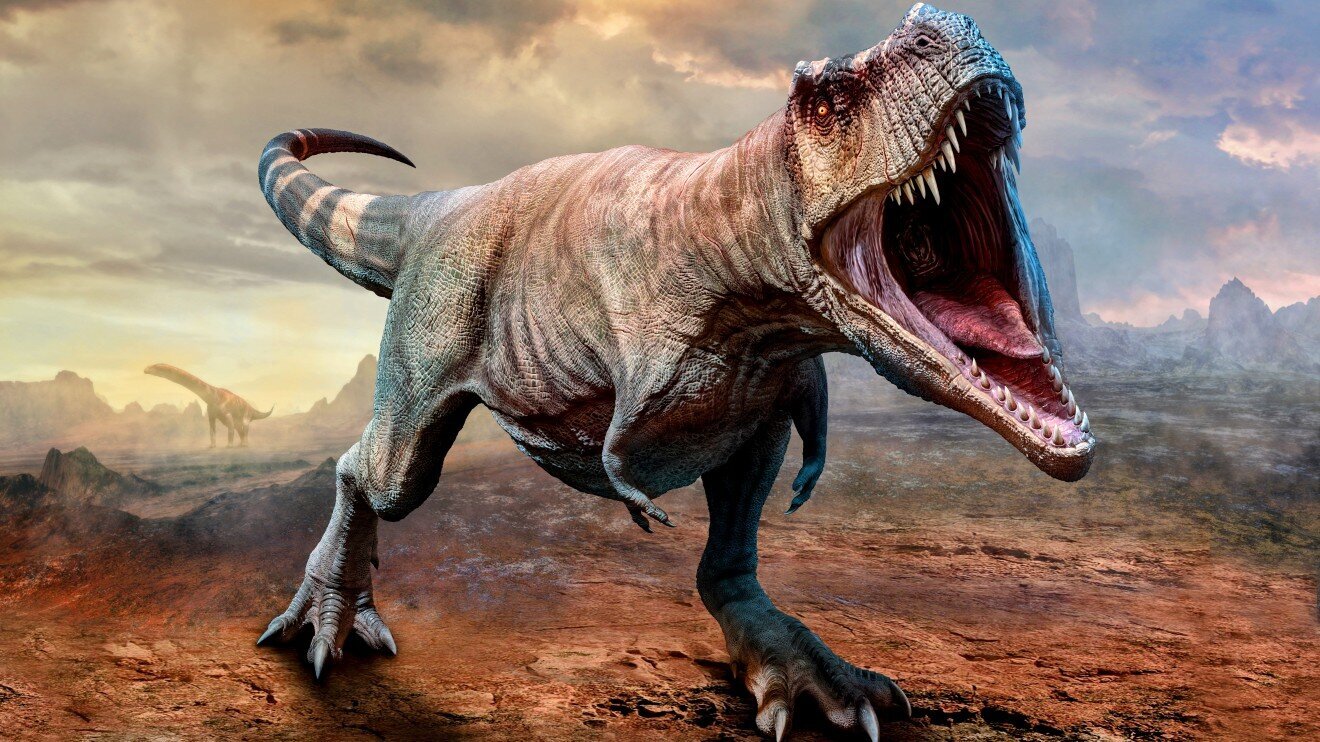
Tyrannosaurus Rex (Latin Tyrannosaurus rex, literally "king of the tyrant lizards") is one of the most famous and fearsome predators ever to have existed on Earth.
Key characteristics
- Period: Late Cretaceous (68-66 million years ago)
- Habitat: The territory of present-day North America
- Length: 12-14 meters
- Height: 3.5-4 meters at the hip, up to 6 meters overall
- Weight: 8-10 tons
Taxonomic classification
Kingdom: Animalia
Phylum: Chordata
Class: Reptilia
Order: Saurischia
Suborder: Theropoda
Family: Tyrannosauridae
Genus: Tyrannosaurus
Species: T. rex
Anatomical features
T. rex had unique anatomical traits that made it an ideal predator for its time:
Skull and teeth
A massive skull up to 1.5 meters long, with powerful jaws fitted with 50 to 60 conical teeth up to 30 cm long. Tyrannosaurus's bite force is the most powerful ever measured among land animals in Earth's history. Scientists estimate it reached 35,000 to 60,000 newtons.
Forelimbs
Disproportionately small forelimbs with two clawed fingers. Despite their size, they were fairly muscular and could bear loads of up to 200 kg. They were likely used to grip prey or to help the animal rise from the ground.
Lifestyle and behavior
For a long time, T. rex was viewed purely as an active predator, but modern research suggests a more complex ecological role:
Contrary to popular belief, T. rex was probably not a fast runner (its top speed is estimated at 20–30 km/h). It relied on sudden ambush attacks and the power of its jaws. It is thought that Tyrannosaurus may have tracked prey using its excellent sense of smell and vision.
There is evidence pointing to possible social behavior among tyrannosaurs. The discovery of several individuals at a single site suggests they may have hunted in groups, or at least gathered together temporarily. Traces of conflict between individuals of the same species have also been found — bite marks on the skulls of other tyrannosaurs.
T. rex was likely both a hunter and a scavenger, depending on the circumstances. Its main prey consisted of large herbivorous dinosaurs, including Triceratops and hadrosaurs. Thanks to its exceptional jaw strength, Tyrannosaurus could crush bone and access bone marrow — a rich source of nutrients.
Cultural significance
Tyrannosaurus Rex holds a special place in popular culture, becoming a symbol of the prehistoric era and of dinosaurs in general:
Film
From the classic film "The Lost World" (1925) to the "Jurassic Park" franchise, T. rex has been a fixture of dinosaur films, usually cast as the key antagonist or final boss.
Literature
It appears in numerous works of fiction, from popular science books to fantasy novels, including alternate-history and fantasy genres in which humans and dinosaurs coexist.
Science and education
It serves as the "face" of paleontology, drawing attention to the science. The discovery of the skeleton nicknamed "Sue" in 1990 (the most complete T. rex skeleton ever found) was a major scientific and media event.
Fun facts
- The first T. rex skeleton was discovered by paleontologist Barnum Brown in 1900, in Montana (USA).
- The name "Tyrannosaurus rex" was given by American paleontologist Henry Fairfield Osborn in 1905.
- More than 50 T. rex specimens, in varying states of preservation, have been found over the history of excavation.
- T. rex's lifespan is estimated at 30 to 35 years.
- There is evidence that T. rex's body may have been covered in primitive feathers, especially at a young age.
"Tyrannosaurus Rex is not just a dinosaur, but a genuine symbol of ancient power and majesty, whose image continues to inspire scientists, writers, and artists millions of years after its disappearance."