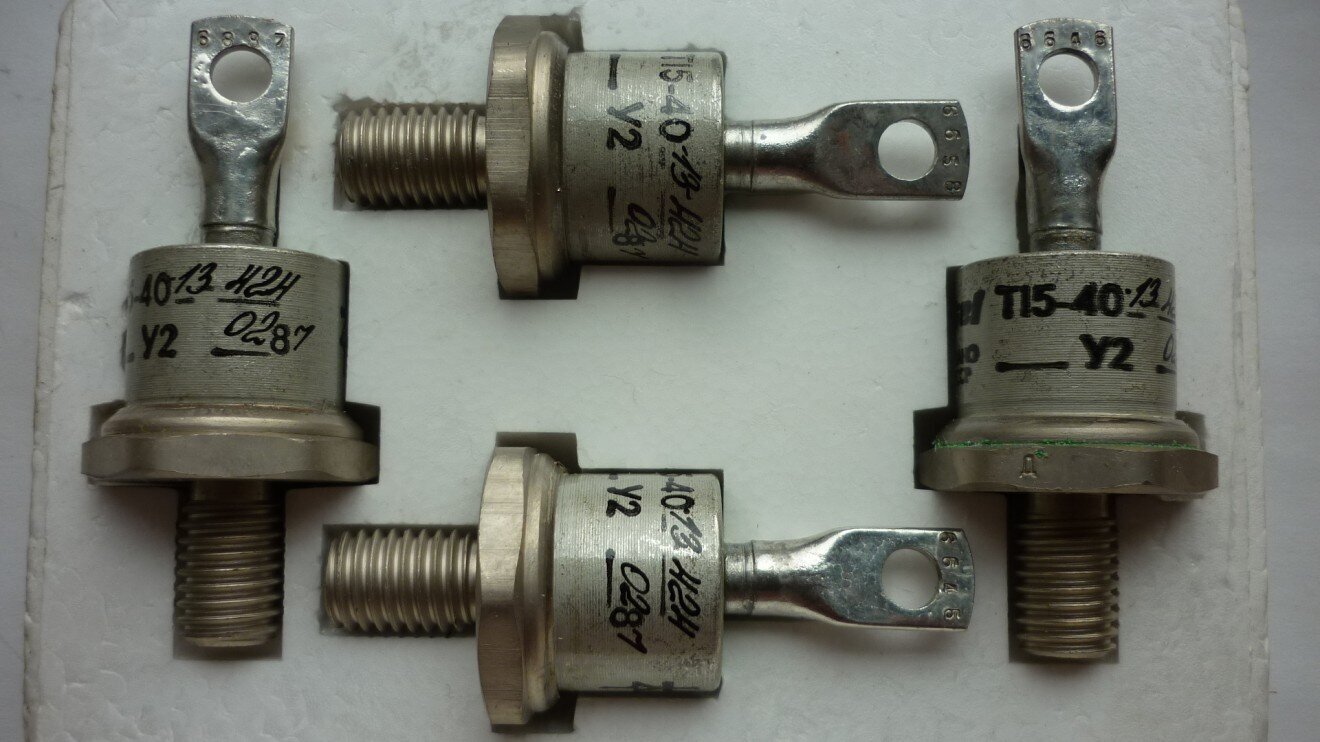
Note: In the characters' conversation, diacs and triacs are mentioned — specific semiconductor devices belonging to the thyristor family. These terms are especially fitting for the technical speech of the 1980s-90s, when such devices were actively studied at technical universities.
A thyristor is a semiconductor device capable of two stable states: closed (high resistance) and open (low resistance). It's mainly used to control current in power circuits. Structurally, a thyristor consists of four alternating layers of semiconductor (p-n-p-n) and at least two leads: an anode and a cathode.
A diac (from "diode thyristor") is a type of thyristor without a control electrode. It has only two leads — anode and cathode — and switches into a conducting state once the voltage between them reaches a threshold value. Essentially, a diac acts as an avalanche switch: it snaps open at a specific voltage and snaps shut just as sharply once the current drops below the holding current.
A triac (or triode thyristor) is a more common and "controllable" variant of the thyristor, with a third lead — a control electrode (gate). Applying a short control pulse lets the device open and switch current through the power circuit even at a voltage below the diac's breakover threshold. Once open, a triac stays in that state until the current through it drops below a certain level (the holding current), even after the control signal has disappeared.
The key difference between a diac and a triac:
- A diac — has no control electrode, switches on once the breakover voltage is exceeded.
- A triac — has a control electrode (gate), switches on by signal, making it suitable for precise control of power circuits.
Both devices are nonlinear: they behave as electronic switches, snapping sharply from a closed state to an open one. Their current-voltage characteristics have an S-shape, indicating a region of negative differential resistance. It's worth noting that diacs were often used in simple starter circuits, while triacs were used in more complex applications — such as power-regulation systems, dimmer switches, and motor drives.
In the 1990s, at technical universities in the USSR and Russia, the study of thyristors, including diacs and triacs, was a mandatory part of the power-electronics curriculum, so this terminology was familiar in engineering circles and even became part of student folklore — as reflected in the scene described in the novel.