About the Song
The song follows a man keeping vigil in a doorway across from his beloved’s building, rain or snow falling, on the chance she might pass by. He confesses that not knowing whether she loves him back is easier to bear than risking a spoken «no.» At night, in the quiet, he writes her poetry — verses in which, line after line, he can’t bring himself to write out the word for love, leaving only a trailing mark where it belongs, trusting she’ll understand what he meant to say but couldn’t. He closes hoping that when the snow melts in spring, she might finally answer «yes.»
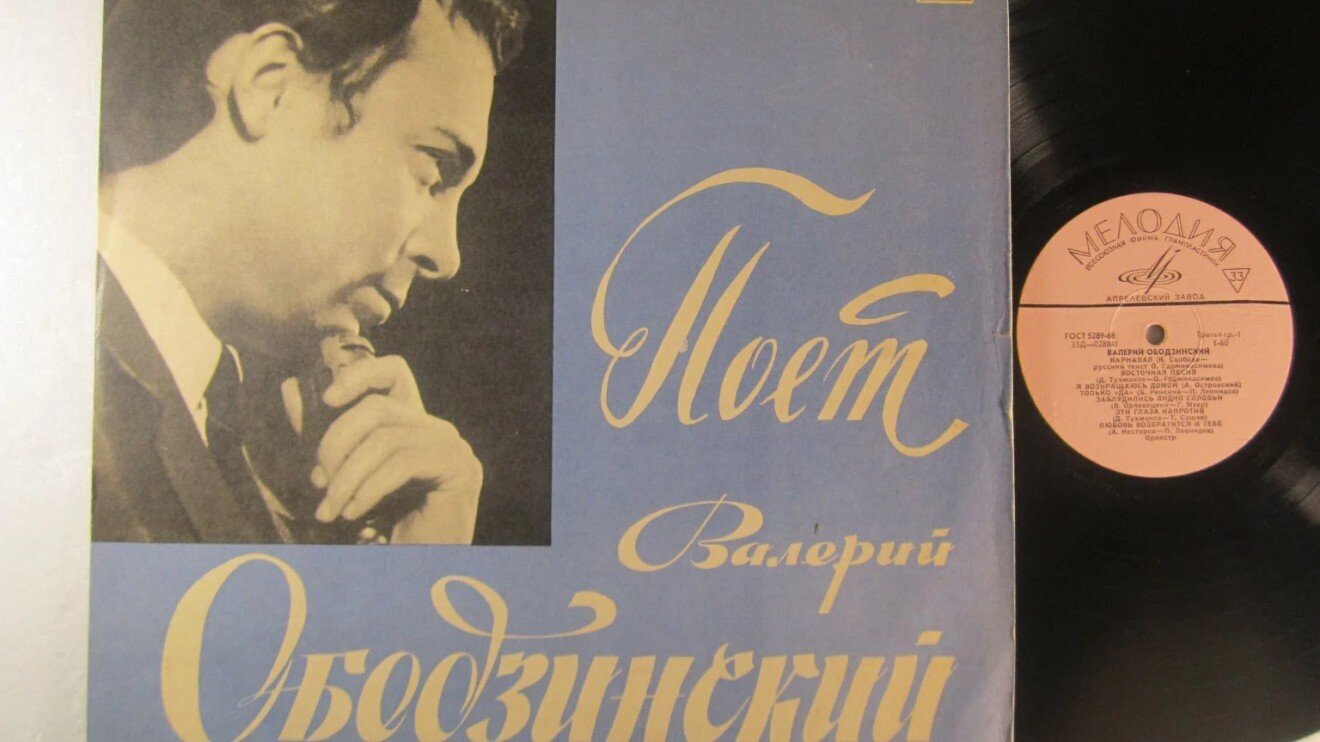
«Eastern Song» (Russian: Vostochnaya Pesnya) is a popular composition from 1968, composed by David Tukhmanov to lyrics by Onegin Gadzhikasimov. The song became widely known through the performance of Valery Obodzinsky and stood as one of the standout musical phenomena of the late 1960s.
History of Its Creation
The song was written in 1968 and wasn’t originally intended as a hit. According to contemporaries, David Tukhmanov composed the melody in a single evening, inspired by Eastern motifs. The lyrics, written by Onegin Gadzhikasimov, fit the musical framework seamlessly. Valery Obodzinsky, with his uniquely timbred voice, gave the composition its particular sound and charm.
The first recording was made for radio, with an orchestra conducted by Yuri Silantyev. The song later entered Valery Obodzinsky’s regular repertoire and became his signature number.
Period of Popularity
«Eastern Song» swept through the late-1960s and early-1970s Soviet pop scene. It played on dance floors, in parks, and people hummed it in the street. Its success was phenomenal — records of it sold in the millions.
An interesting fact: despite its enormous popularity with listeners, the song was effectively banned from central television broadcast. The reason, in the view of Party leadership, was its overly «Western» style, and its lyrical content — with Eastern motifs — unusual for Soviet pop music of the time. Even so, the ban only stoked public interest, and the song kept spreading through radio broadcasts and records.
The Song’s Creators
David Fyodorovich Tukhmanov
Born July 20, 1940, in Moscow. An outstanding Soviet and Russian composer, pianist, and arranger, and a graduate of the Moscow Conservatory in composition. Author of many popular songs, including «Den Pobedy» («Victory Day»), «Eti Glaza Naprotiv» («Those Eyes Across the Way»), «Chistiye Prudy,» and many others. Tukhmanov is regarded as one of the innovators of Soviet popular music, who brought elements of Western musical culture into it.
In the late 1960s, David Tukhmanov began experimenting with new musical forms, blending Soviet pop with elements of jazz, rock, and Eastern motifs. «Eastern Song» was a vivid example of that experiment, and it proved enormously successful.
Onegin Yusufovich Gadzhikasimov
Born May 28, 1937, in Baku; died January 20, 2002. A Soviet lyricist of Azerbaijani descent, author of more than 400 songs performed by many stars of the Soviet stage. His lyrics often turned to Eastern themes, skillfully blended with the poetic trends of his time.
In the mid-1970s Gadzhikasimov converted to Orthodox Christianity and began writing devotional poems and songs. In the spring of 1989 he came as a pilgrim to the reviving Optina Pustyn monastery, where he served as gatekeeper. In the duty log he signed himself simply «Gakasimov,» concealing his former worldly fame from everyone. On December 3, 1989, on the eve of the feast of the Presentation of the Theotokos, he was received into the monastery’s brotherhood. In 1991 he was tonsured a monk (the lesser schema) under the name Silouan by the monastery’s superior, Archimandrite Venedikt (Penkov); he was later tonsured into the great schema under the name Simon.
He died on June 30, 2002, of cancer, and is buried in the cemetery of the village of Lyamtsino in the Domodedovo district of Moscow Oblast.
Valery Vladimirovich Obodzinsky
Born January 24, 1942, in Odessa; died April 26, 1997, in Moscow. A legendary Soviet pop singer possessing a uniquely lyrical tenor. Through the 1960s and 1970s he was one of the most popular performers in the USSR. His famous songs include «Eastern Song,» «Those Eyes Across the Way,» «Vechnaya Vesna» («Eternal Spring»), and a medley of songs by Oscar Feltsman.
Obodzinsky’s career had a difficult arc. After reaching the height of his popularity in the 1970s, a period of obscurity followed. In the early 1990s he attempted a comeback, but his life was soon cut tragically short. Even so, his unmistakable voice and singular style left a vivid mark on the history of Soviet music.
Legacy
«Eastern Song» became one of the symbols of its era and an example of how music can cross ideological barriers. Despite its semi-official ban, it lived on and continued to delight listeners. Today the composition is part of the golden fund of Russian popular music and is regularly featured in retro concerts and music programs.
The song had a notable influence on the development of Soviet pop music, opening the door to new musical trends and experiments with Eastern motifs. It also became an important part of the creative legacy of all three of its creators.