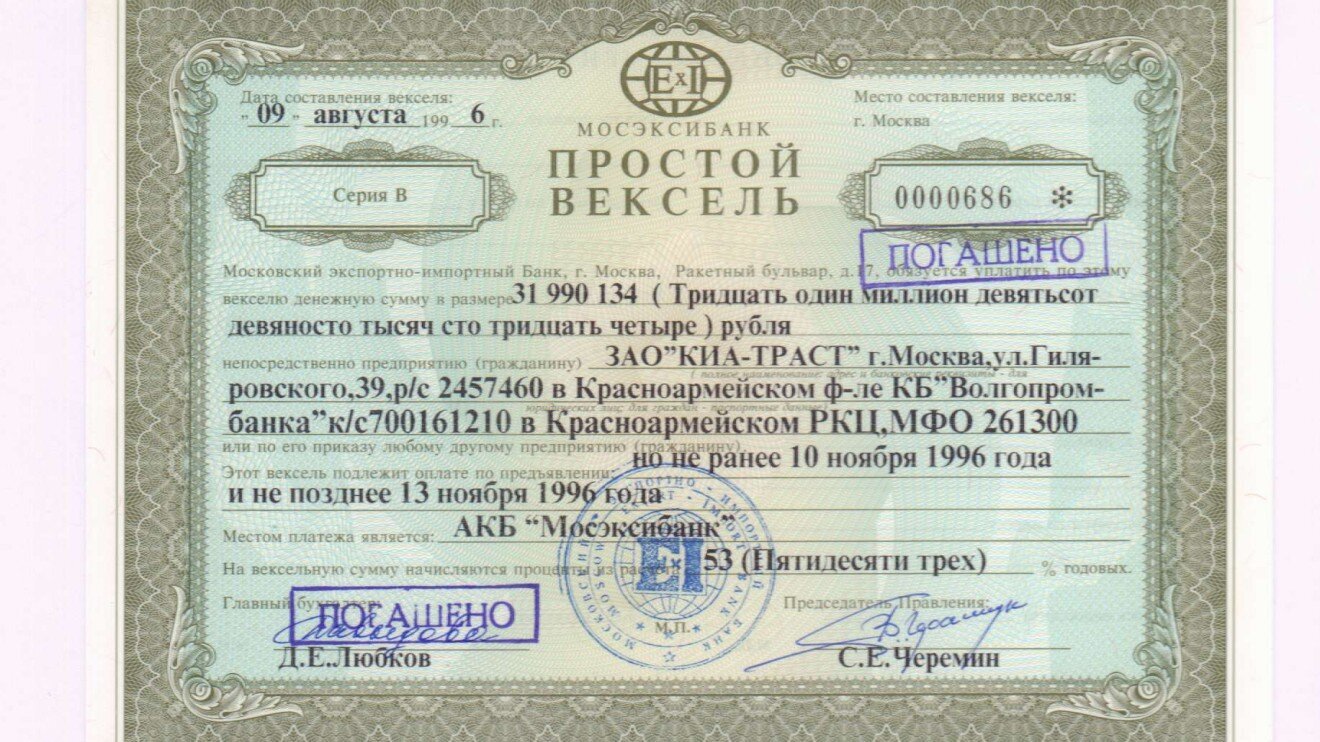
A promissory note (Russian: vexel, from the German Wechsel) is a security representing an unconditional monetary obligation, drawn up in a strictly defined form. It certifies an unconditional obligation of the drawer (a simple/sola promissory note) or another payer named on the note (a bill of exchange) to pay a specified sum to the note's holder upon its maturity.
The Promissory Note's History in Russia
Promissory notes appeared in Russia during the reign of Peter the Great as a means of transferring state funds between cities. Note circulation was formally introduced by the Promissory Note Statute of 1729. In pre-revolutionary Russia, the note became an important instrument of trade, linking manufacturers and merchants.
After the revolution, promissory notes saw active use during the New Economic Policy (NEP) era. In 1937 the USSR joined the Geneva Convention on bills of exchange, adopting the Regulation on Bills of Exchange and Promissory Notes. But with the abandonment of NEP and the shift to a command economy, promissory notes fell out of circulation.
The Revival of Promissory Notes in the 1990s
Promissory notes returned to the Russian economy starting in 1991, when a resolution of the Presidium of the RSFSR Supreme Soviet permitted use of the 1937 Regulation on Promissory Notes. The early 1990s were marked by an acute shortage of working capital, broken economic ties, and high inflation — fertile ground for the growth of note circulation.
Reasons for the popularity of promissory notes in the early 1990s:
- The non-payment crisis — notes let businesses keep operating amid a shortage of cash
- Ease of issue — unlike bonds, notes required no complicated registration procedures to issue
- Tax avoidance — note-based schemes were often used to minimize taxes
- Use as a means of settlement — notes were transferred by endorsement, standing in for non-cash payments
- A tool for raising financing — companies issued notes as an alternative to bank loans
- The possibility of bank discounting — a business could sell a note to a bank before maturity, getting immediate financing
The early 1990s also saw the emergence of bank-issued promissory notes, used as a tool for raising funds. Some banks issued notes to attract deposits from the public, offering higher rates than on standard savings accounts.
Promissory Note Fraud
Weak regulation and imperfect legislation turned promissory notes into a tool for numerous fraud schemes. The novel mentions the possibility of forging notes using computer technology. Indeed, in the 1990s, fraud involving forged notes from major banks and companies was widespread.
A defining feature of the promissory note is its «unconditional character» — once the note matures, the holder is entitled to collect the note's value through a simplified legal procedure. This made notes attractive for building schemes of illicit enrichment.
By the late 1990s, as the economic situation improved and legislation was refined, the role of promissory notes in the economy began to shrink, though they remained an important financial instrument, especially in corporate finance.