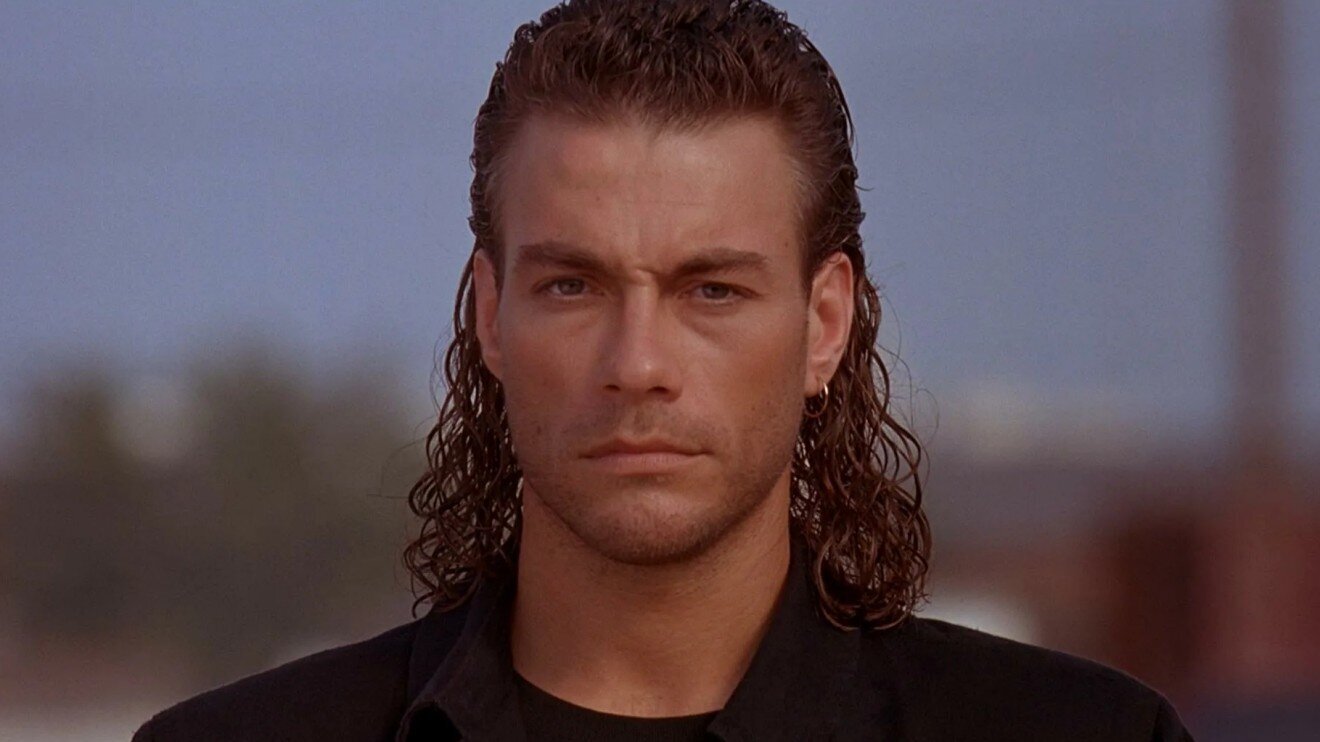
Key facts
Full name: Jean-Claude Camille François Van Varenberg
Born: October 18, 1960
Birthplace: Berchem-Sainte-Agathe, Brussels, Belgium
Profession: Actor, martial artist
Jean-Claude Van Damme (real surname Van Varenberg) is a Belgian actor and martial artist who became one of the most recognizable action stars of the 1980s and 1990s. Nicknamed the "Muscles from Brussels," he embodied the archetype of the Hollywood hero — a man of few words with a cold, piercing gaze.
The road to fame
Martial arts as a foundation
Van Damme began training in martial arts at age ten, when his father enrolled him in a Shotokan karate school. By eighteen, he had reached the level of 2nd-degree black belt. His athletic achievements included:
- Winning the European Professional Karate Association middleweight championship (1979)
- The title of "Mr. Belgium" in bodybuilding (1978)
- A full-contact fighting record: 18 wins (all by knockout), one loss
Interestingly, at age 16 he also studied ballet for five years, which, in his own words, helped him develop the flexibility and coordination needed for his future stunts.
Moving to America
In 1982, at age 22, Van Damme sold his successful "California Gym" in Brussels, which brought in $15,000 a month, and moved to Los Angeles with a dream of becoming an actor. The start was hard: he worked as a limousine driver, a bouncer at a bar owned by Chuck Norris, and a private karate instructor.
His breakthrough: "Bloodsport" (1988)
The turning point came with "Bloodsport," released February 26, 1988. Made on a budget of just $1.5 million, the film became a box-office hit and turned Van Damme into a star. He played US Army Captain Frank Dux, competing in the underground martial-arts tournament "Kumite" in Hong Kong.
Before "Bloodsport"
- 1984: An extra in "Breakin'"
- 1984: A stunt double in "Missing in Action"
- 1986: A Russian villain in "No Retreat, No Surrender"
- 1987: A brief part in "Predator" (cut from the final film)
After "Bloodsport"
- 1989: "Cyborg," "Kickboxer"
- 1990: "Lionheart," "Death Warrant"
- 1991: "Double Impact"
- 1992: "Universal Soldier"
His peak years (1988-1996)
By 1993, Van Damme had become one of the highest-paid action stars. His fee for "Nowhere to Run" was $3.5 million. This period produced his most famous work:
| Year | Film | Box office | Notes |
|---|---|---|---|
| 1989 | "Kickboxer" | $50M on a $3M budget | Launched a franchise |
| 1992 | "Universal Soldier" | $102M on a $23M budget | Co-starring Dolph Lundgren |
| 1994 | "Timecop" | Over $100M | The actor's highest-grossing film |
| 1994 | "Street Fighter" | Tripled its budget | A video game adaptation |
Working with Hong Kong directors
Between 1993 and 1998, three outstanding Hong Kong directors made their Western debuts working with Van Damme:
John Woo
"Hard Target" (1993) — the first American film from the master of "heroic bloodshed"
Tsui Hark
"Double Team" (1997) — a science-fiction action film with Dennis Rodman
Ringo Lam
"Maximum Risk" (1996) — the director and actor's first collaboration
A cultural phenomenon
Sex-symbol status
Unlike his chief rivals in the action genre — Arnold Schwarzenegger, Sylvester Stallone, Steven Seagal, and Bruce Willis — Van Damme was the only action star to make the National Enquirer's list of the "10 Sexiest Men in the World." He reached sex-symbol status in the late 1980s and early 1990s.
Signature moves
Van Damme became known for his acrobatic stunts, especially the splits, which he could perform between two chairs or moving trucks. Director Sheldon Lettich noted that the actor's display of his own physique "became his trademark."
His influence on pop culture
Van Damme's popularity opened the door to Hollywood for action stars like Don Wilson, Olivier Gruner, Dale Cook, and Loren Avedon. His films spawned countless sequels, even ones he himself had no part in.
Personality and method
His philosophy of martial arts
Van Damme studied various martial arts: Shotokan karate, kickboxing, taekwondo, and muay Thai. He considered ballet, which he practiced for five years, "one of the most demanding sports of all." This wide-ranging training let him perform complex stunts without a stunt double.
Screen idols
Among the actors who inspired Van Damme in his youth:
- Charles Bronson
- Bruce Lee
- James Dean
- Montgomery Clift
- Steve McQueen
- Jean-Paul Belmondo
- Sylvester Stallone
Athletic achievements
Full-contact fights (1977-1982):
- 18 wins (all by knockout)
- 1 loss
- Member of the Belgian national team
- European karate champion (1979)
His on-screen persona
Van Damme created a recognizable archetype of the 1990s Hollywood hero: a muscular, taciturn fighter with a European accent, capable of extraordinary physical feats. His characters were often alienated loners, battling against overwhelming forces of evil.
The typical Van Damme hero
- Athletic build
- A cold, piercing gaze
- Long hair (in his early films)
- A European accent
- Few words
- Inner pain or tragedy
- A moral code
- Superior fighting skill
His standing in film history
By 1993, Van Damme had become one of the most recognizable action stars in the world. His films grossed more than $3.3 billion worldwide combined, making him one of the most successful stars the genre has ever had.
Cultural influence
Van Damme influenced an entire generation of martial artists, athletes, and actors. Among those who have cited him as an inspiration: Will Smith, Georges St-Pierre, Conor McGregor, Anderson Silva, Lyoto Machida, and many other MMA and film stars.
The "Muscles from Brussels" phenomenon
The nickname "Muscles from Brussels" became synonymous with Van Damme himself, and a symbol of the era. He represented a unique blend of European refinement and American brutality, setting him apart from the typical Hollywood heroes of the time.
Schwarzenegger
The Austrian "Terminator," a killing machine
Stallone
The American "Rocky," an underdog fighter
Van Damme
The Belgian "master," a warrior-philosopher
Technical skill
Unlike many action stars, Van Damme performed most of his own stunts, thanks to his martial arts training. His signature moves included:
- The splits: His famous full split, often performed under extreme conditions
- High kicks: Head-level spinning kicks
- Acrobatics: Flips, somersaults, jumps
- Balletic movement: Graceful motion, contrasting with the brutality of combat
His legacy and influence
By 1993, Van Damme had become a symbol of the video-rental era, when martial-arts action films were living through a golden age. His films set the standard for the genre for a decade to come, and established a formula for a successful action film: a charismatic hero + spectacular stunts + a simple but effective story.
The Van Damme formula for success
Physical training
Genuine martial arts skill
Screen charisma
A unique look and manner
Spectacle
Impressive stunts, no stand-in
Accessibility
Simple, easy-to-follow stories
Jean-Claude Van Damme became not just an actor, but a cultural phenomenon, embodying the spirit of his era and defining the image of the Hollywood action hero. His influence on film and popular culture is still felt today, and the nickname "Muscles from Brussels" remains a symbol of an entire era in the history of action cinema.
Note prepared for the novel "Russia 1993," based on biographical data about Jean-Claude Van Damme and his career up to the period in question.