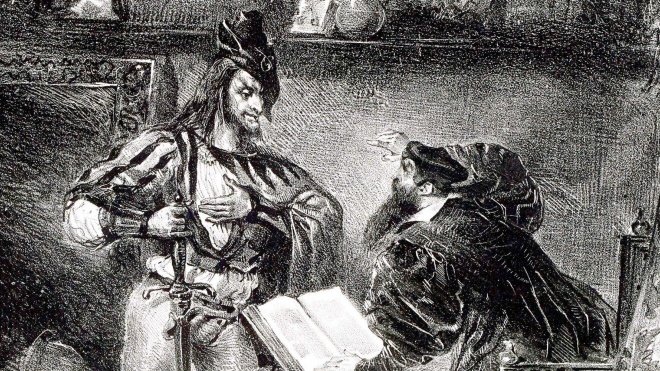
The gentleman relaxed his facial muscles into a neutral expression:
— You're a reasonable man. You know what you need to know. In your world, this place is called hell. There are no devils here, no cauldrons of sinners. There's you, me, and no one else. By the way, do you believe in God?
— No.
— Why so categorical? Imagine there's a universe in which the thinking functions of the so-called God are handled by an information field, called the Universal Mind. The physical functions — those are mine, the Creator's. Two foundations of the universe: one thinks, the other creates. Got it?
— No...
— I'll go on. The Mind and I have a hobby, which is also a subject of dispute between us — people. We created humanity so that I'd get physical assistants in building paradise on Earth. It went sideways. In your opinion, why is a person born?
— To live.
— Live how?
— Well, I suppose.
— Well for everyone, or well for yourself?
— What's the difference?
— None. Help yourself.
A plate of little pastries appeared on the table. I looked closer: not pastries exactly, but small pastry baskets about the size of a coin, filled with bits of fish and meat, caviar, and all sorts of unidentifiable things. They stood four to a row, in three rows.
— The tartlets will help us, — the gentleman remarked.
Whoa! Where had those come from?
I looked around... realized I'd mixed the word up with starlets and tarts off the covers of video cassettes. I took a pastry, swallowed it whole without chewing. I chewed the second one. The third, fourth, fifth I savored. A glass of water appeared on the table. Washing them down, I worked out a strategy: black caviar goes last, red — second to last, right! we finish with the fish, so... no more fish left... then cheese and cottage cheese, and right now, some unidentifiable vegetable!
I finished them off in a couple of minutes.
The gentleman snapped his fingers. White walls rose up around the perimeter. The table shrank down to dining size. The empty plate filled up again with the same tartlets.
— Here's a scenario, — the gentleman appeared at my side. — You've been wandering the desert for a week, on the verge of starvation. You walk into a room, there's food on the table. What's your strategy?
— Eat.
— And eat it all?
— Yes!
— Logical! Let me clarify: eleven more people will come in after you. Will you eat it all, or just one tartlet?
— One!
— The one with black caviar? — the gentleman's eyes flashed with amusement. — Now, a further clarification: the guy who comes after you will gobble down eleven of them and won't care who's left hungry. What do you do?
I froze, my conscience and brain grinding against each other. In good conscience, I should explain to the guy that I ate one tartlet and his share is the same. If he doesn't get it, slap him. My brain strained: since when do I go around slapping strange men?
— Let's change the conditions. — The gentleman didn't press me into a logical corner. — It's not grown men who walk into the room, but scrawny wretches after a week in the sands. They walk in with a choice: eat one tartlet and starve to death tomorrow, or eat two and live until the day after.
I didn't understand a thing. The gentleman went on:
— To survive, you need to eat twelve. The first person into the room can eat it all and survive. The rest will die. Or he can eat one and die, like everyone else. Or he can eat nothing and die, but in that case the second person will survive, if he's smart enough to eat twelve. If he too, out of conscience, eats just one, then no one survives. And so on, until the first smart one who gets all twelve.
I still didn't understand any of it. Tartlets, twelve, dying... What was the logic here?
— The logic is simple: the first smart one gets everything, — the gentleman said, pausing between words and stressing the hard consonants in each one. — This isn't a Young Pioneer troop, where it's one for all and all for one.
For the third time, I understood nothing. With a snap of his fingers, the gentleman brought back the setting with the red sky and the granite table:
— Let's not go deeper into philosophical thickets. Sell me your soul.
There he goes again! Same thing over and over. I won't sell it! Why would I need a soul that doesn't even exist?!
— Nobody needs your soul — what's needed is a bill of sale, — the gentleman read my thoughts. — I was created by the Mind to do good in the universe. I was against the creation of other rational beings. There should be only one mind, just as there's only one creator. But things turned out the way they turned out. I'm not capable of doing good for billions, but I can manage two or three million. The contract is your application to join the club of the lucky few.
It got as boring as a political briefing at a Soviet school. The gentleman tapped the tabletop with his index fingernail to get my attention, and offered:
— The term «selling your soul» sounds macabre. I'm offering you a contract for improving your life.
What did «macabre» mean? And how would my life improve?
— Once the contract is signed, you'll always and everywhere be the first smart one. And unfamiliar words won't bother you anymore. That's clause one of the contract. Clause two. I do your personal good, always and everywhere. That's what I was made for. But remember the tartlet example: you ate your fill and stayed alive, eleven people died. You'll answer for those eleven deaths later... here.
— How?
— You'll fight wars in the desert, break rocks in quarries, brawl in barracks, freeze in cages, and flee from beasts. You'll suffer, agonize, die, and rise again.
— And if I don't sign?
— Your choice. You'll go back to your old life, but after death you'll end up here. That's your fate. You've already been here, and you'll be back without fail.
— And if I sell my soul? What do I get once I'm here?
— The same thing: you'll fight wars in the desert, break rocks, brawl, freeze, flee, suffer and agonize, die and rise again, but... Before that, you'll get to enjoy life. You'll get everything you wish for. Splendid, isn't it?
— Splendid. What I don't understand is something else: the people who don't end up here — where do they go?
— No idea. Some go back and live a new, better life. The rest swim in milk and honey and fly through the air. Doesn't interest me. I'm a practical man. Tell me, can bliss be eternal? Think back on yourself. When you were dying of thirst, what did you want? To drink. Once you'd been given water, you wanted to eat. Once you were fed, you burned with passion for a girl. I understand what you were after. And if you'd gotten it? Would you have had a wedding? What then? A new desire? A limousine, palm trees, a mistress... A person is a spiral of desires, wound around instincts. Unfortunately, Homo sapiens is built so that even landing in paradise, he'll suffer and agonize just as before. Remember the blue room with the girl? A perfect model of paradise. So accept the fact: you have no choice, and you never did. You can only choose from what I offer — fame, wealth, power, sensations you couldn't otherwise reach.
– No, – I blurted, racing through the school literature curriculum in my head. What grade did we study Goethe in? What was «Faust» about? How is the plot built and what is the secret? The banned «Master and Margarita», lent to me to read overnight! What was Woland preaching there? Or that other one, what’s his name, Pontius Pilate? There was a secret in those books! Every work of literature must have a meaning for the instruction of posterity!
As if to spite me, nothing came into my head except the film «Little Tragedies» with the words «I am bored, demon». Though I did recall the words of Joseph Vissarionovich: «This thing is stronger than Goethe’s «Faust»».
Nothing more. Though, wait... Annushka has spilled the oil!
The gentleman smiled, watching my mental struggles.
— I hope that's not your final answer, — he said, folding his prayer beads and tucking them into a side pocket.
A ring with a red-eyed gem flashed as he drew out from beneath the tabletop a small, sparkling crystal sphere, about the size of a chicken's egg. He rolled it through the air toward me.
The sphere didn't fall and shatter. No — shimmering with rainbow colors, inexplicably growing larger, it floated toward me like a soap bubble. I watched as the magical sphere drifted up to me and... ah!... brushed me with its gaseous surface, raising the hair on my body, and breathed out a scent of menthol. The sphere swallowed me, shrinking and warping space. I felt myself rising toward the red sky, leaving the gentleman below...