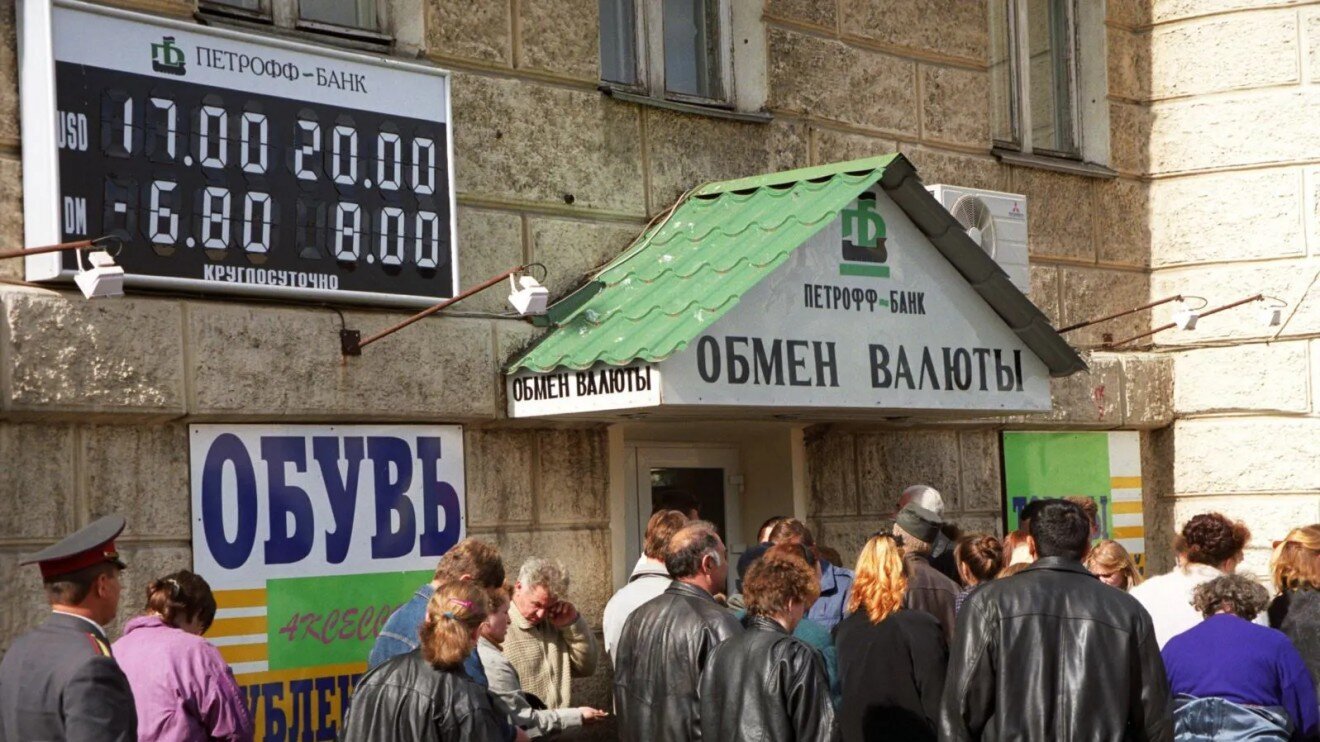
August 17, 1998, went down in Russian history as «Black Monday» — the day the government declared a technical default on its government debt obligations, triggering a collapse of the banking system and a catastrophic devaluation of the ruble.
What a Technical Default Is
A technical default is a state’s inability to meet its debt obligations on time and in full. Unlike full bankruptcy, a technical default still allows for restructuring the debt under new terms.
Russia’s 1998 default was unique in world history — the first time a state had defaulted on domestic debt denominated in its own national currency. Before this, such crises had only ever involved foreign debt denominated in foreign currency.
The Events of August 17
Just three days before the catastrophe, on August 14, President Boris Yeltsin had flatly declared: «There will be no devaluation. I state this firmly and clearly.» But on the morning of Monday, August 17, Prime Minister Sergei Kiriyenko was forced to announce the introduction of «a set of measures aimed at normalizing financial and budget policy.»
The government and the Central Bank simultaneously announced:
- A technical default on government short-term bonds (GKOs) and federal loan bonds (OFZs)
- An end to support for the artificial ruble exchange rate, moving to a floating rate
- A 90-day suspension of obligations to non-residents on loans and collateral transactions
- A halt to trading in government short-term bonds
The Scale of the Catastrophe
By the time of the default, Russia’s government debt had reached critical levels — roughly $200 billion, or 44% of GDP. Obligations to non-residents in the GKO and OFZ market alone exceeded $36 billion, with annual payments around $10 billion. Meanwhile, the Central Bank’s gold and foreign-currency reserves totaled only $24 billion.
Yields on government short-term bonds had reached fantastic levels by summer 1998 — 49.2% in the second quarter, compared to 19% in the third quarter of 1997. Short-term lending rates had jumped from 16.6% to 44.4%.
Immediate Consequences
The reaction of financial markets was swift and devastating. The Central Bank set new currency-corridor boundaries of 6 to 9.5 rubles per dollar, but it didn’t help — the dollar exchange rate shot up from 6.50 rubles to more than 20 rubles within a few weeks.
Huge lines immediately formed outside banks that had stopped honoring withdrawals. Panic spread among the population — people stormed bank branches trying to pull out their savings. Many banks couldn’t withstand the mass outflow of funds and declared bankruptcy.
The Collapse of the Banking System
The banking system suffered catastrophic losses. 288 mid-size and small banks closed, along with major market players, including Inkombank. The Central Bank regularly circulated confidential ratings, sorting banks into four categories, from reliable to slated for immediate closure.
According to the Moscow Banking Union, the default caused roughly $96 billion in total damage, of which $45 billion was direct losses to commercial banks.
Political Consequences
The default immediately triggered political change. Soon after August 17, Prime Minister Sergei Kiriyenko and Central Bank chief Sergei Dubinin resigned. Yevgeny Primakov was appointed the new prime minister, communist Yuri Maslyukov became first deputy prime minister, and Viktor Gerashchenko took over the Central Bank.
Western media didn’t hold back in criticizing the Russian leadership. The British magazine The Economist wrote of a «rush to the abyss,» while the American Forbes compared the situation to the revolutionary period of 1917, calling Yeltsin’s government «a gang of opportunists.»
Its Significance in Russian History
August 17, 1998, became a turning point in Russia’s modern history. The day closed out a period of economic experimentation in the 1990s and laid the groundwork for the reforms that followed. Paradoxically, the catastrophic default ultimately helped put the Russian economy on a healthier footing, though the cost of that «cure» proved extremely high for millions of Russians.