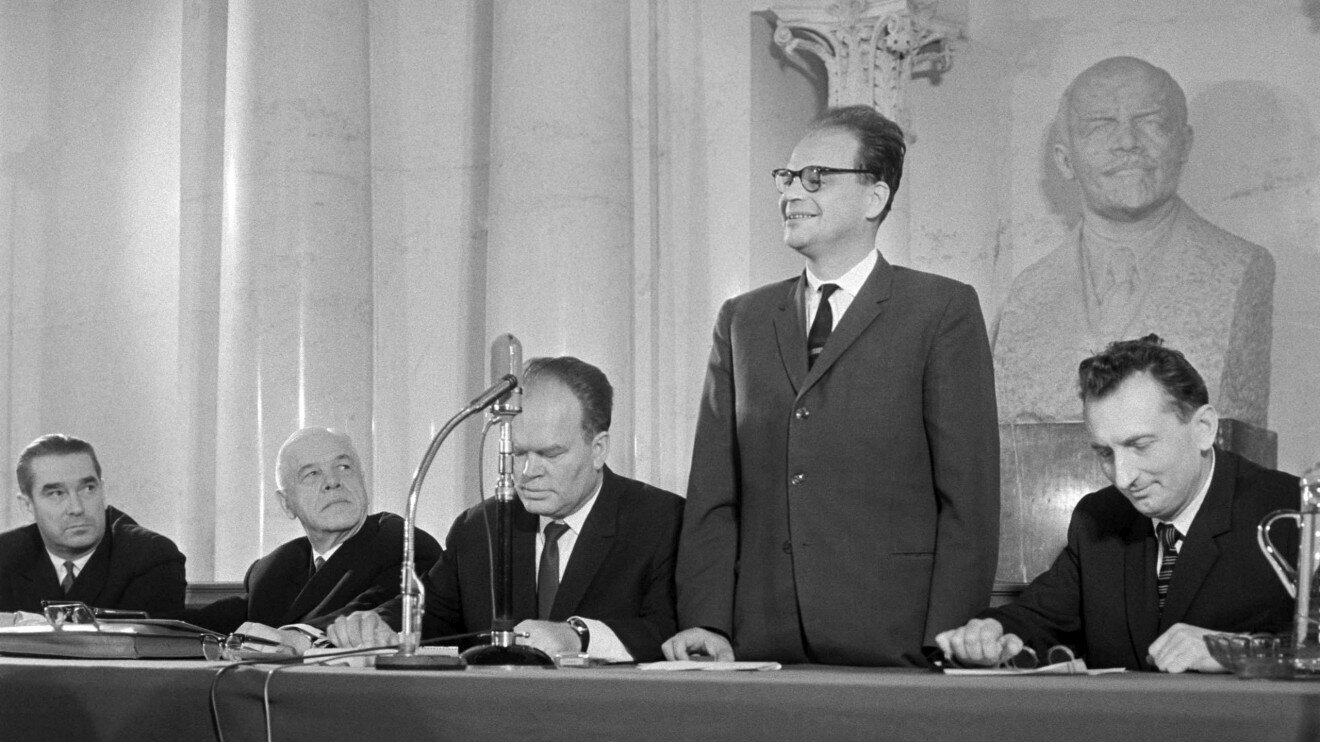
Nikolai Gennadiyevich Basov (December 14, 1922 – July 1, 2001) was an outstanding Soviet and Russian physicist, one of the founders of quantum electronics, and a winner of the 1964 Nobel Prize in Physics. By 1993, when the events of the novel take place, Basov was one of the most significant figures in Soviet and Russian science.
Scientific Achievements
Basov’s principal scientific achievement was establishing the principle of amplifying and generating electromagnetic radiation using quantum systems. Together with Alexander Mikhailovich Prokhorov, he laid the theoretical groundwork in 1952 that led, in 1954, to the creation of the first quantum generator — a maser based on a beam of ammonia molecules. This discovery launched an entirely new field of physics: quantum electronics.
In 1955, Basov and Prokhorov proposed a three-level scheme for creating population inversion, which found wide application in masers and lasers. For this foundational work, Basov, Prokhorov, and the American physicist Charles Townes were awarded the 1964 Nobel Prize in Physics «for fundamental work in the field of quantum electronics, which has led to the construction of oscillators and amplifiers based on the maser-laser principle.»
Development of Laser Technology
Basov made a significant contribution to the development of various types of lasers. Together with Yuri Popov and Boris Vul, he developed ideas for creating semiconductor lasers. The first injection laser was built in 1962, followed by electron-beam-excited lasers, and, in 1964, optically pumped semiconductor lasers.
Under Basov’s direction, powerful gas and chemical lasers were developed, including hydrogen-fluoride, iodine, and excimer lasers. He originated the idea of using lasers for controlled thermonuclear fusion (1961), proposed methods for laser heating of plasma, and analyzed the processes by which laser radiation could stimulate chemical reactions.
Connection to MEPhI
The novel’s mention of MEPhI is no accident. Basov did in fact graduate from the Moscow Engineering Physics Institute in 1950, defending his diploma after serving in the army during the Great Patriotic War. Even as a student, starting in 1948, he worked as a laboratory assistant at the Lebedev Physical Institute of the USSR Academy of Sciences (FIAN), where he continued his career after receiving his degree.
In 1978, Basov organized and headed the Department of Quantum Electronics at MEPhI, later renamed the Department of Laser Physics. This department became one of the leading centers for training specialists in laser technology and quantum electronics in the USSR and Russia.
Administrative and Public Life
By 1993, Basov held senior positions in the scientific hierarchy. From 1973 to 1989 he served as director of FIAN, one of the country’s leading physics institutes. From 1963 he headed the Laboratory of Quantum Radiophysics, which he had founded, leading it until the end of his life.
Basov had been a full member of the USSR Academy of Sciences since 1966, a member of the Presidium of the USSR Academy of Sciences (1967-1990) and of the Russian Academy of Sciences (from 1991). He served as editor-in-chief of the journals «Quantum Electronics» and «Priroda» («Nature»), and sat on the editorial board of «Kvant.» From 1978 to 1990 he chaired the board of the All-Union «Knowledge» Society.
Recognition and Awards
Basov was twice named Hero of Socialist Labor (1969, 1982) and received five Orders of Lenin. Besides the Nobel Prize, he received the Lenin Prize (1959) and the USSR State Prize (1989). His international honors include the Gold Medal of the Czechoslovak Academy of Sciences (1975), the A. Volta Gold Medal (1977), and the M.V. Lomonosov Grand Gold Medal (1990).
In 1993, during the period the novel is set in, Basov remained scientifically active, still one of the most respected scientists in Russia. His name was well known not only in scientific circles but among the general public as well, a symbol of Soviet achievement in fundamental science and advanced technology.