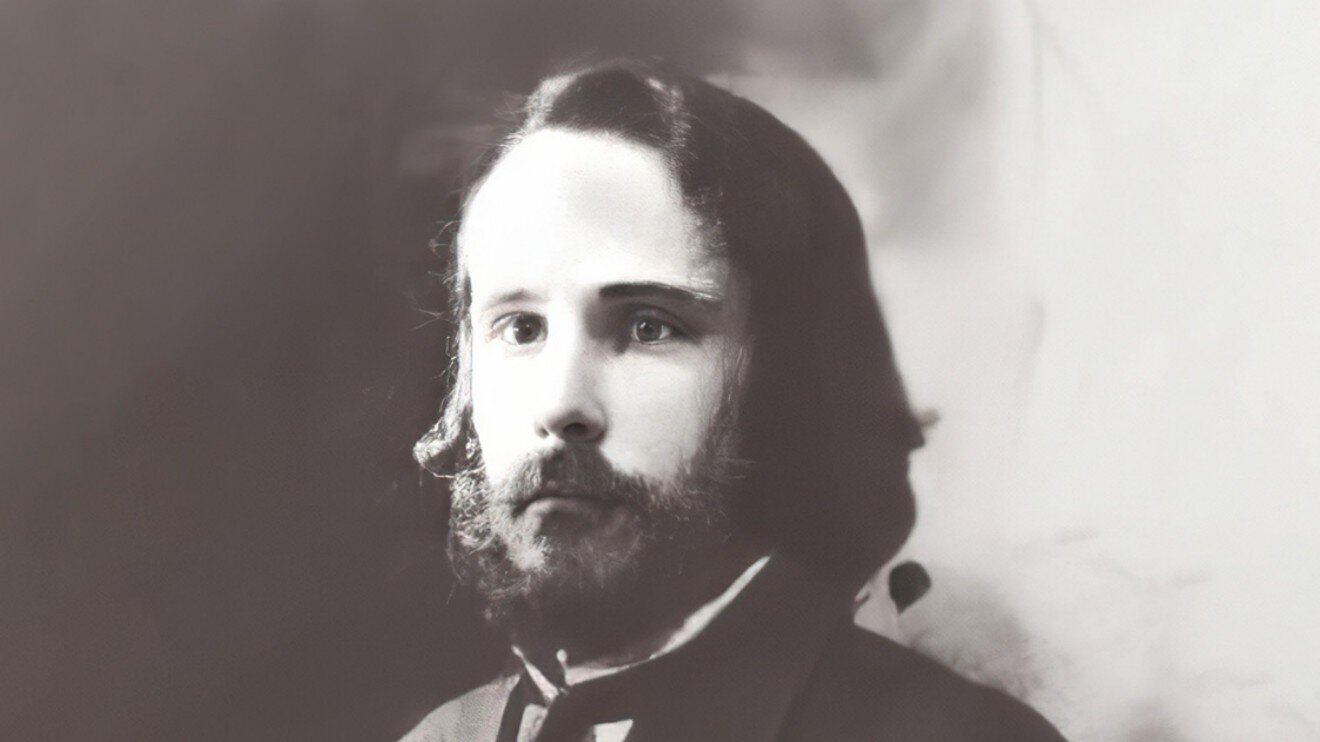
The quotation from Zhorik's line, "July has come, the bees are fucking," refers to one of the most scandalous poems in early-20th-century Russian literature, written by the poet Alexander Tinyakov in 1914. This poem became a symbol of extreme naturalism and provocation in Silver Age poetry, and Tinyakov himself went down in history as one of the most contradictory and tragic figures in Russian literature.
Biographical background
Alexander Ivanovich Tinyakov (1886-1934) was a Russian Silver Age poet, born in the village of Bogoroditskoye, in Mtsensk district, Oryol province, into a well-off peasant family. In 1897, he entered a gymnasium in Oryol, where his literature teacher was F.D. Kryukov, but in 1903 he dropped out without finishing, and left for Moscow to pursue self-education.
In Moscow, Tinyakov met Leonid Andreyev and A. Serafimovich on his former teacher's recommendation. At the "Skorpion" publishing house, he met Valery Bryusov, who rejected his poems but made a huge impression on the young poet, becoming his lifelong idol.
Tinyakov's first publications appeared in 1903 in the newspaper "Orlovsky Vestnik"; in 1904, several poetic sketches appeared in the almanac of the "Grif" publishing house. He was occasionally published in the Symbolist journals "Vesy," "Pereval," and "Zolotoye Runo," though most of his poems were rejected. He became acquainted with Boris Sadovskoy, Vladislav Khodasevich, Nina Petrovskaya, Lyubov Stolitsa, and Sergei Klychkov.
In 1914, Tinyakov moved to St. Petersburg, where he attended the famous salon of Dmitry Merezhkovsky and Zinaida Gippius, and became a regular at the literary café "The Stray Dog." He became acquainted with Anna Akhmatova, Nikolai Gumilyov, Igor Severyanin, A. Kondratyev, and Georgy Ivanov. He took the pen name "Odinoky" ("The Lonely One") from August Strindberg's novel of the same name, whom he tried to imitate.
Creative path and literary reputation
His first collection and Symbolism
Tinyakov's first book, "Navis nigra" ("The Black Ship"), came out in 1912, when interest in Symbolism had already somewhat faded. Nonetheless, the book was praised in print by such masters as V. Bryusov, K. Balmont, and I. Bunin. In poetry, Tinyakov began by imitating Bryusov, and joined the Symbolists. Most of the poems in "Navis Nigra" were typical Symbolism of the period, with characteristic rhymes in the vein of "blood — love," "sobbing — suffering," "firmament — death," and themes of unrequited or forbidden passion, decay, and decadence.
The poetry of the "low"
Yet already in his first collection, the main feature of Tinyakov's poetics emerged — a gift for illuminating the low, repulsive sides of life that other poets avoided. This was not simply a matter of writing poems about prostitutes and the urban underbelly (nothing new for the Silver Age), but of descending into the very filth, into the absolute baseness of existence.
In "Navis Nigra," he included poems written from the perspective of a spider, garbage on a dump, and even human spit. The poem "A Little Gob of Spit" became early Tinyakov's calling card, and demonstrated his ability to find poetry in the utterly repulsive. These "vile, foul little verses," associated with the lowest of men reveling in his own baseness, turned out to be the best thing Tinyakov left behind. When he tried to write beautifully, loftily, and obscurely, the result was dull imitation.
Provocation and shock
Contemporaries recalled that the young Tinyakov looked very presentable — in photographs from the early 1910s he resembled Jesus, was serious and deferential, and had undeniable success with women. His own poems, however, were banal, and caused no sensation — neither admiration nor outrage. For Tinyakov, who dreamed of being known as either a prophet or a blasphemer, such a reaction was the worst outcome of all.
The poet Vladislav Khodasevich recalled: "He would throw himself from one extreme to the other. From time to time I received letters from him. One would say that he had finally turned to God, that Russia's path was one of holy struggle, that she was a light unto the world, and so on. A few months would pass — and Russia turned out to be a dung heap, and a death sentence was pronounced upon the Lord God." Tinyakov's behavior was indeed erratic: when the First World War broke out in August 1914, he shouted on the Fontanka embankment, "Long live Emperor Wilhelm!" — and then wrote patriotic verse in praise of Russian arms.
The 1916 scandal
In 1916, Tinyakov did something that finally ruined his reputation in literary circles. He openly published in the Black Hundreds newspaper "Zemshchina," although he had previously written for the moderately democratic "Rech'." In "Zemshchina," he published an antisemitic article, "Russian Talents and Yid Raptures," devoted almost entirely to Sergei Yesenin. After this, many former friends turned away from him, though Tinyakov never became famous.
Revolution and the Soviet period
A change of allegiance
From 1917 to 1920, Tinyakov lived in Oryol, publishing in local newspapers. Reports by Khodasevich and Georgy Ivanov that Tinyakov worked for the Cheka are probably unreliable. At the end of 1920, he returned to Petrograd.
After October 1917, the former Black Hundreds member Tinyakov sided with the Bolsheviks, and for several years wrote the propagandistic verse typical of the time. In autobiographical fragments from 1925, he recalled: "I began writing for the Soviet press in 1918 and have continued to this day, having published in that time hundreds of political articles and poems (under various pseudonyms), and even more literary articles and reviews."
Scandalous collections
In 1922 and 1924, two collections of Tinyakov's poems appeared — "The Triangle" and "Ego sum qui sum" ("I Am That I Am"). In them, the poet continued his line of nihilistic verse in praise of everything negative. "Ego sum qui sum" included the poem "The Joy of Life" (1921), which finally cemented Tinyakov's reputation as a finished, degraded man.
This poem provoked particular fury for mentioning Nikolai Gumilyov, executed in August 1921. Tinyakov defended himself, claiming in the book's preface that "these verses were written more than a month before Gumilyov's death, and I read them to my literary acquaintances at the time." He explained that the poet's mission was "to reflect the manifestations of life," and that if he wrote verse in the voice of a man who delighted in looking at other people's corpses, this was merely a recording of reality.
The Soviet writer Mikhail Zoshchenko would later say of Tinyakov's verse: "The history of our literature has probably never known cynicism, or human degradation, to any comparable degree."
After reading the book "Ego sum qui sum," Daniil Kharms wrote in his diary: "Poems should be written such that if you threw the poem through the window, the glass would break." Kharms was acquainted with Tinyakov, and the contemporary literary scholar Gleb Morev suggests that Tinyakov served as the prototype for the hero of Kharms's later story "The Knight."
His transformation into a beggar
A new "profession"
In 1926, Tinyakov became a professional beggar. He had his "own" spot on the corner of Nevsky and Liteiny Prospects. Mikhail Zoshchenko described him thus: "I saw him once on the corner of Liteiny. He stood bareheaded. He bowed low to everyone who passed by. He was handsome. His graying head was almost magnificent. He looked like Jesus Christ. And only an attentive eye could see in his face something terrible, repulsive — the mug, with its frozen little smile, of a man who has nothing left to lose."
Around Tinyakov's neck hung a piece of cardboard reading "Give to a former poet." Zoshchenko called him "the Smerdyakov of Russian poetry." According to Zoshchenko's recollection, Tinyakov told him, "laughing and giggling," that begging earned him more than writing, and when reproached for the degradation of it, he answered: "It's degrading not to eat. It's degrading to croak before your time. Nothing else is degrading."
Possible reasons
Zoshchenko and many other contemporaries interpreted Tinyakov's begging as the result of his final descent into drink. But the literary scholar Gleb Morev suggests another explanation: perhaps Tinyakov decided he no longer wanted to work for the Soviet regime, glorifying Red Army soldiers and Stalin. And since no one would publish his decadent poems under the new regime anyway, better to become a beggar. Tinyakov himself submitted a resignation letter to the Writers' Union — "on grounds of the incompatibility of Union membership with begging."
Monarchist poems
In the late 1920s, as the times grew harsher, Tinyakov read openly monarchist poems to his acquaintances. He wrote verse directed against Soviet power, mocking party leaders:
- "Chicherin is at a loss and Stalin is sad, / All that's left of the party is a heap of rubble"
- In "Reflections at the Mikhailovsky Castle" (1927), he pined for Nicholas II, though only eight years earlier he had rejoiced that the revolution had "smashed the throne of Nicholas the Talentless"
Arrest and death
In August 1930, Tinyakov was arrested for begging and "publicly reading counter-revolutionary verse." Under interrogation by the OGPU, he declared that he "hated the White Guard no less than the Bolsheviks," and "dreamed of the patriarchal order of the distant past, of the times of Ivan III and Dmitry Donskoy." He was sentenced to three years in the camps, serving his term at Solovki.
After his release, he returned to Leningrad. He died on August 17, 1934, in the Hospital in Memory of the Victims of the Revolution.
Personality and reputation
Contemporaries' impressions
His contemporaries unanimously described Tinyakov as a repulsive person. The Soviet researcher Vardvan Varzhapetyan, trying to gather information about the poet in the late 1960s, received these characterizations from long-lived witnesses who had known him:
- "For some reason he always seemed hunchbacked to me, though he was even handsome. Inside, he was hunchbacked!"
- "There was always something vile emanating from him. Repulsive, false, and dangerous."
- "A curiosity, in a way. A truly loathsome type!"
A philosophy of unscrupulousness
Tinyakov deliberately flaunted the most repulsive things about himself: alcoholism, unscrupulousness, indifference to others. His 1914 "Sincere Little Song" declared:
"I utterly despise / Truth, conscience, and honor, / My only wish, in the end: / To carouse and whore and eat my fill."
In his autobiographical "Fragments of My Biography" from the 1920s, he wrote that he had always hated his mother — for being an educated "city woman" who brought discord into the family's patriarchal ways, and because of her Alexander had become interested in poetry, which had ruined him. He lamented: "If my father had married a healthy village girl, I would not be a failed man of letters, dying of hunger and even more of every kind of humiliation, but would now be running some District Communal Services office..."
Later he wrote in his autobiography: "Nature, politics, love, alcohol, debauchery, mysticism — all of this gripped me deeply and left indelible traces on my mind and soul." And he concluded: "But born a failure, one must go to the grave a failure, having told nothing of himself and left no trace whatsoever in life."
The significance of his work
A poetics of extreme naturalism
Tinyakov early became a "damned" poet of Russian literature. In fits of delirium tremens he was admitted to psychiatric hospitals, and depicted the most vile naturalistic scenes in his verse. His poetry represented an extreme case of naturalism in Silver Age Russian literature, going beyond every conceivable bound of decency.
The poem beginning with the words "July has come: the bees are fucking..." (1914) became one of the most scandalous texts of the era. In it, Tinyakov carried the idea of depicting "low" reality to the point of absurdity, creating a text that shocked even seasoned members of the bohemian world.
Influence on contemporaries and later generations
Despite universal contempt, Tinyakov had a certain influence on the literary process:
- His poetry of the "low" anticipated certain tendencies of the avant-garde and conceptualism
- His figure became a symbol of the literary outcast, the "damned poet"
- His diaries, published much later, are of interest as a document of the era
Interest in Tinyakov later revived following the publication of his extremely frank diaries. In 1998, a book of "Poems," edited by N. Bogomolov (Tomsk: Vodoley), was published, which, according to the newspaper "Knizhnoye Obozreniye," ranked among the "intellectual bestsellers" of the year.
Conclusion
Alexander Tinyakov remains one of the most contradictory figures in early-20th-century Russian literature. His work balanced on the line between art and tastelessness, provocation and revelation. Striving at all costs for scandalous fame, he created several texts that really were remembered by contemporaries and later generations — though not always for the reasons he had hoped.
Zhorik's quotation in the novel, "July has come, the bees are fucking," is a cultural allusion to Tinyakov's most provocative poem, knowledge of which was characteristic of a certain circle of educated people in the 1990s interested in the marginal figures of the Silver Age. The character's use of this quotation speaks to his literary erudition and taste for provocation, in keeping with the spirit of Tinyakov himself.
Tinyakov left behind no real fame — just thirty years after his death, Varzhapetyan struggled even to establish where the poet had ended his life's journey. But individual lines and phrases of his continue to live on in cultural memory as symbols of extreme literary provocation and marginality.