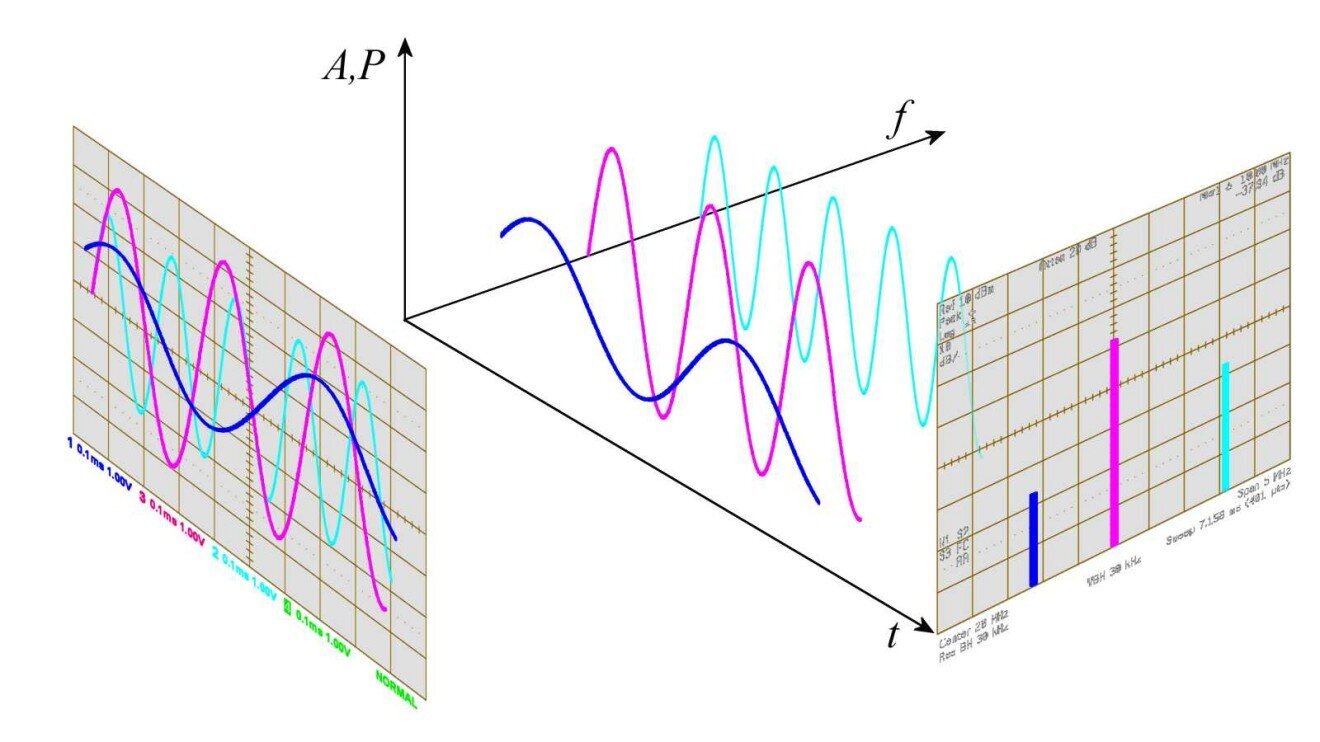
Amplitude (from the Latin amplitudo — magnitude, extent, greatness) is one of the fundamental concepts in physics, describing the maximum value of the displacement or change of a variable quantity from its mean value during oscillatory or wave motion. It is a non-negative scalar quantity whose dimension matches that of the physical quantity being measured.
Mathematical Description
In general, harmonic oscillation is written mathematically as:
x(t) = A(t) sin(ωt + φ) or x(t) = A(t) cos(ωt + φ)
where:
- x(t) — the deviation of the oscillating quantity at time t from its arithmetic mean over a period
- A(t) — the amplitude of oscillation, the maximum deviation from the mean value over a period
- ω — the angular frequency, in radians or degrees per second
- φ — the initial phase of oscillation, in radians or degrees
It’s worth noting that, in general, amplitude can depend on time — for instance, in a damped oscillator, where the system’s energy gradually dissipates.
Physical Meaning and Interpretation
Amplitude characterizes the «swing» of an oscillatory process and is directly linked to the energy of the oscillating system. The larger the amplitude, the greater the energy stored in the system. This holds for all types of oscillation — mechanical, electromagnetic, acoustic, and others.
In mechanical systems, amplitude defines the maximum distance an oscillating body moves from its equilibrium position. For a pendulum, for example, amplitude is the maximum angle of deflection from vertical; for a vibrating string, it’s the maximum transverse displacement from rest.
Amplitude Across Fields of Physics
Mechanical Oscillations
In mechanics, amplitude is measured in units of length (meters, centimeters, millimeters) and represents the maximum distance a body is displaced from equilibrium. This can be:
- The amplitude of a pendulum’s swing
- The amplitude of vibration in mechanical systems
- The amplitude of waves on a liquid surface
- The amplitude of deformation in elastic bodies
Sound Waves
For sound waves, amplitude usually refers to the amplitude of air-pressure variation in the wave, though it’s sometimes described as the displacement amplitude of medium particles relative to equilibrium. The logarithm of sound-pressure amplitude is typically measured in decibels (dB), reflecting the logarithmic nature of how the human ear perceives sound.
The amplitude of sound oscillations determines loudness: the greater the amplitude, the louder the sound seems. Perceived loudness, however, also depends on frequency and individual hearing.
Electromagnetic Waves
For electromagnetic radiation, amplitude corresponds to the strength of the electric and magnetic fields. In an electromagnetic wave, the electric and magnetic fields oscillate perpendicular to each other and to the direction of propagation.
The amplitude of electromagnetic oscillations is tied to the intensity of the radiation: the square of the amplitude is proportional to the energy flux density. This matters greatly in optics, radio engineering, and other fields dealing with electromagnetic phenomena.
Electrical Engineering
In electrical engineering, the concept of amplitude applies to alternating current and voltage. The amplitude value is the maximum instantaneous value of a variable quantity over a period. It relates to the RMS (effective) value through a factor of √2 for sinusoidal signals.
Envelope and Modulation
The pattern of amplitude change over time is called the envelope. This concept matters especially when considering modulated signals, where information is transmitted by varying the amplitude of a carrier frequency.
Amplitude modulation is widely used in radio communication, where a low-frequency information signal controls the amplitude of a high-frequency carrier. The envelope of the modulated signal follows the shape of the modulating signal.
Formal Definition in Radio Engineering
In radio engineering, there’s a strict formal definition: amplitude is the largest value taken by a quantity that varies according to a harmonic law. This definition assumes the term applies only to harmonic functions.
It’s important to distinguish amplitude from other signal characteristics:
- Maximum signal value — the largest instantaneous value over a given time interval
- Minimum signal value — the smallest instantaneous value over a given interval
- Signal swing — the difference between the maximum and minimum values
Measuring Amplitude
Various instruments are used to measure amplitude depending on the type of oscillation:
- Oscilloscopes for electrical signals
- Vibrometers for mechanical oscillations
- Sound-level meters for sound waves
- Spectrum analyzers for frequency analysis
Practical Significance
Understanding amplitude is critical in many fields:
Engineering and construction: monitoring vibration in buildings and machinery, preventing resonance effects that could damage structures.
Medicine: analyzing bioelectric signals (ECG, EEG), ultrasound diagnostics, where the amplitude of reflected waves carries information about tissue structure.
Acoustics: audio system design, noise control, concert-hall architectural acoustics.
Telecommunications: transmitting information, signal modulation, fighting interference.
Relation to Energy
For harmonic oscillations, energy is proportional to the square of the amplitude. This fundamental relationship shows up in every oscillatory system:
- The kinetic energy of an oscillating body is greatest as it passes through equilibrium
- Potential energy is greatest at the extreme points (at maximum amplitude)
- Total energy stays constant in the absence of losses
Nonlinear Effects
At large amplitudes, nonlinear effects can appear, where a simple harmonic description stops being accurate. For example:
- Anharmonicity in mechanical oscillations
- Distortion in electronic amplifiers
- Nonlinear optics at high light intensities
Conclusion
Amplitude is a universal characteristic of oscillatory and wave processes, playing a key role in understanding physical phenomena. From the simplest mechanical oscillations to complex electromagnetic fields, amplitude determines the intensity of a process and its associated energy.
A deep understanding of this concept is essential not only for theoretical physicists but for engineers, doctors, telecommunications specialists, and many other professionals who work with oscillatory and wave phenomena.