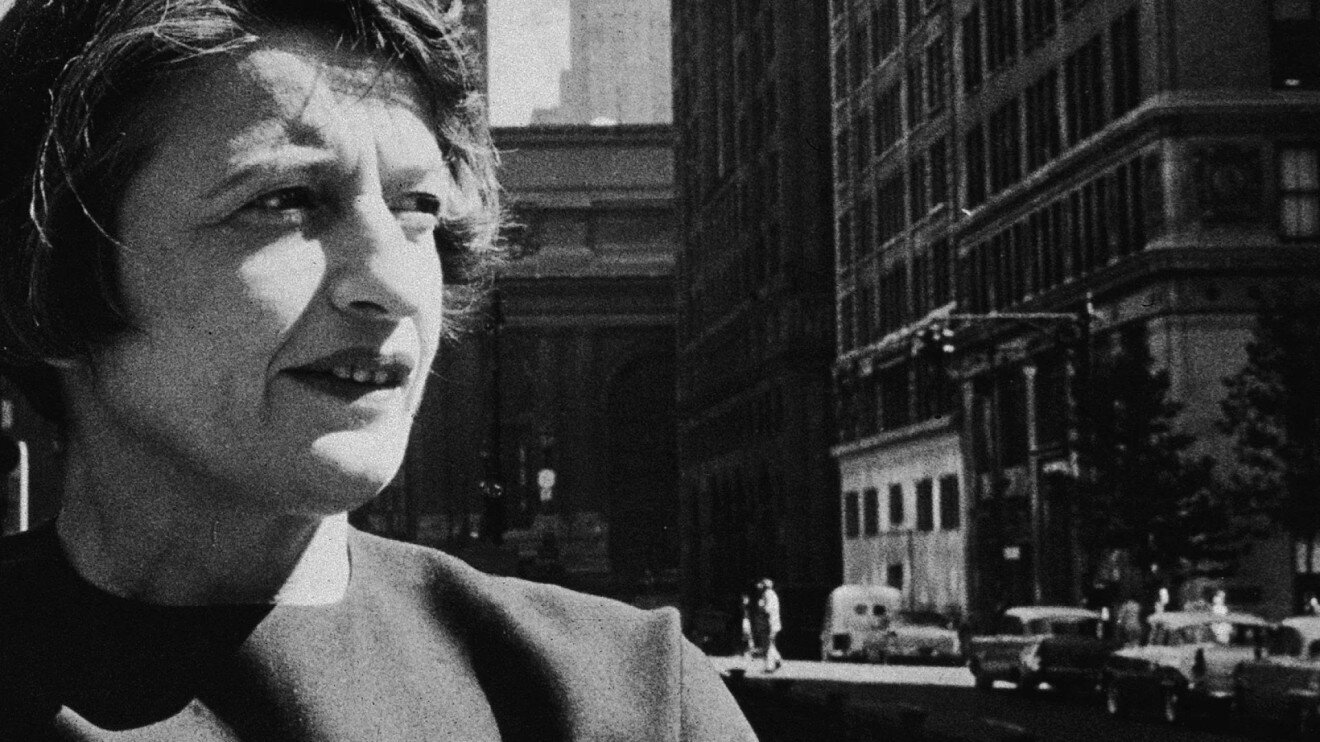
An American writer of Russian origin, creator of the philosophy of Objectivism
Biography
Alisa Zinovyevna Rosenbaum was born in 1905 in St. Petersburg, into the family of a pharmacist. Her father, Zinovy Zakharovich Rosenbaum, owned a large pharmacy on Nevsky Prospekt; her mother, Anna Borisovna Kaplan, was a dental technician. She was the eldest of three daughters.
She learned to read and write at age four, and began writing stories as a child. She attended M.N. Stoyunina's girls' gymnasium alongside Vladimir Nabokov's sister. After the 1917 revolution, the family lost its property and moved first to Odessa, then to Yevpatoria, where Alisa finished her gymnasium studies in 1921.
In 1921 she enrolled at Petrograd University, in the department of social pedagogy. During her studies she became acquainted with the ideas of Friedrich Nietzsche, which had an enormous influence on her. She graduated in 1924, and also managed to complete her first year at the State Institute for Cinematography.
Emigration to the US
In 1925 she received a visa to study in the United States. In January 1926, she traveled through Riga to Berlin, arriving in Chicago at the end of February to stay with her mother's relatives. She remained in the US for good — her parents and sisters stayed in the USSR and perished during the war and the siege of Leningrad.
Her creative path
In America, she worked as a Hollywood extra, appeared in a bit part in the film "The King of Kings" (1927), and rose to head costumer at RKO Pictures. In 1929 she married actor Frank O'Connor, and in 1931 she became a US citizen.
In 1932, she sold the screenplay "Red Pawn" to Universal Studios for $1,500, allowing her to leave her job and focus on writing. Her first novel, "We the Living" (1936), draws on her experience in Russia and depicts life in Soviet Russia.
Major works
- "We the Living" (1936) — an autobiographical novel about life in Soviet Russia
- "The Fountainhead" (1943) — the story of an individualist architect
- "Atlas Shrugged" (1957) — her major novel, the manifesto of Objectivism
The philosophy of Objectivism
Rand created a philosophical system she called Objectivism. Its core principles:
Rational self-interest
Every person should act in their own interest, neither sacrificing themselves to others nor sacrificing others to themselves.
Laissez-faire capitalism
Full economic freedom, with minimal government interference in the economy.
Objectivism opposes collectivism, altruism (as Rand understood it), and government regulation of the economy. It exalts individualism, achievement, and reason as the primary tool of understanding.
Influence on American culture
In the 1940s and '50s, Rand was actively involved in political life. In 1947, she testified before Congress on the matter of Communist influence in the film industry, supporting the creation of "blacklists" for Communists.
In the 1950s and '60s, a circle of followers formed around Rand, which critics called a "cult." Among them was Nathaniel Branden, with whom she had an affair, and who actively promoted Objectivism. In 1968, Rand broke off her relationship with him.
Contradictions
Despite her criticism of the "welfare state," in 1974, after surgery for lung cancer, Rand applied for Social Security and Medicare benefits, which she received until her death. She justified this as "restitution" for taxes the government had forcibly taken from her.
Ayn Rand and 1990s Russia
By the early 1990s, Rand's books had become a symbol of capitalist ideas and the free market. In perestroika-era Russia and the early years of reform, her books were seen as:
- An antithesis to Soviet ideology — a celebration of individualism against collectivism
- A guide to capitalism — many Russian entrepreneurs treated her books as a textbook
- A symbol of the American dream — the story of an emigre who achieved success in the US
"Atlas Shrugged" was especially popular, telling the story of a strike by talented people against a parasitic society. Many Russian readers found parallels here with Soviet reality.
Popularity in Russia
In the 1990s, Rand's books were actively translated and published in Russia. Her ideas influenced the worldview of a new generation of Russian entrepreneurs and politicians. "Atlas Shrugged" became a cult book among supporters of radical market reform.
Criticism and legacy
Rand's philosophy has been criticized for:
- An oversimplified view of human nature
- Absolutizing individualism
- Underestimating social problems
- Dogmatism and intolerance of criticism
Nevertheless, her influence on American culture and politics is enormous. Many Republican politicians, including Ron Paul and Paul Ryan, have called themselves admirers of her ideas.
"Man is a heroic being, with his own happiness as the moral purpose of his life, with productive achievement as his noblest activity, and reason as his only absolute."
Death and legacy
Rand died on March 6, 1982, of heart failure, at her home in New York. She was buried at Kensico Cemetery. At the funeral, a floral arrangement in the shape of a dollar sign — the symbol of her philosophy — was placed beside the casket.
Leonard Peikoff became the heir to her literary estate, continuing to develop Objectivist philosophy through the Ayn Rand Institute.
Key facts
Real name: Alisa Zinovyevna Rosenbaum
Years: 1905-1982
Place of birth: St. Petersburg, Russia
Emigration: 1926
US citizenship: 1931
Husband: Frank O'Connor (1929-1979)
Major works
- "We the Living" (1936)
- "The Fountainhead" (1943)
- "Atlas Shrugged" (1957)
Philosophy: Objectivism
Key ideas: Rational self-interest, individualism, laissez-faire capitalism
Influence in 1990s Russia
Rand's books became popular among Russian entrepreneurs and supporters of market reform. "Atlas Shrugged" was read as an anti-Soviet manifesto and a guide to capitalism.