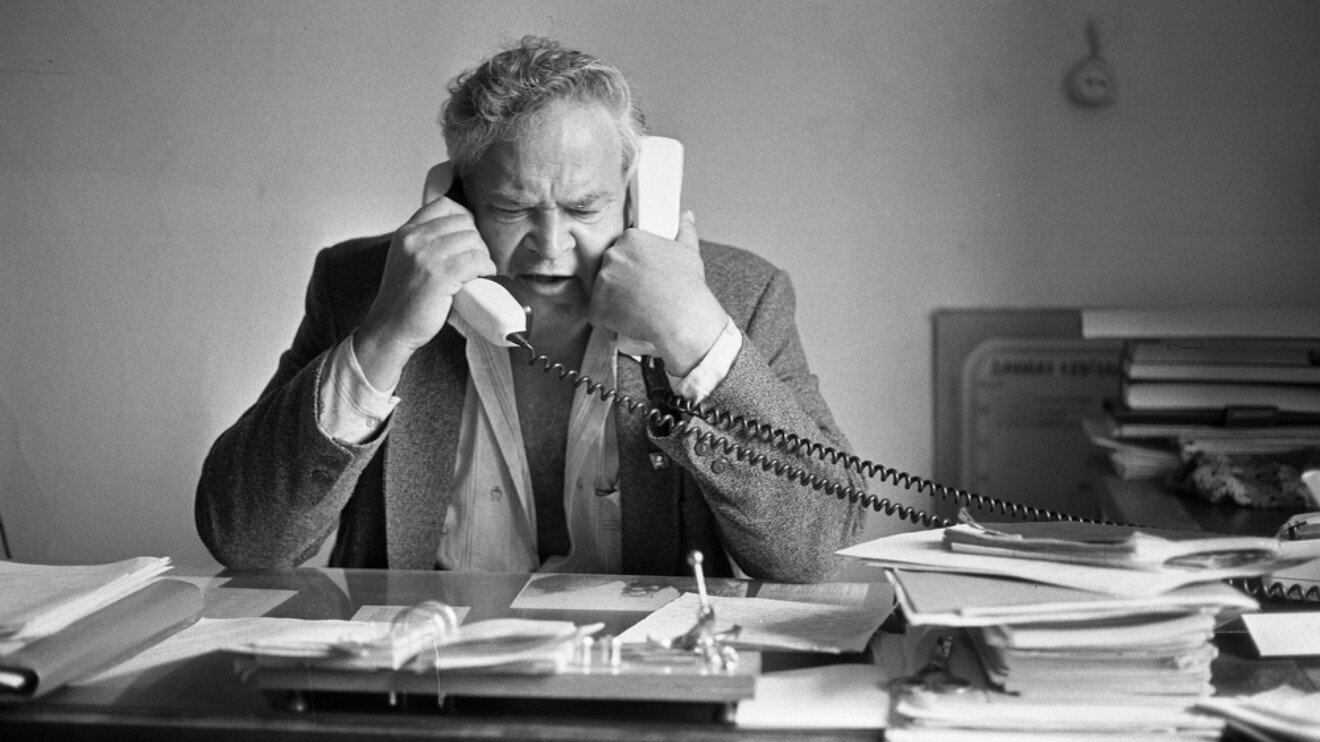
By the mid-1990s the term «red directors» had firmly entered the vocabulary of Russian politicians, journalists, and businesspeople. These people embodied a unique phenomenon of the transitional era – the transformation of the Soviet industrial elite into a new class of capitalists.
Who were the red directors
Red directors were people who came up through the Soviet industrial and managerial elite – heads of enterprises who had taken up their posts back in the Soviet era and managed to hold on to them after Russia’s transition to a market economy. The term became widespread thanks to coverage in Nezavisimaya Gazeta and Kommersant in the early 1990s.
Historically the term has deeper roots. In the 1920s–1930s, «red directors» referred to Communists whom the Party appointed to run enterprises after the October Revolution, replacing the old «bourgeois specialists.»
Traits of the Soviet economic manager
Contrary to the popular notion of their incompetence, many red directors had a deep understanding of economic processes. As researcher E.N. Volosov notes, they «understood the substance of terms like ‘profit,’ ‘revenue,’ ‘losses,’ and ‘non-payments’ quite well,» since from the mid-1960s they had worked with such metrics as volume of goods sold, output of standard-grade product, and profit targets.
The mechanism of becoming «red capitalists»
The transformation of red directors into owners took place within the mass privatization of the early 1990s. The choices made by work collectives played a key role: 75% of them chose the privatization option under which a controlling stake remained in their own hands.
However, «people’s privatization» quickly turned into privatization by the directors. A burst of inflation wiped out the population’s savings, and ordinary workers sold off their shares en masse for next to nothing. The main buyers were precisely the enterprise managers.
According to VTsIOM polling, more than 75% of directors at enterprises cleared for privatization became owners of their own enterprises, and 6% of them acquired controlling stakes.
As Anatoly Chubais – the architect of Russian privatization – himself admitted: «In the course of mass free privatization, we applied options that each politically balanced potentially explosive social groups – from directors to members of work collectives and pensioners.»
Red directors by 1997: the height of their influence
By the mid-1990s the red directors had reached the peak of their influence. In Chubais’s own assessment, they were «the most influential force in Russia in the first half of the 1990s, when they enriched themselves at a rapid pace.»
By 1997 the red directors made up a mixed group, split across several different trajectories:
Successful adapters
Some red directors adapted successfully to market conditions and by 1997 controlled major assets. Examples of such «survivors» include Vagit Alekperov (LUKOIL) and Vladimir Kadannikov (AvtoVAZ), who managed not only to retain control of their enterprises but to turn them into powerful corporations.
Victims of the criminal wars
Many red directors, especially in export-oriented industries, became targets of criminal predation. Organized crime groups and capital-based businessmen with ties to power sought to grab profitable enterprises for themselves. The methods were brutal: directors were beaten, threatened, and some were killed by hired assassins.
Criminal methods of redistributing property
I.G. Turushev, director of the Krasnoyarsk Aluminum Plant, was beaten with iron bars and left disabled. G.L. Sirazutdinov, director of the Sayan Aluminum Plant, was forced to leave the region under threat. Hired killers shot dead E.G. Yevtushenko, general director of the Bratsk timber-processing complex, and A.P. Purtov, deputy general director of the Ust-Ilimsk timber-processing complex.
Minor entrepreneurs
Directors of manufacturing, construction, and logging enterprises suffered from the collapse of the Soviet economic mechanism. Many turned into minor entrepreneurs, living off income from leasing out premises and equipment.
Heads of non-privatizable enterprises
A separate group consisted of directors of enterprises that were not subject to privatization: railway structures, the energy sector, the military-industrial complex. They had no need to change their economic identity, but they gained the ability to dispose of state property not only in the state’s interest but in their own as well.
A social portrait of the red director
By 1997 the typical red director presented a contradictory figure. On the one hand, these were people with enormous production experience, possessing:
- Informal connections – a network of contacts formed back in Soviet times
- Skill managing large collectives – experience leading thousands of workers
- Deep knowledge of production technology – an insider’s understanding of their industry
- A grasp of economic realities – despite the criticism, many understood finance
On the other hand, they were saddled with characteristic shortcomings:
- An authoritarian management style – a habit of one-man rule and rigid hierarchy
- Incompetence in legal matters – a weak grasp of the new legislation
- Unreadiness for market competition – a habit shaped by the planned economy
Red directors in Moscow offices
By 1997 many provincial red directors were regular visitors to Moscow offices, searching for investors and partners. The capital became the place where deals were struck that decided the fate of industrial assets across the entire country.
These visits had their own particular character. Provincial directors, used to being «masters of the universe» back home, often found themselves cast as supplicants in Moscow. They sought financing, technology, markets. Moscow investors and businessmen, for their part, saw them as a source of cheap assets and production capacity.
An alliance of capital and experience
A mutually beneficial alliance often formed between a major capital-city investor and an experienced red director. The former supplied money and connections, the latter, knowledge of production and managerial experience. Such alliances frequently proved successful.
Lifestyle and consumption
By the mid-1990s red directors, especially the successful ones, had radically changed their way of life. From the modesty of the Soviet economic manager, they moved to conspicuous consumption. Expensive cars, foreign trips, restaurants, fashionable clubs became an integral part of their lives.
Gifts like Parker pens or Tissot watches, dinners at restaurants on Tverskaya, visits to fashionable clubs like «Night Flight» – all of it symbolized their new status and their striving to match Western standards of the successful businessman.
Legacy and influence
The red directors played a key role in shaping the Russian economic elite. Many of today’s oligarchs and major entrepreneurs are either former red directors themselves, or adopted their management methods.
Paradoxically, even new managers with Western business educations largely inherited the management style of their predecessors. Authoritarianism, the personalization of power, reliance on informal ties – these traits of the red directors proved remarkably durable.
By the end of the 1990s many red directors had either lost control of their assets or transformed into «ordinary» capitalists. But their influence on the shaping of the Russian model of capitalism remains evident to this day.
Conclusion
The red directors were a unique phenomenon of the transitional period, people who managed to adapt to radically changed conditions. Their experience shows how the Soviet economic elite transformed into a post-Soviet one, by what methods and with what losses. In 1997 they stood at the peak of their influence, but within a few years many of them would give way to a new generation of Russian capitalists.