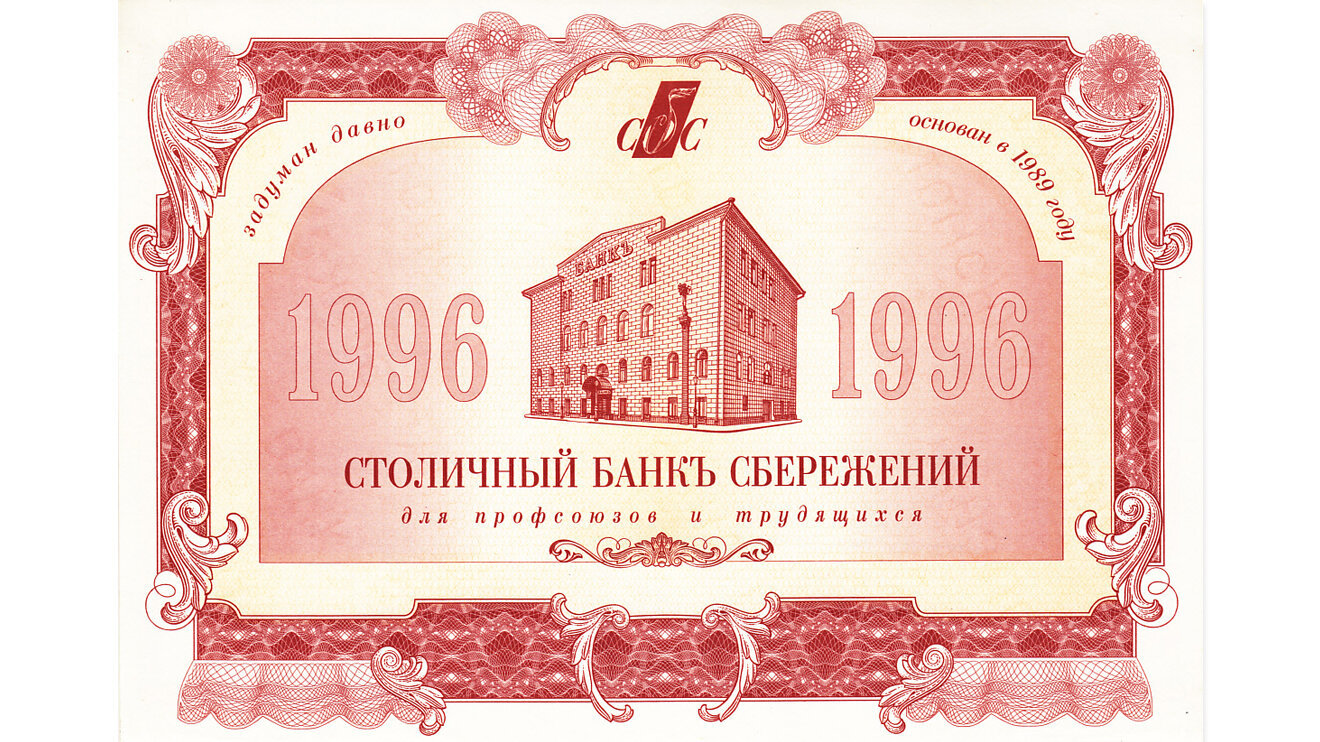
The novel’s «Smolensky Bank» is a fictionalized nod to the real Stolichny Bank Sberezheniy, better known as SBS-Agro, one of the largest private banks in 1990s Russia.
Founding and growth
The bank’s history began in 1989, when Alexander Pavlovich Smolensky founded the commercial bank «Stolichny» and became chairman of its board. By 1994 Smolensky had become the bank’s president, and that same year it was renamed «Stolichny Bank Sberezheniy» (SBS, or «Capital Savings Bank»).
The bank grew rapidly amid Russia’s emerging market economy. In 1996, Smolensky pulled off a major deal, acquiring a controlling stake in Agroprombank. That proved a turning point in the institution’s history – in 1997, «Stolichny Bank Sberezheniy» was renamed «SBS-Agro.»
The founder
Alexander Pavlovich Smolensky (1954–2024) was an unconventional and controversial figure. Born in Moscow to a family of Émigrés from Austria – by his own account, his grandfather had served as a secretary of the Austrian Communist Party’s Central Committee – he trained as an economist at the Dzhambul Institute of Geology and Technology in Kazakhstan.
Smolensky’s career path was varied: he worked as a typesetter in a print shop, and as a merchandiser for the trading firm «Vesna.» In 1981 he was convicted of misappropriating state property and illegal private enterprise – according to his own version of events, for helping typeset a Bible using printing-house ink. After his release he worked at the «Olimpiysky» sports complex, then at a repair-and-construction agency, and went on to organize one of Moscow’s first construction cooperatives.
The rise of a banking empire
By the mid-1990s SBS-Agro had become one of the flagships of the Russian banking system. On the eve of the 1998 financial crisis, the bank ranked second in Russia after Sberbank by number of retail depositors (2 million people), and was among the country’s ten largest banks by capital.
Smolensky was more than just a banker – he became a member of the so-called «Semibankirschina» («the Group of Seven Bankers»), an informal circle of Russia’s seven largest financial figures. Despite their internal disagreements, the group joined forces to back Boris Yeltsin’s re-election in the 1996 presidential race, gaining in return an informal ability to shape state financial policy.
From 1995 to 1999 Smolensky sat on the commission on state awards under the President of Russia, and from 1996 he was a member of the government’s advisory council on banking. He became the first Russian banker to be awarded the Order of Honor, and he also received the Order of Friendship of Peoples.
The darker chapters
The bank’s history wasn’t free of scandal. In 1993 the Prosecutor General’s Office opened two criminal cases against «Stolichny»’s leadership: one over laundering proceeds from the sale of drugs, weapons, and nuclear materials, and another over funneling $25 million to Austria using a forged bank advice. Both investigations were later closed.
A particular role in the bank’s history was played by speculation in the market for government short-term bonds (GKOs). A computer analysis of transactions conducted by the Prosecutor General’s Office showed that SBS-Agro was heavily involved in this speculation, which became one of the contributing causes of the 1998 default.
Collapse and aftermath
The financial crisis of August 1998 proved fatal for SBS-Agro. The bank couldn’t survive the collapse of the GKO market and was effectively bankrupted. In September 1998 the Central Bank of Russia imposed temporary administration on the bank. It was later placed under the management of the Agency for Restructuring Credit Organizations (ARCO).
The bank’s charter capital was reduced to a single ruble, after which ARCO became its majority shareholder (99.9%). SBS-Agro remained several billion dollars in debt to foreign creditors and was besieged by thousands of depositors who had lost their savings. In January 2003 the bank’s license was revoked.
A phoenix from the ashes
Smolensky, however, didn’t give up. Even before SBS-Agro’s final collapse, its good assets had been transferred to a small bank he’d acquired, «Pervoye OVK» («First Mutual Credit Society»). A new banking group, «OVK,» was built on the foundation of SBS-Agro’s subsidiary banks. SBS-Agro’s regional branches were folded in as well, becoming the Central, Siberian, Volga-Vyatka, Volga, and Far Eastern OVK banks.
In June 2003 Smolensky told journalists he was stepping back from business, and that his son Nikolai would represent the OVK group’s shareholders going forward. One of Smolensky’s proteges, Vladislav Valeryevich Pershin, was named chairman of the bank’s board. In the summer of 2003 the OVK group was sold for $200 million to Vladimir Potanin’s company «Interros.»
A bank that defined an era
SBS-Agro became a symbol of the era of primitive capital accumulation in Russia. The bank showed just how quickly a financial empire could be built in a transitional economy – and how quickly it could collapse. The story of Stolichny Bank Sberezheniy reflects all the contradictions of 1990s Russian capitalism: dizzying rises and painful falls, dubious schemes alongside state honors, millions of defrauded depositors alongside billion-dollar fortunes.
The bank left a deep mark on Russia’s banking system, demonstrating both the possibilities and the dangers of aggressive growth in an unstable economic environment. Many of the practices tested at SBS-Agro would later become standard across the Russian banking sector.
Smolensky’s later years
After selling OVK, Alexander Smolensky gradually withdrew from banking. In 2019 he sold his last piece of commercial real estate in central Moscow to Avangard Bank. Smolensky died on October 13, 2024, in Tel Aviv, at the age of 70.
His son Nikolai carried the family’s entrepreneurial line forward, owning the British automaker TVR from 2004 to 2013.
Cultural influence
The story of SBS-Agro and the figure of Alexander Smolensky have repeatedly drawn the attention of journalists, writers, and filmmakers. The bank is mentioned in the documentary film «The Oligarchs,» about the «Semibankirschina.» Fiction has taken up this vivid chapter of Russian history as well – the bank and its founder have served as the prototype for many literary characters embodying the spirit of the 1990s.
In novels, the bank often appears under a changed name, as with the «Smolensky Bank» in this work – letting authors draw on the recognizable traits of a real financial institution to create an authentic atmosphere of the era.