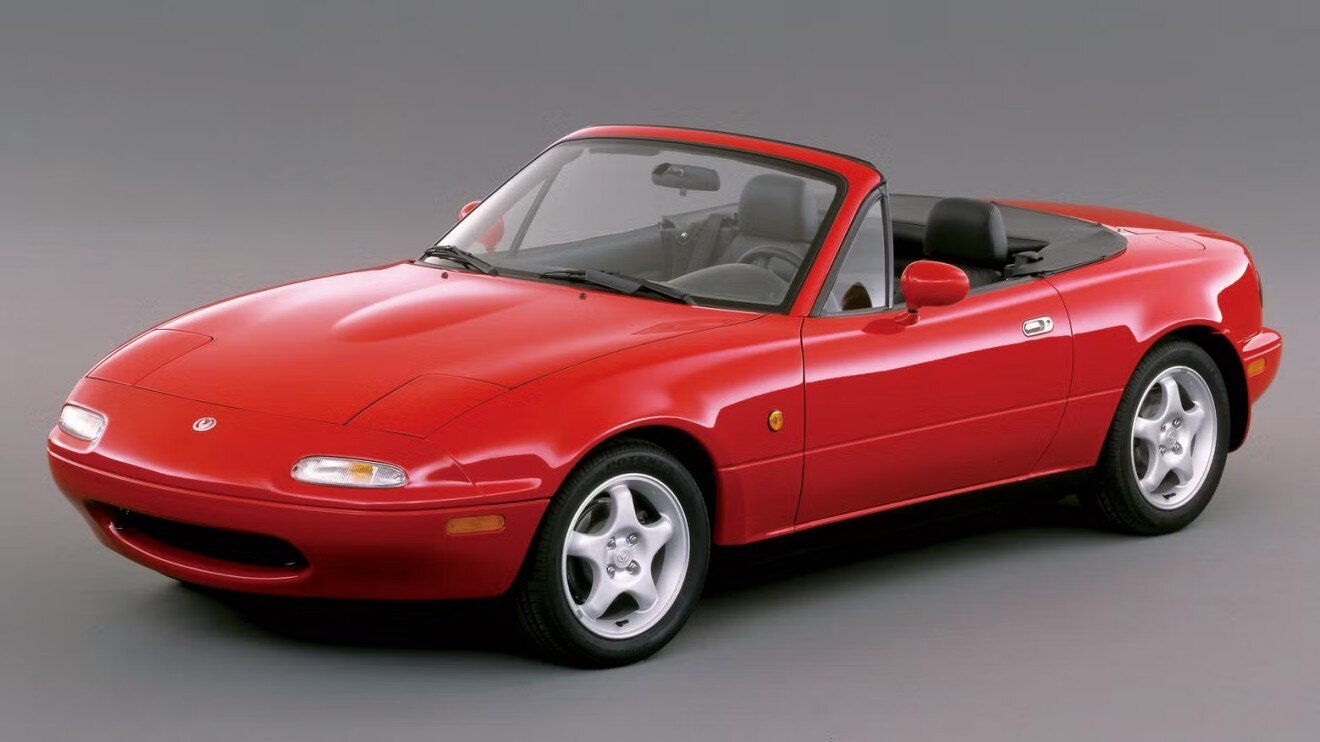
The first-generation Mazda MX-5 Miata (NA, 1989–1997) was a rear-wheel-drive, soft-top roadster that became a cult symbol of driving joy and simplicity. Designed in Japan and inspired by classic British sports cars, the Miata embodied the idea of «jinba ittai» — the unity of driver and machine. Its light body (only about 950–990 kg), near-perfect 50:50 weight distribution, and responsive suspension made it the handling benchmark of its era.
The car came with a 1.6-liter, 116-horsepower engine (from 1993, a 1.8-liter, 130-horsepower unit), a 5-speed manual transmission, and an optional limited-slip differential. Thanks to its simple construction and affordability, the model quickly became popular in amateur motorsport — from track days to autocross competitions. The base trim skipped air conditioning, power steering, and an audio system — all in the name of weight savings and driving purity.
Visually, the NA version stood out with its pop-up headlights, chrome trim, and classic proportions. This model kicked off the era of mass-market affordable sports cars, proving that driving pleasure didn’t require a big budget. In all, more than 430,000 units of the MX-5 NA were built between 1989 and 1997.
Today, the Mazda MX-5 NA is recognized as a modern classic: beloved by collectors, kept alive by enthusiasts, and still one of the brightest representatives of the «pure mechanics» philosophy. Renting a Miata means stepping back into an era when the wheel, clutch, and gearbox were the main interface between driver and road.
Ideal for a leisurely drive through Southern Europe: light weight, an open top, and nimble handling turn an ordinary coastal drive into pure pleasure. The Mazda MX-5 NA isn’t just a car — it’s a lifestyle on wheels.
The Mazda Miata (Mazda MX-5 Miata): the History of a Legendary Roadster
Introduction
The Mazda Miata isn’t just a car — it’s a symbol of a philosophy built on lightness, driving joy, and pure fun. Since its 1989 debut, this two-seat, rear-wheel-drive roadster has become a cultural icon of motorsport and amateur driving. This piece traces the model’s origin story, the technical evolution across its generations, the philosophy behind its creation, and why the Miata remains popular to this day.
Development History
-
Project OGG began in the 1980s as a study of the concept of a compact sports car.
-
Key figures: American Bob Hall and Japanese engineer Kenichi Yamamoto.
-
The «jinba ittai» concept — the unity of driver and car, lightness, and minimalism — became the foundation of the Miata.
First Generation, NA (1989–1997)
-
Unveiled in 1989 at the Chicago Auto Show.
-
Visual signature — pop-up headlights.
-
1.6-liter engine, 116 hp; weight around 980 kg.
Second Generation, NB (1998–2005)
-
Debuted in 1997, sales began in 1999.
-
Fixed headlights instead of pop-ups.
-
Power increased to 140 hp; interior and safety improved.
Third Generation, NC (2005–2015)
-
First version with a retractable hardtop (PRHT).
-
MZR-series engines up to 2.0 liters.
-
Won numerous awards, including Car of the Year Japan.
Fourth Generation, ND (2015–present)
-
Kodo design language, weight reduction, ND2 refresh.
-
2.0-liter SkyActiv engine, improved suspension.
Engines and Technology
The Miata has used a range of engines, from the B6 to SkyActiv-G. The latest technologies include:
- Kinematic Posture Control;
- Limited Slip Differential (LSD);
- Ideal 50:50 weight distribution.
The Driving Philosophy: Jinba Ittai
This is the concept of unity between driver and machine: precise handling, responsiveness, and design minimalism.
The Miata Cult and Motorsport Involvement
- Popularity in series like Spec Miata and the MX-5 Cup;
- Owners’ clubs around the world;
- A legendary tuning and DIY culture.
Sales and Records
As of 2024, more than 1.2 million Miatas have been sold, making it the best-selling roadster in history.
Current State (2023–2025)
- LED headlights, an 8.8-inch screen, improved steering;
- A 35th-anniversary edition, with Artisan Red trim.
Strengths and Weaknesses
Strengths
- Lightness, balance, driving fun;
- Reliability and easy access to parts;
- An attractive price for a genuine sports-car experience.
Weaknesses
- A small trunk;
- Limited interior space;
- A noisy cabin with the top down.
Why the Miata Stays Relevant
The Miata appeals to novice drivers and motorsport veterans alike. Its simplicity, reliability, and driving pleasure have made it a timeless classic.
The Model’s Future
Electrification of the model is expected by 2026–2030. But Mazda plans to preserve the philosophy of lightness and minimalism even in EV form.
Frequently Asked Questions (FAQ)
-
Why is it called «Miata»?
From the Old High German word for «reward.» -
How many generations of the Miata are there?
Four: NA, NB, NC, ND. -
How much did the first Miata weigh?
About 980 kg. -
What engines were used?
From 1.6 to 2.0 liters, including the MZR and SkyActiv units. -
What does the «jinba ittai» concept mean?
The bond between car and driver, like that between a horse and its rider. -
How many have been sold?
More than 1.2 million, as of 2024.
Conclusion
The Miata is more than a car. It’s a philosophy of lightness, engineering artistry, and the joy of motion. Thirty-five years on, it still inspires and delights millions of drivers around the world.