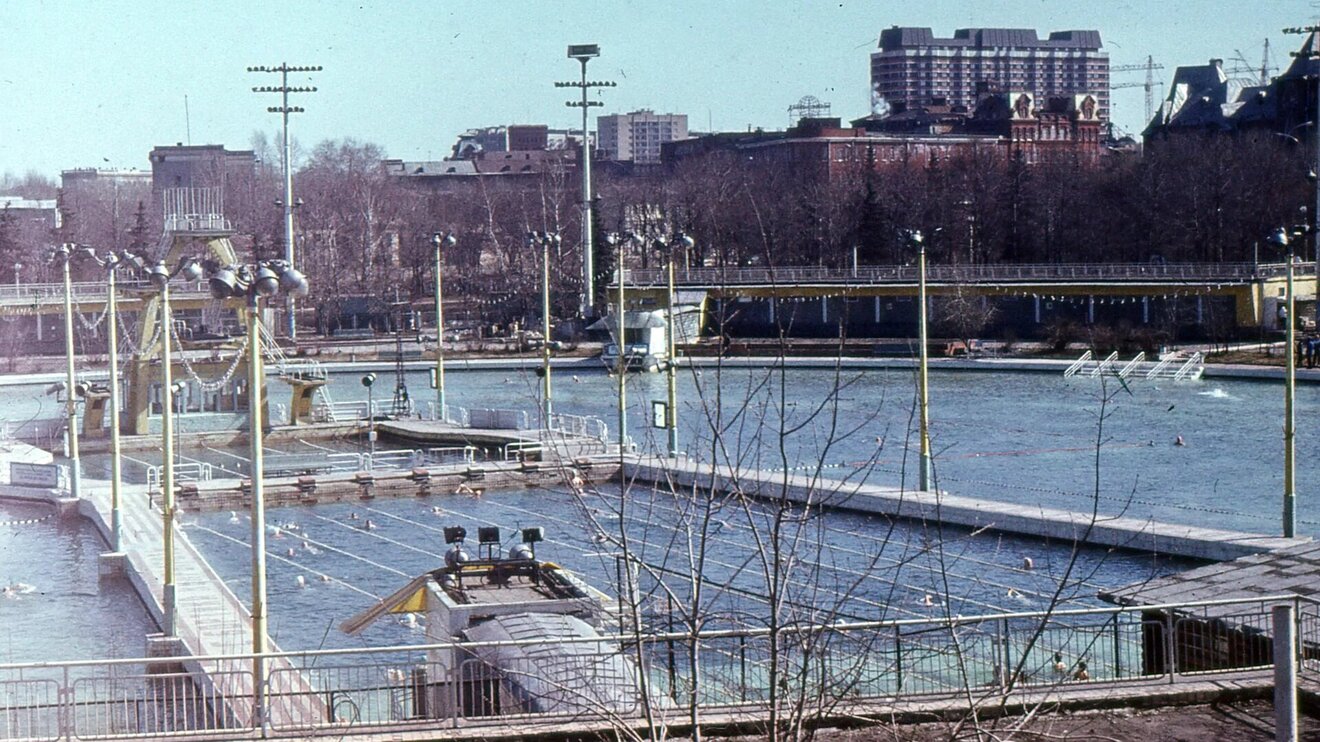
The "Moskva" Pool was the largest open-air swimming pool in the USSR and one of the largest in the world, in operation from 1960 to 1994 on the site of the demolished Cathedral of Christ the Saviour.
The history of its creation
The history of this unique structure began with the tragic events of 1931, when, by decree of the Politburo, the Cathedral of Christ the Saviour was demolished. On its site, planners intended to erect the grandiose Palace of the Soviets — the tallest building in the world and the centerpiece of the new Soviet Moscow. The decision to build it was made personally by Joseph Stalin.
By 1939 the foundation of the Palace of the Soviets was complete, but the outbreak of the Great Patriotic War froze construction. The metal structures intended for the building were used in the defense of Moscow in 1941–1942. After the war, the project was never resumed, and the excavation pit sat abandoned until the late 1950s.
According to a widely repeated account, the idea of building a pool there belonged to Nikita Khrushchev. The remaining structures and concrete foundation would often fill with water, resembling a swamp in the middle of the capital. The project was designed by architect Dmitry Chechulin, in collaboration with V. Lukyanov and N. Molokov.
Construction and opening
Construction began in 1958. The builders faced the task of making maximum use of the surviving foundation of the Palace of the Soviets, so the pool was placed inside the concrete ring originally intended as the base for the palace's Great Hall. This explains the structure's unusual round shape and enormous size.
The opening took place on July 16, 1960. The pool was located at 37 Kropotkinskaya Embankment, on the bank of the Moskva River. Its famous visitors included Ernesto "Che" Guevara (November 1960) and Mali's president Modibo Keita (May 1962).
Specifications and features
The water surface measured 130 meters in diameter, with an area of 13,000 m² and a water volume of 25,000 m³. Its capacity was enormous: up to 20,000 visitors a day, and around three million a year. In its first ten years of operation, the pool was visited by roughly 24 million people.
The water area was divided into sections for free swimming and for training. Groups operated for therapeutic and recreational swimming, synchronized swimming, and water polo. The sports sector had a separate entrance, eight swimming lanes, and a 10-meter diving platform. The complex also included a bathhouse with a sauna.
Infrastructure
The water basin was ringed by an 11-meter-wide beach with an embankment of sea gravel. Here stood five shallow children's pools, benches, and greenery. Pavilions with ticket booths, a coat check, and a snack bar could hold two thousand people at once. In winter, the exits from the pool connected to the pavilions via special covered corridors.
The depth originally reached four meters, but after a rise in accidents the bottom was filled with concrete, raising the water level to 1.85 meters. Admission cost a ruble and a half; monthly and "weekend" passes were also sold.
Closure
In April 1988, a public movement emerged in Moscow calling for the restoration of the Cathedral of Christ the Saviour. In September 1989, a decision was made to rebuild the cathedral on its original site. With the start of the 1990s, maintaining such an enormous facility became unprofitable.
The "Moskva" Pool ceased operating in 1991 and stood abandoned for three years. On September 15, 1994, it closed for good, and the basin and its structures were dismantled. On January 7, 1995, the foundation of the new Cathedral of Christ the Saviour was laid.
The pool's construction provoked a mixed reaction from the Moscow public. A wry saying became common: "First there was a cathedral, then there was junk, and now there's just shame" (a pun in Russian on "khram," "khlam," and "sram").