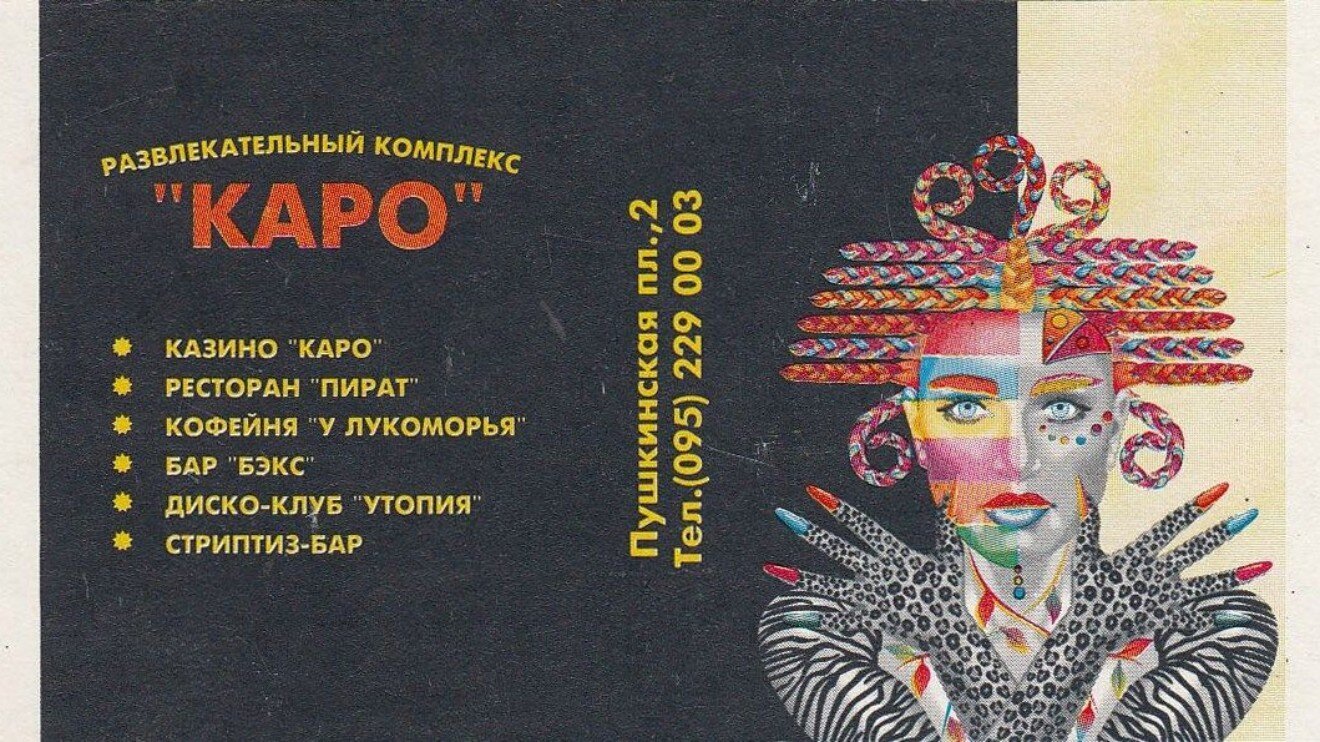
The disco club Utopia, mentioned in the text, was one of the cult venues of mid-1990s Moscow, located in the basement of the famous Rossiya cinema on Pushkinskaya Square, 2.
Origins
The club appeared in the early 1990s through a partnership between the company Karo (founded by Mikhail Rudyak, Leonid Ogorodnikov, and Oleg Andreyev) and a German entrepreneur and casino operator named Böttcher, from Storm International. The partners took over management of the Rossiya cinema building and opened a restaurant and the Utopia disco there, along with several gaming tables.
A team of managers from Las Vegas, led by Böttcher, was brought in to run the casino, immediately giving the venue an international level of service and respectability.
Atmosphere and Clientele
Utopia quickly became a magnet for Moscow’s bohemian crowd, the creative intelligentsia, and the «new Russians.» The venue was known for its particular atmosphere — a mix of disco culture, gambling, and the high life of the capital. The club billed itself as «the best club in our capital,» where «everything you’ve dreamed of for so long, but never dared say out loud, you’ll find here.»
Utopia regularly hosted themed parties, including the «SUPER FANTASY» program, run in partnership with the Arlekino modeling agency. These events drew young people, models, performers, and other creative professionals.
Transformation Into Shangri La
In 1999, the casino Shangri La opened where Utopia had been, named after the fictional paradise from James Hilton’s novel. The new venue was even more exclusive — a ticket cost $200, a significant sum for a Moscow that had just lived through the 1998 default.
Shangri La drew show-business celebrities, including Alla Pugacheva, and became one of the most popular gambling destinations alongside the Metelitsa casino.
Historical Significance
Club Utopia became a symbol of an era — a time of turbulent change, when new forms of leisure and entertainment were taking shape in Russia. The venue captured the spirit of the mid-1990s: a blend of Western glamour and Russian specificity, a hunger for luxury and enjoyment after decades of Soviet austerity.
Its location inside the historic Rossiya cinema building on Pushkinskaya Square made the club part of the cultural landscape of central Moscow. Here, in a basement beneath one of the country’s leading movie theaters, the nightlife of the new Russia came alive.
Cultural Context
Utopia was more than an entertainment venue — it functioned as a kind of social elevator and networking hub for the emerging middle class and creative elite. Business contacts, romances, and friendships all took shape there — the club became an important part of the social infrastructure of «the new Moscow.»
The mention of Utopia in the novel’s text captures the atmosphere of that time precisely, when venues like it served as windows into another world — a world of opportunity, risk, and pleasure, standing in such sharp contrast to the everyday reality of most Muscovites.