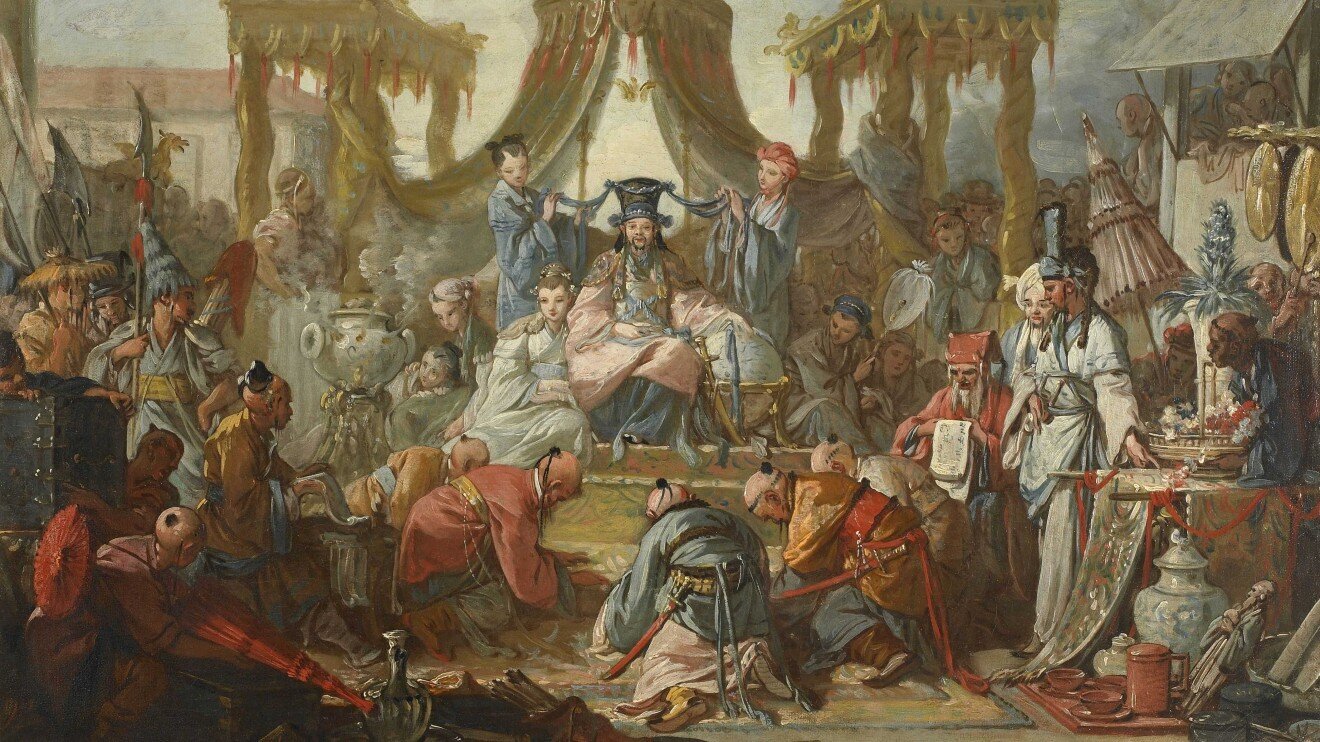
Bogdykhan (from Mongolian Bogd khaan, «sacred sovereign») is a term used in Russian documents of the 15th–16th centuries for the emperors of China’s Ming dynasty (1368–1644) and, later, the Qing. Figuratively, it means a ruler with absolute power over their domain.
The title entered Russian usage after the Mongol title «bogdo khan» was adopted by the Manchu emperor Abahai (1592–1643), even before the Manchu conquest of China. Documents from the time of Yerofei Khabarov’s expedition to the Amur (1650s) and the Russo-Chinese contacts that followed also use phrases like «the bogdoi tsar,» «the bogdoi prince,» «the bogdoi khan.»
In Russian literature, the term was long used broadly for Chinese emperors in general. Alexander Pushkin, in his poem «Ruslan and Lyudmila,» listed «bogdykhans» among a procession of Eastern rulers:
«…Steel knights, sullen sultans,
Monks, dwarves, Arabian kings,
Greek women with prayer beads, corsairs, bogdykhans…»
After the Mongolian national revolution of 1911, the title «bogdo khan» was taken by the head of Mongolia’s Buddhists, Bogd Gegeen VIII, who ascended the throne, inheriting the title from the last Qing emperor.
The Ming Empire (1368–1644)
The Great Ming Empire (大明朝) was the state that formed on Chinese soil after the overthrow of the Mongol Yuan dynasty. It existed from 1368 to 1644, though a loyalist remnant (the Southern Ming) held on until 1662.
The Ming built a powerful navy and a standing army as large as a million men, and imposed strict centralized rule with attempts to regulate every sphere of citizens’ lives. The first two emperors, Zhu Yuanzhang and his son Zhu Di, ruled successfully, but by the early 17th century the state apparatus was riddled with corruption.
Ming emperors took little interest in governing, handing real power to a sprawling entourage of relatives, eunuchs, and courtiers. Ming China pursued a policy of self-isolation, which contributed to its decline. Taking advantage of Li Zicheng’s peasant rebellion, the Manchus captured Beijing in 1644 and absorbed China into the Qing empire.
The Qing Empire (1644–1912)
The Qing Empire (大清國) was the last state to encompass the whole of historical China, existing from 1644 to 1912, with a brief restoration in 1917. It was founded and ruled by the Manchu Qing dynasty, of the Jurchen Aisin Gioro clan.
The empire arose from the unification of Jurchen clans by Nurhaci into the «Eight Banners» army. In 1616 Nurhaci proclaimed the Jin state, and in 1636 his son Abahai proclaimed the Qing empire. The Manchu conquest of China wasn’t complete until 1683, under the Kangxi Emperor.
Qing rulers, while carrying the official title of Emperor of China, simultaneously remained khans of the Mongols and patrons of Tibetan Buddhism. They governed using a Confucian approach and the traditional Chinese bureaucracy, preserving the imperial examination system.
The empire’s power peaked under the Qianlong Emperor (1735–1796), after which decline set in. The population grew to 400 million, but taxes stayed low, leading to fiscal crisis. Corruption became pervasive, and the ruling elite refused to change in the face of outside pressure.
Defeats in the Opium Wars, the Taiping Rebellion (1850–1864), failed reforms, and the Xinhai Revolution of 1911 brought the dynasty down. The last emperor, Puyi, abdicated on February 12, 1912.