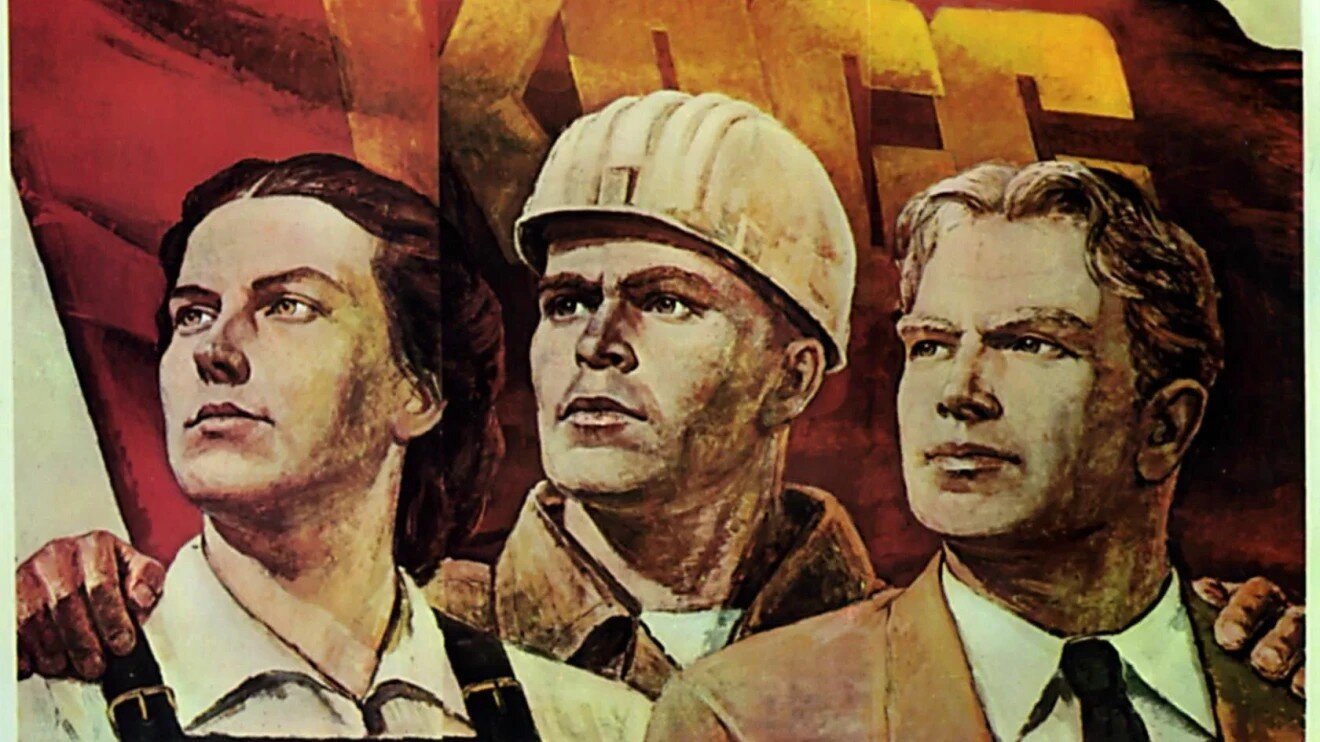
Who Nikolai Travkin is
Nikolai Ilyich Travkin (b. March 19, 1946) is a Soviet builder, foreman, and Hero of Socialist Labor (1986), the originator of the so-called "collective contract" (kollektivny podryad) method in rural civil construction. In the 1980s, his name became a symbol of an innovative method of organizing labor, promoted as a breakthrough for the Soviet economy.
He was born in the village of Novonikolskoye, in the Shakhovskoy district of Moscow Oblast. He graduated from the Klin Construction Technical College, then completed a physics and mathematics degree by correspondence at the Kolomna Pedagogical Institute. After serving in the army, he worked at Glavmosoblstroy and Gidromontazh, and later headed the "Mossel'stroy No. 18" trust in Volokolamsk.
Travkin came from a working-class background, and rose from ordinary builder to trust director through hands-on mastery of the trade. His biography is typical of the Soviet worker-innovator: modest formal education, offset by practical experience, organizational skill, and an ability to find unconventional solutions to production problems.
What brigade contract work is
The general concept
Brigade contract work (brigadny podryad) is a method of organizing labor based on contractual relations between a client and a contractor, where the contractor is not an individual worker but a labor collective — a brigade (work crew). Unlike the traditional Soviet management system, in which all decisions were made "from above" by the administration, brigade contract work implied significant independence for the work crew.
The basic principles of brigade contract work:
- The brigade signs a contract for a specific volume of work
- The crew itself plans and organizes the production process
- Payment is based on the final result, not hours worked
- The brigade independently distributes the earned funds among its members
- The crew bears collective responsibility for the quality and timeliness of the work
Difference from the Stakhanovite movement
Where the Stakhanovite movement of the 1930s was aimed at publicizing individual labor records and created a cult of the personality of the star worker, brigade contract work placed the emphasis on collective work and collective responsibility. Alexei Stakhanov was one man — a lone hero. Brigade contract work implied that the whole crew became the hero, with everyone contributing to the common result.
A Stakhanovite worked within the traditional hierarchical system, overfulfilling the quota through personal effort. A brigade, on the other hand, gained the ability to organize its own labor, which meant an element of production democracy and self-management.
The essence of Travkin's method
Collective contract work in construction
Travkin's method represented the most developed form of brigade contract work, known as "collective contract work." A distinctive feature of the construction industry was that it traditionally had the highest level of bureaucratic chaos: numerous related organizations, constant material shortages, a lack of clear coordination, and high staff turnover.
Travkin proposed a radical solution: hand the brigade not just the execution of the work, but a significant share of management functions as well. The brigade itself:
- Planned the sequence of work
- Ordered and received materials
- Divided responsibilities among its members
- Controlled quality
- Determined each worker's pay
The administration, meanwhile, supplied the brigade with the means of production, set the norms, and paid out for exceeding those norms. In effect, management admitted its own inability to bring order by traditional methods, and stepped aside, retaining only supporting functions.
The labor-participation coefficient (KTU)
The key element of fairly distributing earnings within the brigade was the KTU — the coefficient of labor participation. This was a numerical measure of each worker's contribution to the overall result. The base value of the KTU was one (1.0). A worker who contributed more could receive a KTU above one (say, 1.2 or 1.5); one who worked worse, below one (0.8 or 0.7).
Crucially, the KTU was set not by the administration, but by the brigade itself, at a general meeting. Since everyone worked in full view of everyone else, every member of the crew understood their comrades' real contribution well. This created an atmosphere of fairness, and ruled out the possibility of "padding" figures or undeserved rewards.
The distribution formula was simple: the brigade's total earnings were divided in proportion to the product of each worker's wage grade, their KTU, and the hours they worked. Such a system motivated everyone to work at maximum effort, since their earnings depended directly on it.
The evolution of the method
The method developed in stages, expanding the boundaries of self-management:
- Simple brigade contract work — a single brigade is moved to a contract basis, receives an assignment, and carries it out independently
- An enlarged brigade — when the success of one link requires pulling others along, several brigades are combined into a larger structure
- End-to-end flow-line brigade contract work — related crews from other departments, working on the same site, are also moved to contract terms, to eliminate mismatches
- Collective contract work — the entire enterprise is moved to a contract basis, including engineering-technical staff and specialists
At each stage, a "collective council" was formed — an elected body making key decisions. This was an element of production democracy, in which workers themselves managed the labor process.
The role of the foreman
A crucially important point was that the foreman (brigadir) in the contract system was not a "boss" in the traditional Soviet sense. He remained a worker, doing the same work as the rest of the crew, while coordinating the collective's actions.
The foreman could be:
- Appointed by the administration (at the initial stage of forming the brigade)
- Elected by the crew itself, democratically (which became mandatory once a brigade moved to full contract status)
Often the foreman would put together his own brigade from people he trusted, with whom he had worked before. Leadership thus emerged naturally — through a professional's authority, not administrative appointment.
The foreman had no right to unilaterally decide matters of pay or hiring and firing — these were decided collectively, at a general meeting of the brigade. His role came down to coordination, representing the brigade's interests in dealings with the administration, and technical direction on site.
Economic effectiveness
Striking results
Brigades working under Travkin's method showed a striking rise in labor productivity. Typical figures:
- Construction times cut by a factor of 1.5-2
- Improved quality of work
- A sharp decline in staff turnover
- Workers' wages rising 2-3 times compared to traditional brigades
- Savings on materials and reduced losses
This high efficiency was explained simply: when people work for themselves, not "for the boss man," when they see a direct link between their effort and their pay, when bureaucratic red tape is removed — productivity multiplies.
Why it worked especially well in construction
Construction proved an ideal environment for introducing brigade contract work, for several reasons:
- Relative autonomy — construction sites were often located far from central offices, limiting the administration's ability to exercise day-to-day control
- A high level of chaos — the traditional management system in construction was so inefficient that even basic order-bringing produced a striking effect
- A variety of tasks — builders had to master many related trades, which developed versatility and interchangeability
- Visibility of the result — unlike assembly-line production, in construction everyone sees the finished product of their labor, which strengthens motivation
- Artel traditions — the traditions of artel-based labor organization historically persisted in the construction trades
Ideological and political problems
A conflict with the planned economy
Brigade contract work came into fundamental conflict with the principles of the Soviet planned economy. Central planning assumed that "the top" knew best how much, when, and how to produce. Brigade contract work proved the opposite: workers on the ground understood the production process better than any planner.
Absurd situations arose: a brigade might complete its annual plan in six months, but only get paid at year's end. Or the reverse — the plan was set "based on past achievement," meaning the better a brigade worked one year, the higher the bar was raised the next, effectively punishing success.
"Too high" earnings
One of the main problems was that successful brigades earned far more than the average salary, sometimes exceeding the earnings of engineers, foremen-supervisors, and even enterprise directors. This provoked:
- Envy from colleagues — other workers, still on the old system, saw their peers earning several times more
- Discontent from management — supervisors couldn't stomach subordinates earning more than they did
- Ideological objections — high earnings contradicted the idea of "material equality among working people"
- Attention from prosecutors — high income automatically raised suspicion of "unearned income," padded figures, or embezzlement
There were cases where successful foremen faced criminal prosecution precisely for earning "too much," even though all the money had been honestly earned at official rates.
The question of unnecessary bosses
The most painful question was this: if a brigade manages perfectly well on its own, why are foremen-supervisors, site superintendents, engineers, planning-economics departments, and the whole army of managers even needed? Travkin's method showed that most of the administrative apparatus was not just useless, but actively harmful — it created obstacles to normal work.
This was an explosive conclusion. Acknowledging it meant calling the entire Soviet management system into question. So the administrative apparatus instinctively resisted the spread of brigade contract work, even when it was officially endorsed "at the top."
The method's fate
Recognition and attempts at implementation
In the first half of the 1980s, Travkin's method received official recognition at a high level. Nikolai Travkin was awarded the title Hero of Socialist Labor (1986), his experience was widely publicized in the press, conferences were held, and methodological materials were published.
Attempts were made to introduce brigade contract work nationwide. These attempts, however, ran into serious resistance:
- Enterprise managers formally created "contract brigades," but kept every element of administrative control
- The KTU was set not by the brigade itself, but by foremen-supervisors and managers, turning it into just another bureaucratic formality
- Brigades were stripped of independence in planning and organizing labor
- Economic incentives were diluted through a system of "gross output" indicators and planning "based on past achievement"
The method was hollowed out through bureaucratic implementation at scale. As critics sarcastically noted, it was like trying to spread the experience of Makarenko by creating a network of Suvorov military schools — the outward form was copied, but the substance was lost.
A natural ceiling on development
The most interesting question is hypothetical: what would have happened if the method had continued its natural development? The logic of its evolution pointed toward the following stages:
- From the brigade — to the enterprise on collective contract
- From the enterprise — to an association of several enterprises
- From the association of enterprises — to a territorial unit (district, city, region)
- From production self-management — to socio-economic, and then political, self-management
At each level, the "collective council" would have had to expand its functions, turning from an organ of production management into an organ of political power. This would have meant restoring an authentic soviet (in the original sense of the Russian word "sovet," council) system of power, built from the bottom up.
It was precisely this prospect that formed the real "ceiling" against which the method broke. The Soviet nomenklatura could not allow a parallel structure of power, based on production democracy, to emerge. As soon as experiments began to approach this dangerous line, they were shut down.
Other examples
Besides Travkin, there were other well-known examples of successfully implementing brigade contract work and similar methods:
- Vladimir Shcherban' — a construction foreman from Dnepropetrovsk, Hero of Socialist Labor
- Nikolai Zlobin — a construction foreman from Moscow, an active promoter of the method in the 1970s
- Leonid Pruss — head of the Kaluga Turbine Plant, who introduced brigade contract work with brigades given the right to independently hire and fire workers and set wage grades
- Ivan Khudenko — organizer of an economic experiment in agriculture, executed in 1974 on charges of embezzlement
- Vadim Tumanov — a foreman of gold miners in Kolyma, who applied artel methods of organizing labor
All these experiments demonstrated the same thing: when workers gain real independence and economic interest, labor productivity multiplies. And all of them ran into the same problems: bureaucratic resistance, ideological accusations, and sometimes outright repression.
Theoretical significance
Production democracy
The experience of brigade contract work clearly showed that the production process naturally gives rise to workplace democracy, if not interfered with. Joint labor toward a common goal, where everyone works in full view of everyone else, creates a situation in which:
- Everyone knows their comrades' real worth as workers
- Everyone understands how compensation should be fairly distributed
- Complex tasks demand not just physical but intellectual effort from everyone
- Collective decisions can only be made democratically
- Everyone must show initiative, or disorder sets in
This is not an ideology imposed from above, but a natural form of organization arising from the conditions of collective labor itself.
The connection to the artel
In its most primitive form, brigade contract work contained nothing new — it was an ordinary artel, a traditional Russian form of labor organization. Artels had existed for centuries: artels of builders, bargemen, prospectors, fishermen.
But socialist organization of production gave the artel principle the chance to reach a qualitatively new level. The absence of a private, exploiting owner, social ownership of the means of production, and planned resource distribution — all of this created conditions for the artel principle to fully unfold its potential, and grow from a local phenomenon into a general system of labor organization.
Why this matters for understanding the Soviet system
The history of brigade contract work highlights a fundamental contradiction of the Soviet system: between its declared goals (the power of working people, social ownership, planning in the people's interest) and the actual practice of bureaucratic management.
Brigade contract work showed that:
- Workers are capable of managing production themselves, and do so more effectively than bureaucrats
- The administrative apparatus doesn't manage production so much as parasitize on it
- Economic incentives work better than ideological exhortations
- Production democracy naturally grows into political democracy
That is precisely why the method could not be widely adopted. It threatened not some isolated flaw in the system, but its very essence — the power of the nomenklatura.
Conclusion
Nikolai Travkin went down in history as a man who proved, in practice, that effective production democracy was possible. His method was not a theoretical construct — it was a living solution to concrete problems, found by a practicing builder.
Brigade contract work demonstrated an enormous economic effect. But even more important was its social effect: people stopped being cogs in a bureaucratic machine, and became masters of their own labor. It "straightened people out," as one participant in such experiments wrote — people worn down by mismanagement, by foolish orders, by pointless red tape.
The method broke against a political ceiling. The Soviet nomenklatura could not allow production democracy to develop to its logical conclusion — the replacement of bureaucratic management with the self-management of working people. So the experiments were shut down, and successful innovators were either co-opted into the system (as happened with Travkin himself, who became a politician in the 1990s) or neutralized by other means.
Nonetheless, the experience of brigade contract work remains important evidence that alternative forms of labor organization are possible and effective. By 1993, when the novel takes place, Travkin's method had already become history. But memory of it persisted, especially among people in construction and manufacturing. That is exactly why the novel's character Zhorik mentions "Kolya Travkin" as a widely understood symbol of efficient work organization, where people pay a fixed price for access to resources and earn extra through their own effort.