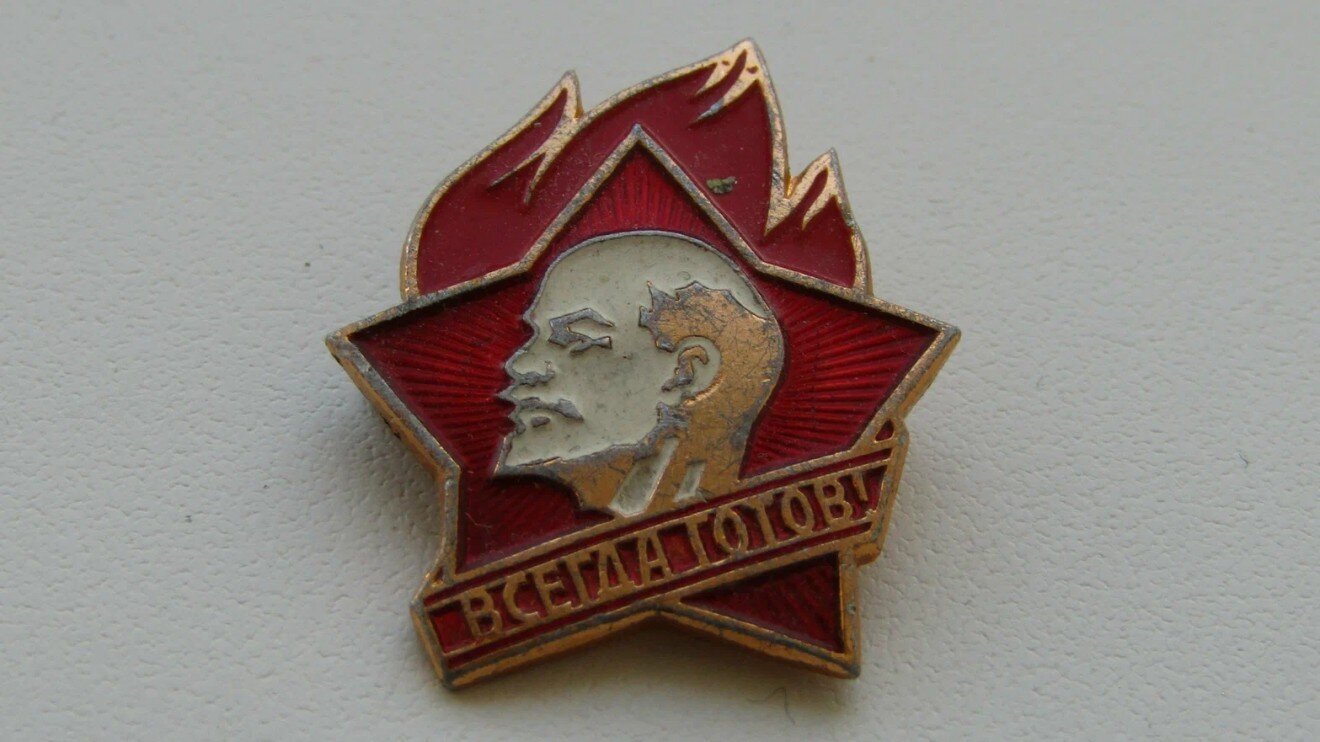
When someone in the mid-1990s dropped the phrase «be ready, like a Young Pioneer,» it referenced a universal motto familiar to every Soviet schoolchild. The call — «Young Pioneer, for the cause of the Communist Party of the Soviet Union, be ready!» — was met with a brisk reply: «Always ready!» Millions of children repeated these words across nearly seventy years of the Vladimir Lenin All-Union Pioneer Organization’s existence.
That said, Pioneer «readiness» was the subject of folk humor as much as propaganda slogans. One popular Soviet-era joke asked: «What’s the difference between a Pioneer and a sausage?» The answer, simple and ironic: «A Pioneer is always ready, but a sausage has to be boiled.» The joke poked fun at the organization’s formalism, where readiness was declared but not always backed up by real deeds.
The All-Union Pioneer Organization: A Brief Overview
The Vladimir Lenin All-Union Pioneer Organization was a mass children’s communist organization in the USSR. Officially it was considered voluntary, though in practice membership was practically mandatory for every Soviet schoolchild. It was founded by decision of the Second All-Russian Conference of the Russian Communist Youth League (Komsomol) on May 19, 1922. That date was thereafter marked as Pioneer Day.
Originally, from 1922 to 1924, the organization was named after Spartacus and called the «Young Pioneers Named After Spartacus.» After Vladimir Lenin’s death on January 21, 1924, the organization took his name, becoming the «Vladimir Lenin Children’s Communist Organization.» Its final name — the «Vladimir Lenin All-Union Pioneer Organization» — was settled on in March 1926.
The Pioneer organization’s activities were overseen by the Central Committee of the Komsomol (the All-Union Leninist Communist Youth League). It operated across the entire Soviet Union, uniting republic-level, regional, district, city, and local organizations. At its peak in the 1970s, the Pioneer organization counted more than 23 million members.
The Scouting Movement: Pioneering’s Forebear
Paradoxically, but true: the Soviet Pioneer organization, meant to raise future builders of communism, grew out of a movement created by a British military officer to prepare boys for service in the army of the British Empire. That movement was scouting, whose founder is credited as Sir Robert Stephenson Smyth Baden-Powell.
The Birth of Scouting
The history of the scouting movement began during the Second Boer War of 1899. Colonel Baden-Powell had been appointed commander of the fortress at Mafeking in South Africa. When the fortress came under siege by Boer forces, the garrison numbered a little over a thousand soldiers. The colonel organized an auxiliary unit made up of local boys, who took on reconnaissance and message-running duties across enemy lines.
Baden-Powell was struck by the fact that the boys fought no worse than adults, showing courage, cunning, and diligence. Thanks to his young cadets, he managed to hold the tiny garrison for 207 days, until reinforcements arrived. From that point on, the colonel concluded that training military scouts needed to start in childhood.
After becoming a general and returning to England, Baden-Powell founded the scouting movement in 1907. That same year, the first scout camp was held on Brownsea Island in the UK, and in 1908 his world-famous book «Scouting for Boys» was published. By 1909, England already counted 14,000 scouts. For his achievements, Baden-Powell was elevated by King George V to the rank of baron, with the title Lord Baden-Powell of Gilwell.
Forerunners and Inspirations
But the idea of a children’s organization didn’t originate with Baden-Powell at all — it belonged to the American writer and artist Ernest Thompson Seton, who created the world’s first youth troop, the Woodcraft Indians. In 1906, Seton sent his notes to Baden-Powell, who drew heavily on the writer’s experience in creating the scouting movement.
The word «scout» translates into Russian as «razvedchik» (reconnaissance man). Scouting’s innovation lay in bringing together teenagers, children, and adults within a single organization, engaged in shared activity, a long-running collective game of «scouting,» striving to be useful to other people, to nature, and to the world at large. Under Baden-Powell, relations between adults and children were built as equals, with each playing their own role.
Principles and Symbolism of the Scouts
The scouting movement used a distinctive method — an informal education program emphasizing hands-on activities outdoors. Scouts learned wilderness survival skills, hiking and canoeing, and sports. A defining feature was the uniform, including mandatory scout neckerchiefs. The movement’s emblem became a heraldic fleur-de-lis and a trefoil.
The universality of the scouting system lay in its capacity for self-development. It brought teenagers and adults together into a single organization regardless of religious denomination, race, or ethnicity — spanning not just Catholic Europe but Orthodox peoples and the Muslim world as well. In effect, scouting laid the foundations for a new type of pedagogy, later termed «informal pedagogy» in the USSR, as distinct from formal (compulsory) school education.
From Scouts to Pioneers: The Russian Transformation
The scouting movement spread quickly around the world, including into the Russian Empire. But after the 1917 revolution and the establishment of Soviet power, the fate of scouting in Russia turned dramatic. The Bolsheviks saw the scouts as ideological rivals and competitors for influence over the country’s youth.
Scouts in Revolutionary Russia
In territories controlled by Soviet power, the scouting movement splintered into several factions. Amid the ensuing Civil War, scouts helped search for homeless children, organized youth-militia detachments, and provided social assistance. But the Komsomol, seeing the scouts as rivals, took a sharply negative view of all these efforts and, as early as 1919, declared war on them. At the 1919 Komsomol congress, a decision was made to disband scout troops.
Even so, pro-Soviet tendencies emerged within scouting itself. Their most prominent spokesman was Innokenty Zhukov, scout leader of the RSFSR and the Far Eastern Republic, and former secretary of the «Russian Scout» society. He called for creating a Worldwide Knighthood and Labor Brotherhood of Scouts, built on labor, play, and love for one another and the world, urging close cooperation between scouting and the Komsomol.
Alongside this, there also existed a movement of «Yukism» (YuK-scouts, YuKS, or «Yuki» — «young communist scouts»), which tried directly to merge scouting principles with communist ideology. It was the «Yukists» who first began wearing a red neckerchief in place of the green scout one.
Krupskaya and the Founding of the Pioneers
At the same time, communist circles were coming to feel the need for their own communist organization for working with children. The idea was formulated by Nadezhda Konstantinovna Krupskaya, Lenin’s wife. In late November 1921, she gave several talks titled «On Boy Scouting,» in which she proposed that the Komsomol adopt scouting methods and create a children’s organization «scout-like in form and communist in content.»
Komsomol leaders, who held an extremely negative view of scouting, initially received these ideas with suspicion. But after Krupskaya’s address to the Komsomol Central Committee bureau on November 29, a special commission was formed. Innokenty Zhukov presented the commission with a detailed report, and on December 10, 1921, a favorable decision was reached.
It was Zhukov who proposed the name «Pioneers» for the new organization, borrowed from Seton’s pioneering practice. The Great Soviet Encyclopedia later clarified that «the communist children’s movement (the Pioneers) borrowed from Boy Scouting precisely its methods of external organization, while, of course, giving the ideological side of the whole movement an entirely different character.»
The First Pioneer Troops
On February 2, 1922, the Komsomol Central Committee bureau sent a circular letter to local organizations about forming children’s groups attached to Komsomol cells. On February 4, the corresponding decision was adopted by the Moscow Komsomol committee. A special bureau was set up for this purpose.
On February 13, 1922, a former scoutmaster and 19-year-old Komsomol member named Mikhail Stremyakov organized a troop of «Young Pioneers» at the N.A. Borshchevsky factory-apprentice school, attached to the former Mashistov printing house on Krasnaya Presnya in Moscow. This group is generally considered the first Pioneer troop. Stremyakov later became the first editor of the newspaper «Pionerskaya Pravda.»
In October 1922, the Fifth All-Russian Komsomol Congress decided to merge all Pioneer troops into a children’s communist organization, the «Young Pioneers Named After Spartacus.» And in early 1923, the first Pioneer troop was organized in Petrograd, formed by Komsomol members at the «Krasnoye Znamya» knitwear factory. The first gathering of Pioneers drawn from workers’ children took place on February 19, 1923.
Symbolism: From Scouts to Pioneers
The Pioneer organization’s symbols were a somewhat modified version of scout symbolism. This direct borrowing was entirely deliberate — the Soviet organizers of the children’s movement made no secret of taking the scouts’ «form» and filling it with new «content.»
The Neckerchief
The red neckerchief (in place of the green scout one) had already been used by the «Yukists» — the young communist scouts. The three ends of the now-red Pioneer neckerchief came to represent three generations — Pioneers, Komsomol members, and Communists. In scout symbolism, the neckerchief also held significance, but without this kind of ideological interpretation.
The Badge
The Pioneer organization also borrowed its badge from scouting. The three petals of the fleur-de-lis on the scout badge were replaced, in the Pioneer badge, with three tongues of campfire flame. The Pioneer badge depicted a red banner with Lenin’s profile against a campfire with three flames, above which sat a five-pointed star with a hammer and sickle.
The Motto
The scout call to «Be Prepared!» survived as well — though its direction shifted. Where scout readiness meant a readiness to help one’s neighbor and serve one’s country, Pioneer readiness was aimed at the struggle to liberate workers and peasants worldwide.
In the version approved by the Central Committee of the Russian Communist Party (Bolsheviks) on August 4, 1924, the call ran: «For the workers’ cause, be ready!» with the reply «Always ready!» From 1954 onward, the motto took a more elaborate form: «Young Pioneer, for the cause of the Communist Party of the Soviet Union, be ready!» — «Always ready!»
The Salute
Originally, per organizational regulations from August 28, 1923, the Pioneer salute copied the scout one: the five fingers of the right hand, held tightly together, palm facing forward, brought to the right shoulder. The five fingers symbolized the five continents, where the oppressed lived, for whose liberation the Pioneers fought.
But as early as December 23, 1923, the Komsomol Central Committee changed the form of the salute: the five fingers of the right hand, held tightly together, palm facing left, were raised to the middle of the forehead, above head level. The explanation stayed the same: five fingers for five continents, and the hand raised above the head meant that the interests of the proletariat stood, for Pioneers, above their own personal interests.
Other Elements
From scouting, the Pioneers inherited:
- Game-based methods of educational work with children
- Organizing children into troops
- The institution of troop leaders (counselors)
- Gatherings around the campfire
- A white blouse (in place of the scouts’ green one)
- An organizational structure (link — troop — brigade)
- The use of the bugle and drum
- Pennants and banners
Structure and Organization
The Pioneer organization was built along school lines: a class became a troop, a school became a brigade. Troops were divided into links. Formally, the Pioneer organization was considered self-governing: gatherings elected councils, and councils elected chairs. In practice, all leadership ran through the Komsomol and the Party, via the system of troop leaders.
Admission to the Pioneers
Schoolchildren aged 9 to 14 were admitted to the Pioneer organization. Formally, admission was voluntary, but in practice, Pioneer membership was nearly mandatory. Admission was done individually, by open vote at a Pioneer troop gathering. A new member took the Solemn Pledge of a Pioneer of the Soviet Union during a Pioneer assembly. A Communist, Komsomol member, or senior Pioneer would then tie the red Pioneer neckerchief around their neck and pin on the Pioneer badge.
As a rule, admission into the Pioneers took place in a formal setting, during communist holidays, at historic revolutionary sites — for instance, on April 22, Lenin’s birthday, beside a monument to the leader.
The Solemn Pledge
In its 1986 wording, the Solemn Pledge ran as follows:
«I, (surname, first name), joining the ranks of the Vladimir Ilyich Lenin All-Union Pioneer Organization, solemnly promise, before my comrades, to love and cherish my Motherland with all my heart, to live as the great Lenin bequeathed, as the Communist Party teaches, and to always follow the laws of the Pioneers of the Soviet Union.»
The Laws of the Pioneers
The Laws of the Pioneers changed repeatedly over the years, reflecting shifts in ideological emphasis. In their 1986 wording, they read:
- A Pioneer is a young builder of communism, working and studying for the good of the Motherland, preparing to become its defender
- A Pioneer is an active fighter for peace, a friend to Pioneers and working people’s children in every country
- A Pioneer looks up to Communists, prepares to become a Komsomol member, and leads the Little Octobrists
- A Pioneer values the honor of their organization, strengthening its standing through their own deeds and conduct
- A Pioneer is a reliable comrade, respects their elders, cares for the younger ones, and always acts according to conscience and honor
It’s worth comparing this to the very first version, from 1922, which was far more practical and far less ideologically laden:
- A Young Pioneer is loyal to the working class
- Honest, modest, truthful, and never lazy
- A friend and brother to every other Pioneer and Komsomol member
- Disciplined
- Hardworking, cheerful, and never loses heart
- Thrifty, and respects socially useful labor
The Pioneer Organization’s Activities
Pioneers engaged in a wide range of activities, both socially useful and recreational. All-Union competitions, reviews, expeditions, and marches were held. Popular were «young naturalist» drives — collecting scrap metal and wastepaper, helping with farm work.
An important part of Pioneer life was the Pioneer camp, where children spent their summer vacations. The most famous was the All-Union Pioneer Camp «Artek,» in Crimea, where a place was awarded as a prize to the best Pioneers.
Pioneers put out wall newspapers, took part in amateur performing arts, played sports, and went on hikes. The organization had its own publications — the newspaper «Pionerskaya Pravda,» and magazines like «Pioner,» «Yuny Tekhnik» («Young Technician»), «Murzilka,» and «Kostyor» («Campfire»).
Pioneering in Other Countries
Following the Soviet model, children’s communist organizations were established in many countries around the world. The first Pioneer organization outside the USSR was founded in Mongolia in 1925. Others followed:
- The Ernst Thälmann Pioneer Organization in East Germany (1948)
- The Dimitrov Pioneer Organization «Septemvriche» in Bulgaria (1944)
- The Union of Hungarian Pioneers (1946)
- The Union of Pioneers of Yugoslavia (1942)
- The Pioneer organization in Czechoslovakia (1945)
- The Union of Rebel Pioneers in Cuba (1961)
- The Ho Chi Minh Pioneer Organization in Vietnam (1941)
- The Young Pioneers of China (1949) — the largest in the world, with 130 million members
- «Sonyeondan» in North Korea (1946)
Pioneer organizations also existed in a number of Western countries — Belgium, Norway, Finland, France, Switzerland. Even in the United Kingdom, the Woodcraft Folk operated, holding left-wing views and friendly ties to the Soviet Pioneers.
The End of Pioneering
The All-Union Pioneer Organization was dissolved at the 22nd Extraordinary Congress of the Komsomol on September 28, 1991, alongside the dissolution of the Komsomol itself. By that point, the organization had already effectively ceased to exist — many schools had stopped holding Pioneer assemblies and gatherings back in 1989–1990.
After the collapse of the USSR, state-level support for the Pioneer organization ended in Russia. Under the Russian Constitution, open activity and propaganda by political and religious organizations in secular educational institutions contravenes the country’s fundamental law. Even so, several Pioneer organizations survived as voluntary associations attached to various parties and movements.
In some post-Soviet countries, Pioneer organizations survived at the state level. Belarus operates the Belarusian Republican Pioneer Organization (BRPO), part of the BRSM, which as of 2007 counted more than half a million members. Cuba has the José Martí Pioneer Organization, China the Young Pioneers of China, Vietnam the Ho Chi Minh Pioneer Organization, and North Korea «Sonyeondan.»
Legacy
The Pioneer organization left a deep mark on the history and culture of the peoples of the former USSR. For several generations of Soviet people, the red neckerchief and the call «Be Ready!» — «Always Ready!» became symbols of childhood — for some, a bright and joyful one; for others, one saturated through and through with ideology, and false.
The paradox of Pioneering lay in the fact that an organization created to be «scout-like in form and communist in content» inherited from its ideological rival not just its form, but many valuable pedagogical methods as well. The romance of hikes, campfires, collective projects, and mutual aid — all of it came from the scouts, and turned out to be in demand regardless of political system.
By the mid-1990s, as the novel’s events draw to a close, Pioneering had already become history. The call to «be ready, like a Young Pioneer» rang out more as irony, a nod to the recent past, when these words were spoken in earnest by millions of schoolchildren. And yet the underlying principle of readiness — readiness to act, readiness to seize opportunities, readiness to stay alert — proved universal, and outlived the organization that gave rise to it.
Conclusion
The history of the Pioneer movement is a history of paradoxes and borrowings. A movement created to raise future defenders of communism grew out of a scouting organization founded by a British military officer to prepare boys for service in the army of an empire. The motto «Be Ready!», borrowed from ideological adversaries, became one of the central symbols of Soviet childhood. And the joke about the Pioneer and the sausage shows that people always found a way to poke fun at official propaganda, keeping a healthy sense of humor intact.
The insignia, the rituals, the organizational structure — all of it came from the scouts. But Soviet Pioneering also built its own tradition, its own culture, which for many generations became an inseparable part of childhood. And though the organization vanished along with the state that created it, the memory of it lives on in folklore, in jokes, in reminiscence — and in phrases like «be ready, like a Young Pioneer,» which continue to live in the language, a reminder of an entire era of Soviet history.