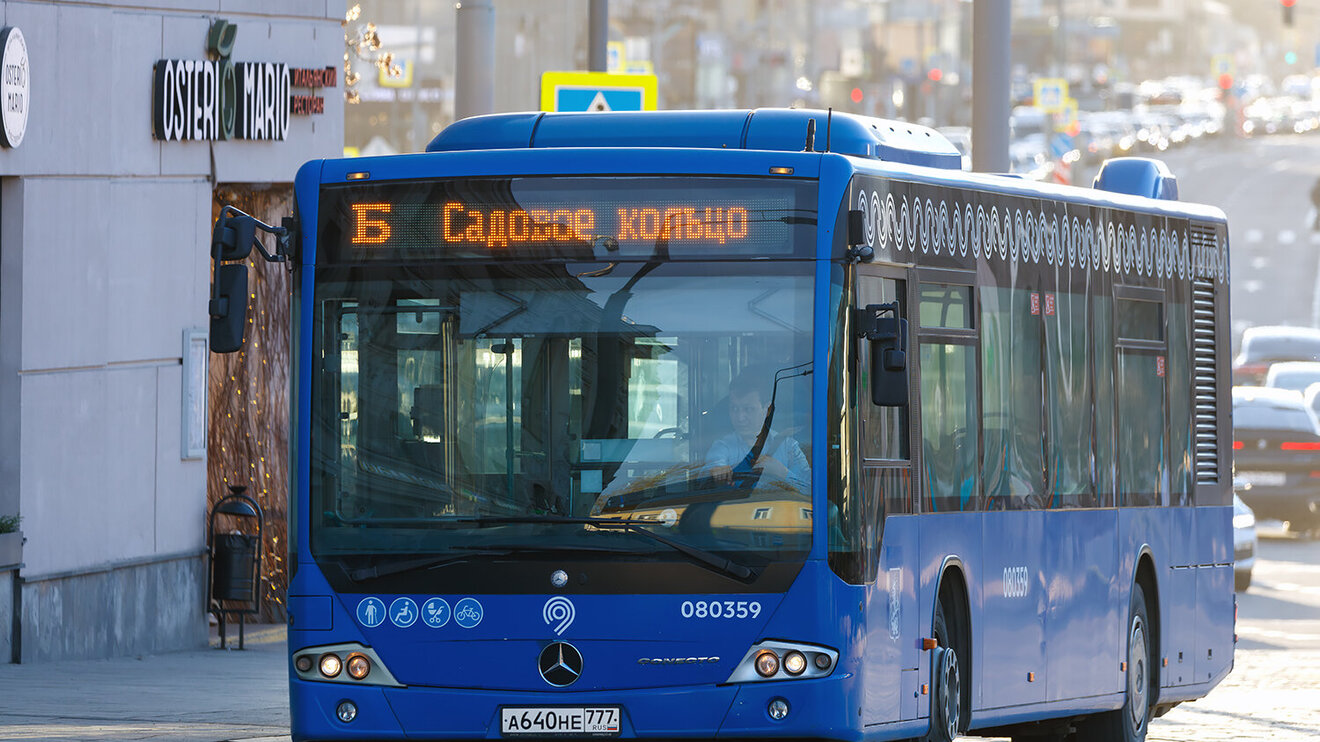
The novel's text mentions the protagonist riding the "bukashka" — the popular nickname for the legendary "B" trolleybus route, which ran along Moscow's Garden Ring.
The origin of the nickname
The nickname "Bukashka" ("Little Bug") became attached to the route as far back as 1912, when a tram on line "B" was launched along the Garden Ring in place of a horse-drawn tram. The route letter was chosen by analogy with the "A" ring tram route on the Boulevard Ring — at the time, the Boulevard Ring was called "Ring A," and the Garden Ring, "Ring B." The popular nickname "Bukashka" stuck, thanks to its sound resemblance to the letter "B" (Russian "Б," pronounced roughly like the start of "bukashka," meaning "little bug"), and possibly because the tram looked small against the wide Garden Ring.
From tram to trolleybus
In 1936–1937, a landmark change took place: the tram was removed from the Garden Ring, replaced by a trolleybus, which inherited not only the "B" designation but the popular nickname "Bukashka." Initially the trolleybus ran from Krymskaya Ploshchad to Kursky Station, but the route gradually expanded.
By 1939 the trolleybus route had been extended to Taganskaya Ploshchad, and the route finally closed into a complete ring only in 1963, after the reconstruction of the Zamoskvorechye arc of the Garden Ring was finished. By the mid-1990s, then, when the events of the novel take place, the trolleybus had already been running the full ring for more than thirty years.
The route in 1996
In 1996, when the events of the novel take place, route "B" was one of the most important and recognizable forms of public transit in Moscow. In 1982, the route was split into two rings: an inner one ("Bk") and an outer one ("Bch"), allowing passenger traffic to be handled more efficiently.
The trolleybus ran along the entire Garden Ring, connecting the capital's most important transit hubs: Paveletsky and Kursky stations, and the main stations of the metro's circle line and radial lines. The route was about 16 kilometers long, and a full circuit took just over an hour.
Operational details
By the mid-1990s, the "Bukashka" ran on a normal daytime schedule; it did not become a round-the-clock route until later, on August 31, 2013. In 1996, the route was served mainly by Soviet-built trolleybuses of various models typical of the era.
The route was very popular with Muscovites for its convenience — it made it possible to reach nearly any point in central Moscow, using transfers at the metro stations located along the Garden Ring. For many residents of the capital, riding the "Bukashka" was not just a way to get around, but a kind of tour of the city's historic center.
Cultural significance
Even in the 1990s, the "B" trolleybus was more than just a means of transportation — it was a genuine symbol of Moscow. The route was mentioned repeatedly in fiction, and celebrated by bards and poets. "Bukashka" became part of Moscow folklore and urban mythology.
The route gained particular fame from the song "Moskovskie Marshruty" ("Moscow Routes") by the band "Va-Bank," which contains the lines: "Let's hop on the little 'Bukashka,' head off at random." This song precisely captured Muscovites' feelings about the legendary route — it was seen as a way to travel unhurriedly through one's own hometown.
Its practical importance for Muscovites
In 1996, riding the "Bukashka" was an everyday thing for residents of Moscow's central districts. The route connected many important points: theaters and museums, train stations and business centers, residential neighborhoods and recreation spots. Many Muscovites used the trolleybus to commute to work, especially those who lived near one stop on the Garden Ring and worked near another.
Trolleybus fares in the mid-1990s were affordable for most city residents, making the "Bukashka" a democratic mode of transport. Amid the economic hardship of the time, many Muscovites preferred surface transit to the more expensive metro.
The technical side
In 1996, various models of Soviet-built trolleybuses operated on the route. The overhead contact network, built back in the 1930s and repeatedly upgraded since, provided reliable power. Despite the age of the infrastructure, the route ran reliably, though technical breakdowns typical of trolleybus transit of the era did happen occasionally.
The daytime interval between trolleybuses was usually 6 to 15 minutes, depending on the time of day and the day of the week. During rush hour, trolleybuses ran more frequently, providing relatively comfortable travel for passengers.
Social context
For the novel's protagonist, as for many Muscovites of the time, riding the "Bukashka" was a familiar way to get home. In 1996, this route had not yet become a tourist attraction, as it later would — it was a living part of the city's transit system, used daily by thousands of people.
The mention of the "Bukashka" in the novel's text precisely captures Moscow reality of the mid-1990s, and underscores the protagonist's rootedness in the urban environment — he uses public transit as naturally as he breathes the air of his native city.