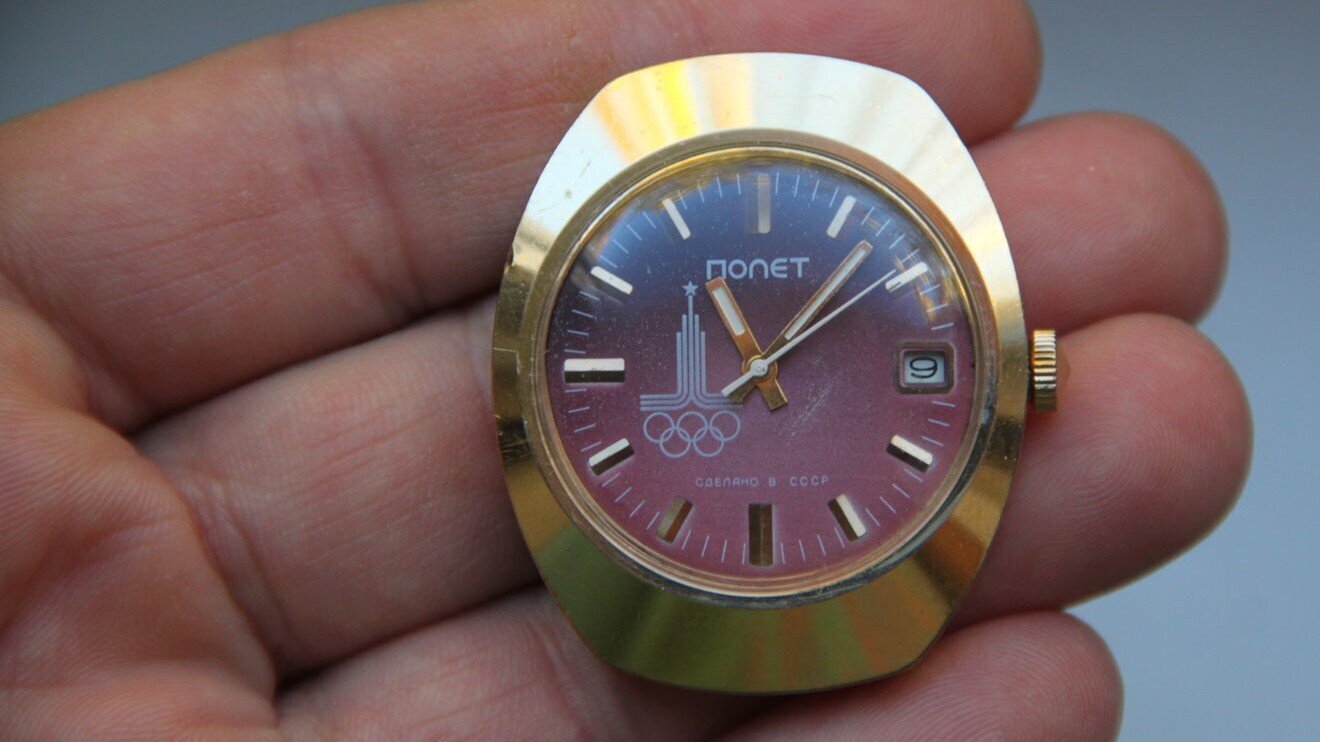
The “Poljot” (“Flight”) watch brand was one of the most iconic names in the Soviet watchmaking industry, a symbol of technical progress and quality that conquered not only the Soviet Union but the whole world. The history of these watches is inseparably tied to the country’s space achievements and became part of the cultural legacy of an entire era.
History and Brand Development
The “Poljot” brand appeared in 1964, when watches from the First Moscow Watch Factory began carrying the registered trademark “Poljot” (Poljot). But the brand’s roots go much deeper — into the history of the founding of the USSR’s first state watch factory.
The First Moscow Watch Factory
The enterprise was founded in 1930 by Joseph Stalin’s personal order, as part of the First Five-Year Plan. It was the first large-scale Soviet factory producing watches and mechanical movements. The plant was located on Marksistskaya Street, 34, building 5 (production later moved to Vorontsovskaya Street).
An interesting fact about the acquisition of equipment: through the Amtorg Trading Corporation, the Soviet government bought out the bankrupt American company Dueber-Hampden Watch Company of Canton, Ohio, as well as the Ansonia Clock Company of Brooklyn. Twenty-eight railroad cars of equipment and parts were shipped from the US to Moscow, and twenty-one former Dueber-Hampden specialists trained Russian workers in the craft of watchmaking.
A curious detail: the movements of the very earliest products still bore the stamp “Dueber-Hampden, Canton, Ohio, USA,” which makes these examples especially prized by collectors.
The War Years and Postwar Development
In 1935 the plant was named after S.M. Kirov, and its watches came to be nicknamed “Kirovka” by the public. With the start of the Great Patriotic War the plant was evacuated to Zlatoust, but by 1942 it had resumed operations in Moscow, producing goods for the front.
In the postwar years the plant was the first in the USSR to produce various types of watches: from 1946 to 1961 it made “Pobeda” (“Victory”) watches, and in the late 1950s it began producing the country’s first mechanical alarm watches under the “Poljot” brand, model “Signal” 2612.
The Brand’s Space Fame
The most celebrated model in the plant’s lineup was the “Shturmanskie” (“Navigator’s”) watch, which achieved worldwide fame thanks to space flight. On April 12, 1961, Yuri Gagarin took a “Shturmanskie” watch, made to a special order for the Air Force, with him on the first spaceflight.
This 17-jewel, hand-wound watch with a Poljot movement had been given to Gagarin back in 1957, when he graduated from Soviet Air Force flight school. Originally, “Shturmanskie” watches were made exclusively for military aviation and weren’t available to civilians. Public versions of the model appeared only years later.
The watch worked flawlessly in weightlessness and is now kept at the Moscow Memorial Museum of Cosmonautics. The original watch had a 33 mm diameter, considered small by today’s standards.
In 1965 cosmonaut Alexei Leonov, during the first spacewalk, wore a Strela (“Arrow”) chronograph made by the same plant.
Technical Achievements and Innovation
The First Moscow Watch Factory pioneered many technical solutions:
Calibers and Movements
In 1961 the plant began producing the country’s first ultra-thin watches, the “Vympel,” with the 2209 caliber. The movement was only 2.9 mm thick, with a total case height of 5 mm. These watches were made until 1975, after which the technology was transferred to the Minsk Watch Factory.
In 1976 production began of a new chronograph caliber, 3133 — a cam-less movement acquired under license from a Swiss firm. Initially, watches with this caliber were supplied only to the Navy and Air Force in special “Okean” and “Shturmanskie” series. Only in 1983 did watches with the 3133 movement become available to ordinary buyers.
This movement turned out to be of such high quality that it was successfully exported and even installed in elite Swiss watch models.
Specialized Models
The plant produced a wide range of specialized watches:
“Shturmanskie” — watches for military pilots and navigators, with 23 jewels. Issued with customer (Ministry of Defense) acceptance and handed out as equipment. Some models had a double calendar, a stopwatch, and a scale for calculating distance from light-and-sound signals (based on the difference between the speed of light and sound). The cost of such watches in the mid-1980s was 140 rubles (147 rubles at GUM).
“Okean” (“Ocean”) — the naval version of the “Shturmanskie,” for sailors. Its distance scale was graduated in cable lengths and nautical miles. These watches were listed as ship’s equipment and were not the captain’s personal property.
“Signal” 2612 — the USSR’s first mechanical alarm watch, with 18 jewels.
Export Brands and International Recognition
From the late 1960s the plant began producing watches under the “Sekonda” brand exclusively for export, mainly to England and Europe. This brand became extremely popular in Western markets and contributed to the international recognition of Soviet watches.
In 1972 the plant produced 2.7 million wristwatches, of which 70% were exported to 63 countries. By 1973 production of “Poljot” watches exceeded 3 million units, in 114 design variants with various additional features.
In the 1980s “Poljot” successfully moved into producing quartz and electronic watches, keeping pace with global trends in the watch industry.
Iconic Models of the Soviet Era
Besides the “Shturmanskie,” the plant produced many other landmark models:
“Pobeda” (“Victory”) — though this model was mainly produced at other plants, the First Moscow Watch Factory’s designers actively participated in developing the K-26 model.
“Moskva,” “Mayak,” “Sputnik” — models with special designs honoring the 1957 launch of the first artificial Earth satellite.
“Rodina” (“Homeland”) — the first Soviet watch with an automatic winding function.
“Sportivnye” (“Sport”) — models with a function to stop the second hand for precise timekeeping.
After Gagarin’s flight, models with “space” names were released: “Orbita” in 1962, “Kosmos” in 1963.
Quality and Reliability
“Poljot” watches were known for their quality and reliability. In 1961 the plant was awarded the title “Enterprise of Communist Labor,” and in 1966 it received the Order of Lenin.
The “Poljot” and “Poljot” trademarks were registered in more than 90 countries, evidence of the international recognition of Soviet watch quality.
The movements were noted for their accuracy, durability, and low maintenance needs. Many “Poljot” watches are still running today, decades after they were made.
Design
“Poljot” watches were marked by concise, functional design. Dials came in black or white with contrasting hands and numerals. Cases were made of stainless steel or brass, straps of leather or fabric.
Special attention was paid to dial legibility — numerals and markers were clear and easily distinguishable even in poor lighting, especially important for military and aviation models.
The Post-Soviet Period
After the USSR’s collapse, the plant faced serious challenges. On February 14, 1992, the enterprise was converted into a joint-stock company. In attempts to adapt to a market economy, various structures were created:
In 1997, on the plant’s base, “Poljot-Klassika” LLC was founded; in 2001, “Poljot-Khronos” LLC. These enterprises specialized in producing award and gift watches carrying the symbols of various organizations.
In 2005 the plant’s equipment and the manufacturing technology for the legendary 3133 chronograph caliber were bought out by the watch holding company “Maktime.” After that, mass watch production ceased, and the production facilities were leased out.
On August 2, 2018, the closed joint-stock company “First Moscow Watch Factory” was converted into a limited liability company of the same name.
New Brands and the Present Day
In the post-Soviet period, new brands emerged on the plant’s base:
“Romanoff” — a brand representing the First MWF in the international market since 1993. The watch collection received a Certificate of High Craftsmanship, endorsed by leading Russian museums, including the Moscow Kremlin, the Russian Museum, the State Hermitage, and the Russian Museum of Ethnography.
Modern heirs of “Poljot” continue producing watches, though on a much smaller scale, aimed at collectors and enthusiasts of Soviet watchmaking classics.
Collector Value
Today, vintage “Poljot” watches are of significant interest to collectors worldwide. Especially prized are:
Early “Shturmanskie” from the 1960s, similar to the one Gagarin took with him. Watches with rare dials and special military series. Models with the 3133 caliber, especially early versions. Export “Sekonda” variants with original markings.
Prices for authentic vintage “Poljot” watches at international auctions can reach significant sums, especially for models in excellent condition with original documentation.
Technical Specifics
“Poljot” watch movements were based on various calibers:
2609 — the base caliber for “Shturmanskie,” with 15 jewels
2612 — for the “Signal” alarm watch (18 jewels)
2614 — a date-display modification
3133 — the chronograph caliber, with 23 jewels
2209 — the ultra-thin caliber for the “Vympel”
Most calibers operated at a frequency of 18,000 vibrations per hour, providing good accuracy with a reliable construction.
Cultural Significance
“Poljot” watches became an integral part of Soviet culture. They symbolized the country’s technical progress, the quality of domestic products, and were a source of pride for their owners.
The “Poljot” brand was associated with the USSR’s space achievements, lending the watches special prestige. Wearing the same brand of watch as the first cosmonaut was an honor for many Soviet citizens.
The watches also played an important social role — they were a coveted gift, a symbol of prosperity and success. Quality “Poljot” watches were passed down through generations, becoming family heirlooms.
Conclusion
“Poljot” watches are more than just a timepiece. They are a symbol of an entire era, an embodiment of Soviet industry’s technical achievements, and witnesses to great historical events. From the first human spaceflight to the everyday lives of millions of people, “Poljot” watches accompanied Soviet citizens at every stage of their country’s life.
Today, when digital technology has transformed our sense of time, mechanical “Poljot” watches remain a reminder of an era when a watch wasn’t just an accessory, but a reliable companion, made by master craftsmen with particular care and attention to detail.
The legacy of “Poljot” lives on in the hearts of collectors, in museum exhibitions, and in the memory of the great achievements of Soviet science and technology. These watches will remain an eternal symbol of a time when humanity took its first steps toward the stars.