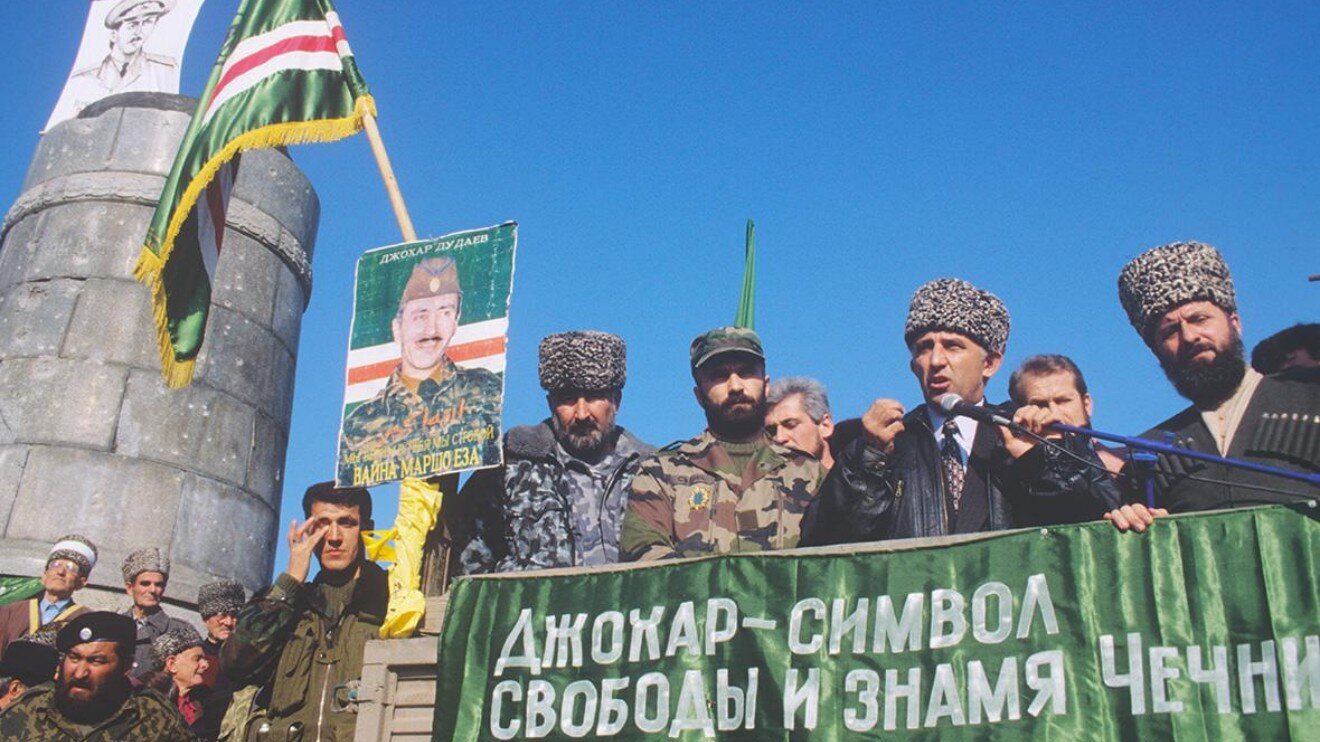
By June 1993, Chechen separatism had reached a critical point in its development. The self-proclaimed Chechen Republic of Ichkeria, led by General Dzhokhar Dudayev, was living through an acute internal political crisis that would soon grow into open armed confrontation between supporters and opponents of the regime.
Background to the Conflict
Chechen separatism had deep historical roots. After the collapse of the USSR in 1991, the national liberation movement in the former Checheno-Ingush ASSR sharply intensified. The key figure of this movement was Major General of Aviation Dzhokhar Dudayev, the only ethnic Chechen general in the Soviet Army, who had commanded a strategic bomber division in Tartu.
On October 27, 1991, Dudayev was elected president of the self-proclaimed Chechen Republic. According to the local Central Election Commission, 72% of voters took part, with 90.1% voting for Dudayev. However, these elections were not recognized by Russian authorities and were held in serious violation of the law in effect.
On November 1, 1991, Dudayev’s first decree proclaimed the independence of the Chechen Republic (Nokhchi-Cho) from the RSFSR and the USSR. This declaration received no international recognition, but de facto Chechnya became independent territory.
The Political Situation by Mid-1993
By early 1993 the political situation in Chechnya had become extremely tense. Dudayev faced growing opposition from his own parliament and various political forces in the republic. The opposition accused the president of authoritarian rule and of wrecking the region’s economy.
On February 19, 1993, Dudayev approved a new constitution establishing a presidential republic, further expanding his powers. This move sparked sharp discontent among parliament and opposition forces.
On April 15, 1993, an indefinite rally by parties and movements opposed to Dudayev began on Theatre Square in Grozny. The protesters demanded the president’s resignation, the dissolution of parliament, and new elections.
The April 1993 Crisis
The situation sharply escalated on April 17, 1993, when Dudayev took radical steps to hold onto power. He dissolved:
- The Cabinet of Ministers of the Chechen Republic of Ichkeria
- The republic’s parliament
- The Constitutional Court of Ichkeria
- The Grozny City Council
At the same time, direct presidential rule was introduced across Chechnya and a curfew was imposed. These actions effectively amounted to a coup and the establishment of a dictatorship.
The Opposition’s Response
On May 25 the dissolved Parliament of Ichkeria, the government it had appointed, and the muftiate appealed to the citizens of Chechnya to rise up in defense of the constitution and restore legitimate authority in the republic. On May 28 the Constitutional Court ruled that Dudayev’s actions were criminal, aimed at an unlawful seizure of power.
On June 2, 1993, the first assassination attempt on Dudayev took place, a sign of how extreme the political confrontation in the republic had become.
The Bloody Events of June 4-6, 1993
The crisis reached its climax with the tragic events of early June. On June 4, 1993, a special unit of Dudayev’s national guard stormed the Grozny City Council building, where the dissolved Parliament and Constitutional Court of the ChRI were meeting.
The assault killed 58 people and wounded around 200 — the bloodiest events in the history of the internal Chechen conflict to that point. On June 5-6, the same guard dispersed a rally of parliament supporters on Theatre Square.
A referendum scheduled by parliament for June 5, on confidence in the president and parliament and on the form of state structure, never took place — the ballots were destroyed by Dudayev’s armed supporters inside the ChRI Central Election Commission building. Related clashes killed, by various estimates, between 7 and 50 people.
The Aftermath of the June Events
After the June 1993 events, Dudayev finally lost any legal opposition in Grozny. Parliament, the Constitutional Court, and the Grozny City Council were all dispersed. The opposition rally on Theatre Square, ongoing since April 15, dissolved itself given the threat of armed clashes.
Armed opposition supporters withdrew to remote districts of Chechnya — the Nadterechny and Urus-Martan districts — where they continued resisting the Dudayev regime. On June 12 residents of the Nadterechny district resolved to consider all orders issued by Dudayev and his government invalid within the district.
The Socioeconomic Situation
By June 1993 the self-proclaimed Chechen republic was living through a deep socioeconomic crisis:
- Industrial production had fallen sharply
- Pensions and social benefits went unpaid
- Schools and hospitals were closing
- 70% of the working-age population was unemployed
- Corruption and crime flourished
A particular problem was the mass flight of the Russian and Russian-speaking population from the republic. This process amounted to outright ethnic displacement, adding further tension to relations with the federal center.
The Criminalization of the Economy
The absence of federal oversight led to large-scale criminalization of Chechnya’s economy:
- Illegal trade in weapons, petroleum products, and drugs
- Duty-free import and export of goods
- Theft of petroleum products disguised as their protection
- Systematic attacks on Russian trains passing through the republic’s territory
- Mass financial fraud using fake payment orders (avizo)
Grozny’s airport became a major smuggling hub, since federal customs authorities did not operate on Chechen territory. The republic became a refuge for many Russian economic criminals.
Relations with the Federal Center
By June 1993, Russian-Chechen negotiations had reached a dead end. Despite several rounds of talks from March 1992 to January 1993, the sides reached no concrete agreements on normalizing relations.
On January 14, 1993, a protocol of intent was signed in Grozny between Russian representatives (Deputy Prime Minister S. Shakhrai, R. Abdulatipov, S. Shuikov) and representatives of Ichkeria, in which the sides confirmed their readiness to discuss a treaty normalizing relations. However, the document was disavowed by President Dudayev that same day.
On June 17, 1993, the Council of Nationalities of the Russian Supreme Soviet adopted a statement calling on federal authorities to take immediate steps to normalize the situation in Chechnya and protect individual rights and freedoms.
Armed Opposition
After the June 1993 events, civil confrontation in Chechnya began growing into armed conflict. The first to take up armed struggle against the Dudayev regime was the Committee of National Salvation (KNS), led by former Dudayev supporter I. Suleimenov.
Punitive raids by armed Dudayev supporters in the lowland districts in June-August 1993 helped escalate the internal Chechen conflict. Opposition forces began forming their own armed units to defend against Dudayev’s detachments.
The Position of Neighboring Republics
The stance of neighboring North Caucasus republics played a particular role in the development of the Chechen crisis. After Dudayev proclaimed independence, Ingushetia held its own referendum, in which the population voted to form an independent Ingush republic within the Russian Federation, thereby separating from Chechnya.
On July 23, 1993, Ingushetia and the unrecognized Ichkeria signed a treaty “On the Principles for Determining the Borders of the Chechen and Ingush Republics,” which fixed the de facto division of the former Checheno-Ingush ASSR.
The Significance of June 1993
June 1993 became a turning point in the history of Chechen separatism. The month’s events meant:
- Dudayev’s final shift to authoritarian methods of rule
- The elimination of legal opposition in the republic
- The start of an armed internal Chechen conflict
- A deepening socioeconomic crisis
- Further deterioration in relations with the federal center
These events set the stage for the future First Chechen War, which began in December 1994. Dudayev’s inability to compromise and his forceful methods of solving internal political problems made federal military intervention practically inevitable.
International Context
It is worth noting that Chechen separatism developed in a complete absence of international support. No country in the world recognized the independence of the Chechen Republic of Ichkeria — a fundamental difference from other separatist movements in the post-Soviet space.
Nevertheless, Dudayev’s leadership actively sought international ties, trying to gain support in the Muslim world. These attempts brought no substantial results, and Chechnya remained internationally isolated.
Conclusion
By June 1993, Chechen separatism was in a state of deep crisis. The 1991 declaration of independence had not produced a viable state. Instead, Chechnya sank into chaos, marked by political instability, economic collapse, rising crime, and internal conflicts.
The events of June 1993 — the bloody suppression of the opposition and the establishment of Dudayev’s dictatorship — became a point of no return in the development of the Chechen crisis. They predetermined the conflict’s further escalation and made federal military intervention to restore constitutional order in the republic practically unavoidable.
Chechen separatism as it stood in June 1993 was less a national liberation movement than an authoritarian regime built on force and the suppression of all dissent — a circumstance that largely explains its eventual failure and defeat in its confrontation with the Russian state.