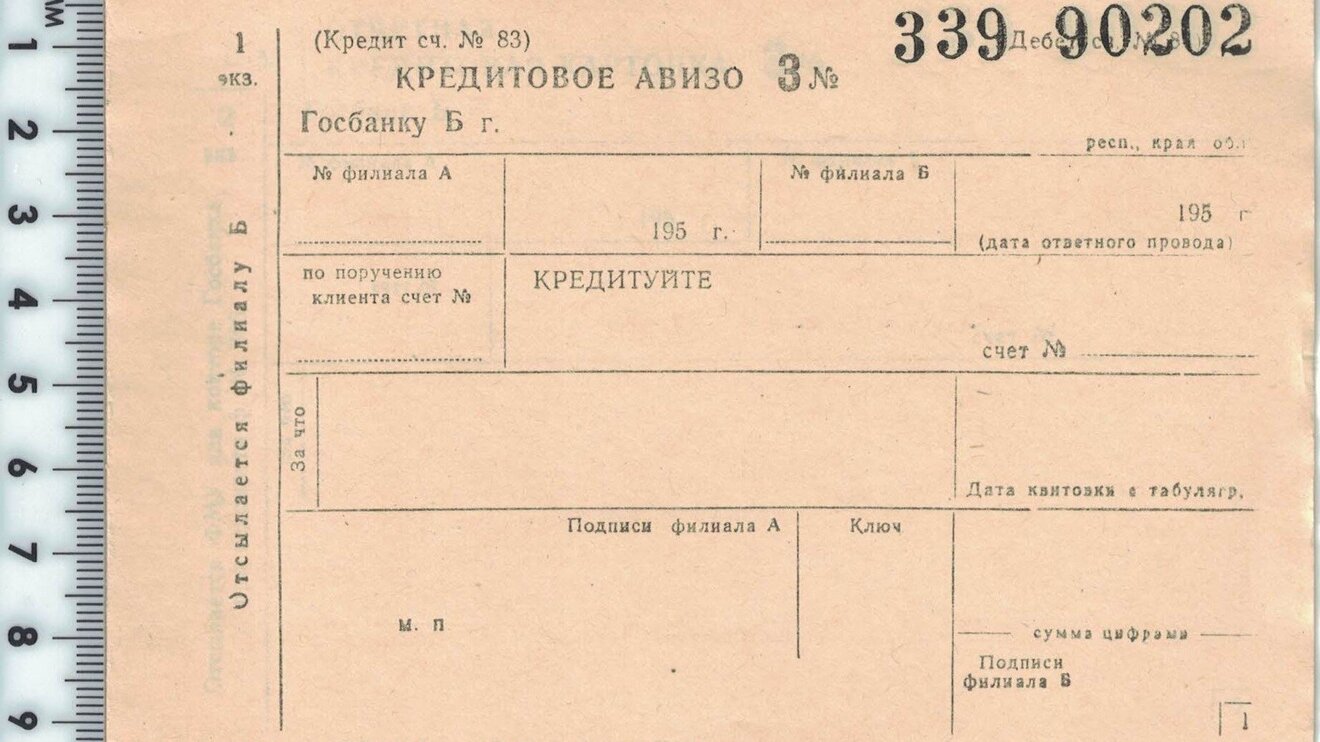
The novel's mention of how regional businesses "feared non-cash payments like the plague, ever since the Chechen avizos," refers to one of the largest financial scams in Russian history, which inflicted colossal damage on the country's banking system.
What an avizo was, and how the fraud became possible
An avizo is a banking document notifying of a transaction on an account. A credit avizo means funds are credited to an account; a debit avizo means funds are withdrawn. In the early 1990s, avizos were used for interbank settlements and were simple paper documents with no serious security features.
The opportunity for large-scale fraud arose during the restructuring of the banking system, as the Central Bank of Russia's regional settlement and cash centers (RKTs) were being set up. A parliamentary commission later criticized the Central Bank for the RKTs structure it had created, saying it had "severed the link between the actual sender of money and its recipient, creating a kind of black hole."
The Soviet-style banking system proved utterly unprepared for such an elementary, yet effective, scheme. Clearing between banks took place monthly, quarterly, or even annually, giving fraudsters plenty of time to cash out and conceal the stolen funds.
How the fraud worked
The scheme was strikingly simple. Fraudsters would arrange with a bank employee, who would print an avizo for a given sum and send it to the Central Bank or one of the specialized banks (Promstroybank, Sotsbank, Agroprombank). After that, all that remained was to collect the money.
The magazine "Kommersant" described a typical scheme in 1992: a "messenger" would arrive at a Moscow enterprise with a blank avizo form and offer, for a certain percentage of the cash, to transfer a much larger sum in non-cash funds to the enterprise's bank account. Chechen "financiers" targeted bank clients who could handle large amounts of cash.
Former deputy and businessman Artem Tarasov recalled the words of Aslan Didigov, a representative of the Grozny branch of the "Istok" bank: "We write up a piece of paper, it goes to the bank. We get two truckloads of cash and drive them straight home, to Grozny."
The scale of the fraud
The damage figures are staggering. According to the newspaper "Kommersant," more than 600 billion rubles were stolen from the Central Bank in 1992 alone. A press release from the Central Bank of Russia's Main Directorate for Moscow, dated September 1995, reported that from December 1992 to September 1995, around 2,900 fake avizos were uncovered at Moscow RKTs, totaling more than 800 billion rubles.
Fake avizos were especially widely used in Chechnya. According to the Interior Ministry, from 1992 to 1994, 485 fake avizos totaling 1 trillion rubles came out of nine Chechen banks. In total, 250 criminal cases were opened over the use of 2,500 fake avizos totaling more than 270 billion rubles.
The cashing-out of stolen funds involved 892 banks and 1,547 enterprises across 68 regions of Russia. The magazine "Ogonyok" noted that from 1991 to 1992, 400 billion rubles in cash were carried into Chechnya: "in physical terms, this mass of money had such volume and weight that it was hauled out of Moscow banks in sacks, by truckload — thousands of sacks."
Who was involved
Fake avizos were widely used by organized Chechen criminal groups, including the Lazan gang, as well as by figures connected to Dzhokhar Dudayev's regime. Dudayev himself later said he "sent various pieces of paper, and in exchange they brought him planes full of sacks of money."
A 1995 Interior Ministry analytical report gave the ethnic breakdown of those prosecuted: of 417 people, 99 were Russian, 151 Chechen, and 26 Ingush. This refutes the notion that the fraud was exclusively "Chechen" — people of various nationalities took an active part in it.
As journalist Yuri Shchekochikhin noted: "Take those same fake avizos, which cost Russia damages of two trillion rubles at 1992 prices. They're called 'Chechen,' but I'm certain this operation couldn't have been carried out without Russian, Moscow banking structures."
The fight against the fraud
Starting in June 1992, the Central Bank began actively combating the theft, setting stricter rules for verifying incoming avizos and requesting supporting documents. A ban was introduced on transactions with institutions of the Bank of Chechnya.
As Arnold Voilukov, first deputy chairman of the Central Bank of Russia, recalled: "At first, we passed every such avizo along to the investigative agencies. Then they started coming in such a stream that we could barely keep up with recording the data on them. We handed cases over to the police in whole lists at a time."
Technical countermeasures were developed in parallel. In 1992–1993, a cryptographic security system for telegraph avizos was rolled out at 1,800 Central Bank settlement and cash centers. This used "Elektronika MK-85S" encryption devices and specialized "Kriptotsentr-avizo" software.
In September 1993, the "Blitz" digital signature system was introduced at the Moscow RKT, establishing personal accountability for the employee who signed off on each avizo. By the end of 1993, the fake-avizo problem had largely been resolved.
Consequences for the economy
Sergei Stepashin, chairman of Russia's Accounts Chamber, noted that "the damage from the fake-avizo fraud was equivalent to the sum of unpaid wages, at the time, to miners, defense-industry enterprises, the military, and teachers." Money from fake avizos went not only toward the "respectable" business of building criminalized banks, but toward funding hit squads, bribing officials, and dubious deals to acquire production facilities.
Experts believe the fake-avizo fraud helped facilitate the takeover of entire industries. One frequently cited example is brothers Mikhail and Lev Chernoy establishing control, by the mid-1990s, over the ferrous and non-ferrous metals industry. Materials from the Interior Ministry's Investigative Committee noted that the Chernoy brothers paid for metal with money cashed out through fake avizos, totaling more than 10 billion rubles.
Its effect on trust in non-cash payments
The Chechen avizo fraud had long-term consequences for the Russian economy. It undermined trust in non-cash payments, especially in the regions. Many businesses and organizations preferred to work exclusively with cash, considering it more reliable.
It is precisely this distrust that the novel's author refers to, describing the situation in 1996: regional enterprises "feared non-cash payments like the plague, ever since the Chechen avizos." This distrust lingered for many years, hampering the development of a modern banking system in Russia.
The fake-avizo fraud became one of the symbols of the chaotic 1990s, a time when weak state institutions and an imperfect legal system created fertile ground for large-scale financial fraud. The consequences of this crisis of trust were felt in the Russian economy for many years afterward.