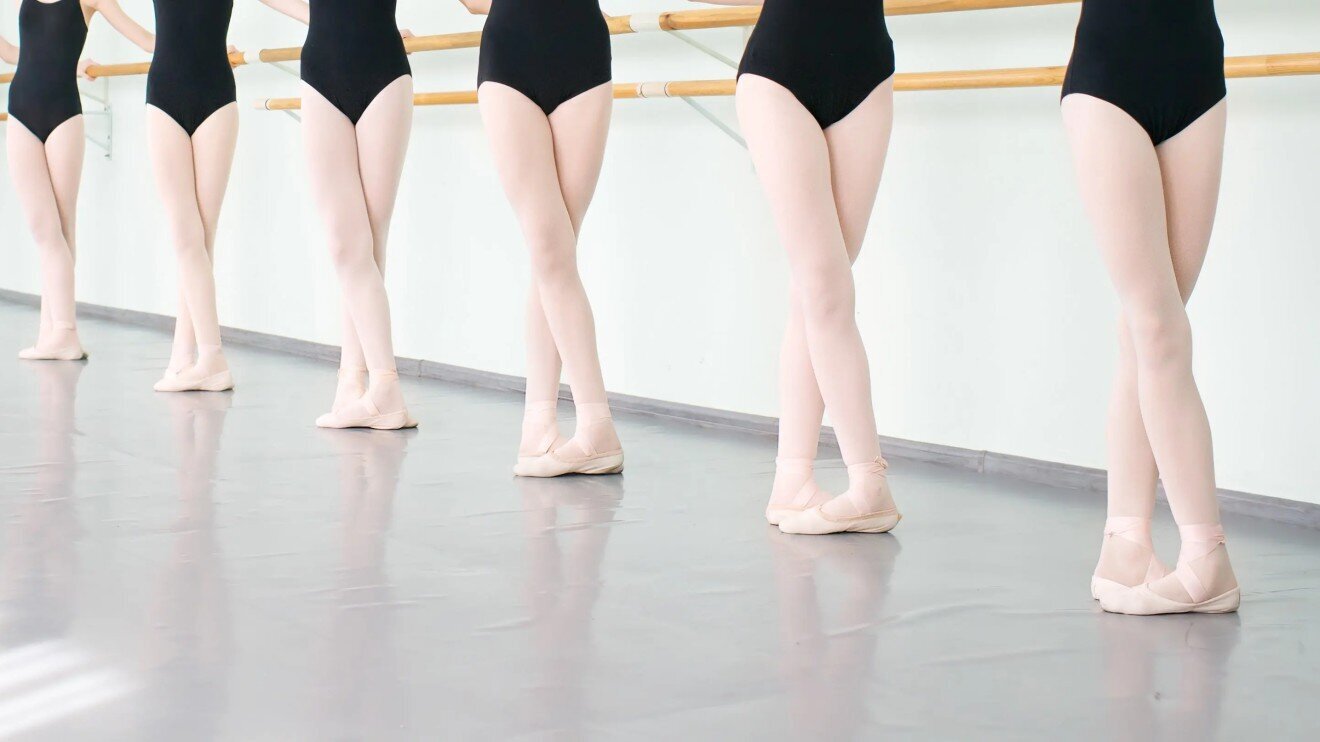
In this context, the reference is to the fourth position of the feet in classical ballet — one of the five basic positions that form the foundation of ballet technique.
Technical description
The fourth position of the feet is performed as follows: one foot is placed in front of the other, with the heel of the front foot facing the toe of the back foot. The distance between the feet equals or exceeds the length of a foot. Both legs must be turned out as far as possible (en dehors), meaning the legs are rotated outward along their entire length — from the hips to the feet.
The Western ballet school distinguishes two variants of the fourth position:
- IV crossed (croisé) — the classic variant described above
- IV open — where both heels are on the same line
Historical background
The system of the five basic foot positions in ballet was first codified by the French dancer Pierre Rameau (1674—1748) in his book «The Dancing Master» (Le Maître à danser), published in 1725. Rameau taught dance at the court of the Spanish queen Maria Luisa of Savoy, and later at the French court.
The development of ballet terminology began as early as the 17th century, with the work of Pierre Beauchamp, dance teacher to the French king Louis XIV. The French ballet school, which became the first professional ballet institution (the Academy of Music in 1661, the dance academy attached to the Royal Academy of Music in 1672), laid the foundations of the classical terminology still used in ballet today.
Practical application
The fourth position is one of the most difficult to perform, since it requires well-developed turnout and strong muscles. Correctly executing this position gives the dancer stability and serves as the basis for many ballet movements and transitions.
In all the classical foot positions, including the fourth, body weight must be distributed evenly between both legs, all the muscles engaged, the stomach drawn in, the glutes tucked, and the posture upright. It's from these basic positions that many other dance positions and steps in classical ballet are built.