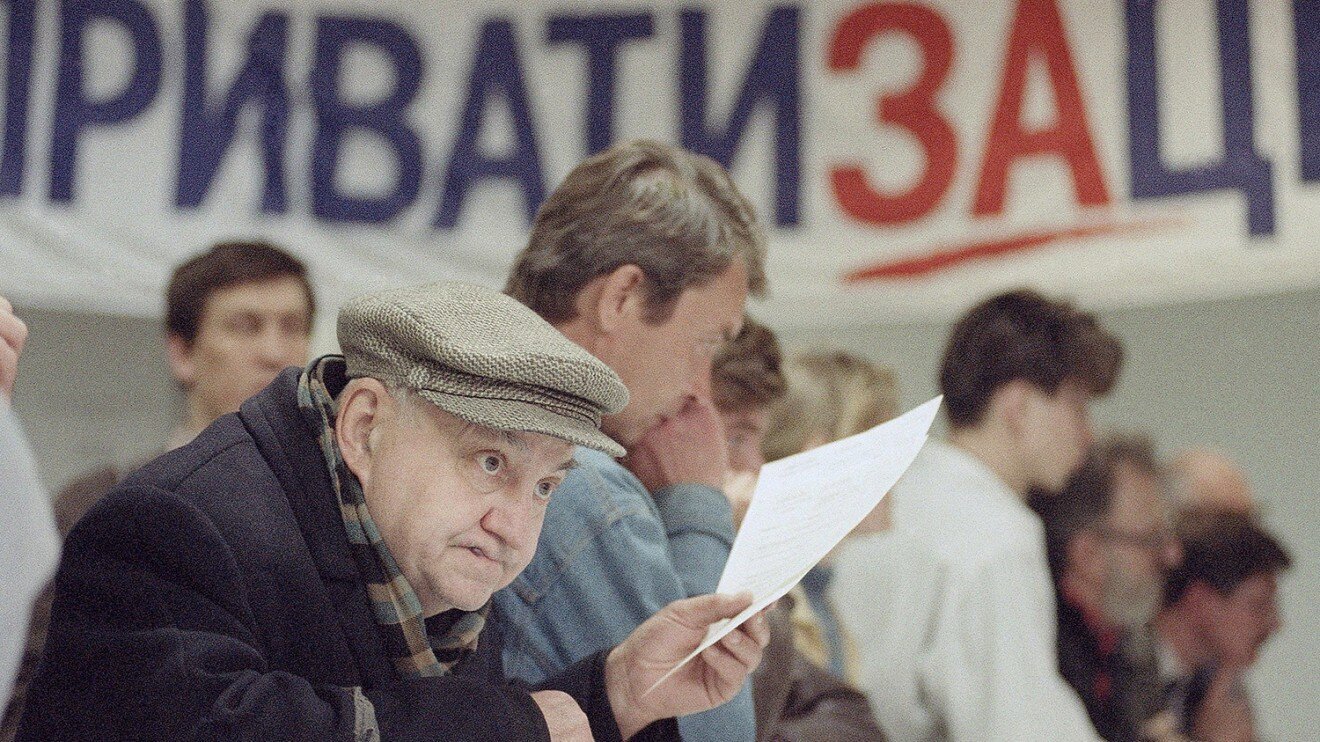
Voucher auctions became one of the key mechanisms of mass privatization in early-1990s Russia, letting millions of citizens become shareholders in newly privatized enterprises.
Legal Basis
Voucher auctions were held under the Russian Federation Law «On the Privatization of State and Municipal Enterprises in the Russian Federation» and a special «Regulation on Specialized Voucher Auctions.» Under these rules, voucher auctions were used to sell:
- 80% of shares in state enterprises
- 35–90% of shares in municipal enterprises
The only accepted payment at these auctions was privatization vouchers — issued free to every Russian citizen, with a face value of 10,000 rubles.
How the Auctions Worked
The voucher-auction procedure was fairly complex, involving several stages:
Bid Submission
Participants could submit two types of bids:
- Type 1 — specifying only the number of vouchers the participant was willing to spend
- Type 2 — specifying the number of vouchers and a maximum price per share
Setting the Price
A commission set a single sale price for all shares, such that:
- Every Type 1 bid was satisfied
- Every Type 2 bid at or above the sale price was satisfied
- At least 95% of the shares on offer were sold
Public Notice
Four weeks before an auction (two weeks for municipal enterprises), a public notice was published containing:
- The enterprise’s full name and address
- The number and types of shares
- The shares’ face value
- Information on employee benefits
- The procedure for submitting bids
For large enterprises with charter capital exceeding 50 million rubles, additional publication in national newspapers was required.
Real-World Practice, 1993–95
In practice, voucher auctions often took place amid low public awareness and heavy involvement by organized groups of investors. Many ordinary citizens:
- Didn’t understand how the auctions worked
- Sold their vouchers for token sums
- Didn’t take part in the bidding at all, for lack of information
This created opportunities for concentrating ownership in the hands of a few participants — exactly what happens in the novel with the character Zhorik, who confidently declares: «No one else is going to be there but us.»
The Social Context
Voucher privatization unfolded amid a deep economic crisis. Most citizens were focused on survival, not investment. Privatization vouchers were often seen as just another piece of paper, not a real tool for acquiring property.
At the same time, a new class of entrepreneurs — the «New Russians» — was taking shape, actively buying up vouchers from the public and taking part in auctions. It’s exactly this category the character Zhorik places himself in, talking about the need to «become capitalists, real ones, fat-faced.»
Results and Consequences
By 1995, around 17,000 voucher auctions had been held, privatizing tens of thousands of enterprises. But the results proved contradictory:
Positives
- Mass creation of private property
- Formation of a stock market
- Elimination of the state monopoly
Negatives
- Concentration of ownership
- Devaluation of public assets
- Rising social inequality
Historical Note
The voucher privatization of 1992–94 became the largest program in history for transferring state property into private hands. Every Russian citizen received a privatization voucher with a face value of 10,000 rubles, which in theory represented their share of the nation’s collective property.