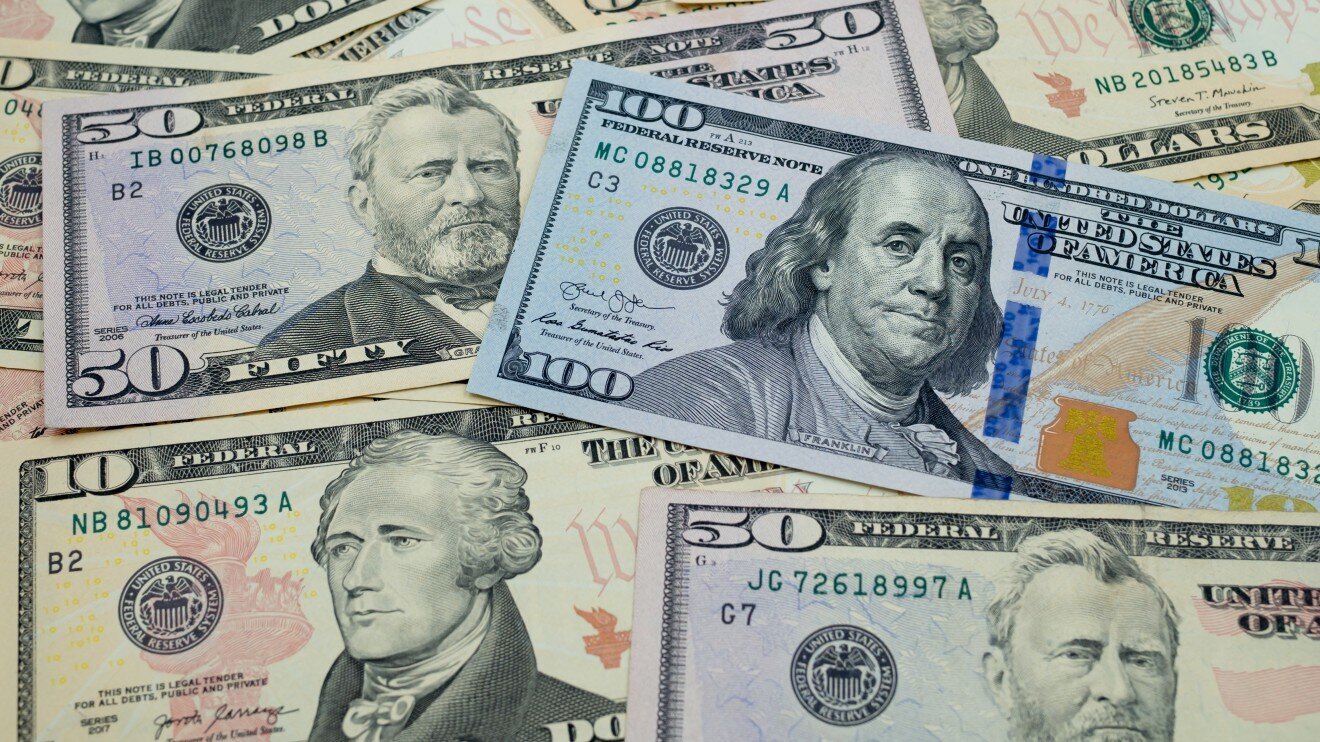
The United States Dollar is the currency of the United States of America, one of the world's primary reserve currencies. 1 dollar = 100 cents. Its official symbol, $, is placed before the number. The power to issue currency belongs to the Federal Reserve System (the Fed), which performs the functions of the US central bank.
In 1993, the American dollar was the most important currency not only in international transactions, but in Russia's shadow economy after the collapse of the USSR. At the time, on Russian territory, the dollar served as the primary store of value and the currency of choice for large transactions.
The dollar's history
The word "dollar" comes from the name of the "thaler" coin, minted in Bohemia (modern Czechia) starting in the 16th century. In colonial America, Spanish silver 8-real coins were called "dollars."
After the US declared independence in 1776, coins from various countries circulated within it. In 1785, the US Congress adopted the Spanish peso as the national currency, under the name "dollar." In 1792, the Coinage Act was passed, and a mint was established in Philadelphia to produce the first American coins.
The first one-dollar US coins were silver. In 1900, the Gold Standard Act was passed, establishing gold as the sole monetary metal. During the Great Depression, in 1933, the US gold-coin standard was abolished.
The dollar finally secured its leading position in the world after the Second World War. In 1944, the Bretton Woods Agreement cemented the dollar's dominance, letting it replace gold as the world's means of payment. In 1971, US President Richard Nixon ended the dollar's peg to gold, and since 1976, under the Jamaica Accords, the dollar has remained the world's reserve currency with a floating exchange rate.
Denominations of bills and coins
US coins
- 1 cent (penny) — featuring Abraham Lincoln
- 5 cents (nickel) — featuring Thomas Jefferson
- 10 cents (dime) — featuring Franklin D. Roosevelt
- 25 cents (quarter) — featuring George Washington
- 50 cents (half dollar) — featuring John F. Kennedy
- 1 dollar — featuring Sacagawea
US bills in circulation in 1993
- $1 — George Washington, 1st US President
- $2 — Thomas Jefferson, 3rd US President
- $5 — Abraham Lincoln, 16th US President
- $10 — Alexander Hamilton, the first US Secretary of the Treasury
- $20 — Andrew Jackson, 7th US President
- $50 — Ulysses S. Grant, 18th US President
- $100 — Benjamin Franklin, scientist, writer, and diplomat
Bills of $500, $1,000, $5,000, and $10,000 also existed, though they were rarely seen. These large denominations were issued until 1945, and officially withdrawn from circulation starting in 1969.
High-denomination bills (rarities)
- $500 — William McKinley, 25th US President (1934 series)
- $1,000 — Grover Cleveland, 22nd and 24th US President (1934 series)
- $5,000 — James Madison, 4th US President
- $10,000 — Salmon P. Chase, Secretary of the Treasury under President Lincoln
- $100,000 — Woodrow Wilson, 28th US President (used only for internal transactions between Federal Reserve banks)
Design features
All modern dollar bills share the same size, 155.956 by 66.294 mm. The basic design of most dollar bills was approved in 1928.
The reverse side of the bills carries images illustrating US history: on the $1 bill, the Great Seal of the United States; on the $2 bill, the signing of the Declaration of Independence; on the $5 bill, the Lincoln Memorial; on the $10 bill, the Treasury Building; on the $20 bill, the White House; on the $50 bill, the Capitol; on the $100 bill, Independence Hall.
Before 1929, dollar bills were printed in a variety of colors. The uniform green color was introduced in 1929, owing to the low cost of green dye, its resistance to external wear, and a psychological factor — green was thought to inspire trust in money.
Anti-counterfeiting measures
Dollar bills are printed on a special paper made of 25% linen and 75% cotton fiber, reinforced with synthetic threads. The ink formula is a secret held by the US Bureau of Engraving and Printing.
Bills have varying lifespans: a one-dollar bill lasts around 22 months, a $5 bill 24 months, a $10 bill 18 months, a $20 bill 25 months, a $50 bill 55 months, and a $100 bill up to 60 months.
* "Four Franklins" means four one-hundred-dollar bills bearing Benjamin Franklin's portrait — that is, $400.