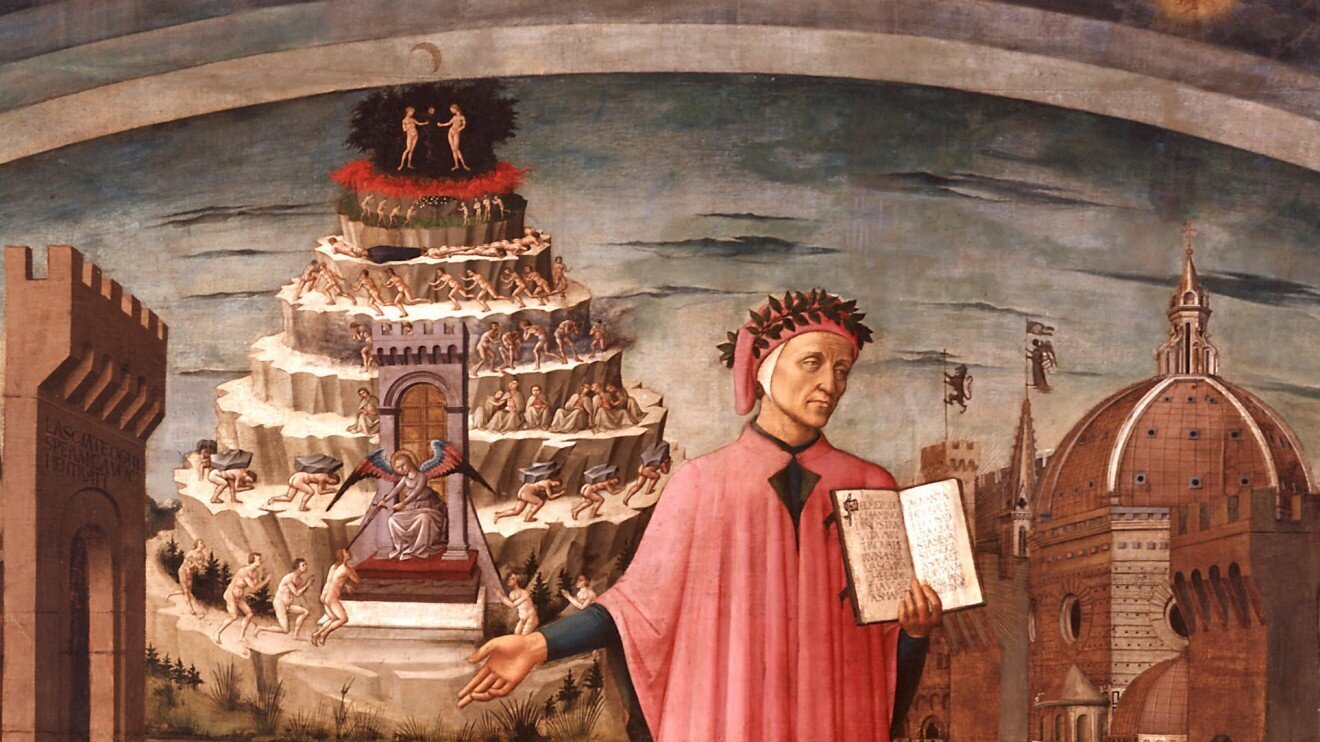
The mention of Dante Alighieri in the context of Russian reality in 1993 is no accident. The great Italian poet, creator of the "Divine Comedy," remains one of the most influential figures in world literature, and his image of a wanderer who passed through hell, purgatory, and paradise takes on a particular symbolic power at historical turning points.
A life in exile
Dante Alighieri (full name Durante di Alighiero degli Alighieri) was born in Florence in the last third of May, 1265. His fate became tragically entangled with the political upheavals of his era — in 1302 he was exiled from his native city along with the "White Guelph" faction and never saw Florence again. His years of exile became a time of wandering across Italy for the poet, but it was precisely in these years that his great poem was written.
The experience of exile, of losing his home, of drifting between foreign courts, left a deep mark on Dante's work. The poet learned firsthand what it meant to be cast out of a familiar world, to lose one's roots, and to search for new footing amid the chaos of political passions.
The "Divine Comedy" as a journey of the soul
Dante's principal work — the "Divine Comedy" (originally simply the "Comedy"; the epithet "Divine" was added later by Boccaccio) — is an allegorical journey of the soul through the three realms of the afterlife: Hell, Purgatory, and Paradise. The poem opens with its famous lines: "Midway upon the journey of our life, I found myself within a forest dark..."
In the context of a novel about Russia in 1993, this work takes on particular relevance. Like Dante's protagonist, the people of that era found themselves "in a forest dark" — in a world where the old values and points of reference had collapsed, where the familiar coordinate system no longer functioned.
Alcohol references and cultural codes
The mention of an "imported 'Dante Alighieri!'" as the name of an alcoholic drink is a typical sign of the times. In the 1990s, the market filled up with imported goods bearing grand names, often far removed from their original context. Using the name of the great poet to label cheap liquor becomes a bitter irony — a symbol of high culture being cheapened in an age of market relations.
This detail reflects a mixing of high and low characteristic of the era, when great names were turned into brand names and cultural symbols were subjected to commercialization.
Dante and Russian culture
Dante's work had a significant influence on Russian literature. He was translated by Dmitry Min and Dmitry Merezhkovsky, and the most famous translation is Mikhail Lozinsky's (1945). Images and motifs from the "Divine Comedy" can be found in Pushkin, Blok, Akhmatova, and Mandelstam.
The Dantean tradition mattered especially to 20th-century Russian poets who had lived through revolutions, wars, and repression. The journey through hell toward the light became a metaphor for Russia's historical path.
Symbolic significance
In the context of a novel set in 1993, the mention of Dante can symbolize several important motifs:
- A journey through hell — a metaphor for the passage through the chaos of a transitional era
- The search for truth — the drive to find bearings in a world of shattered values
- Exile — a sense of being lost in a changed world
- The cheapening of the sublime — cultural symbols turned into brand names
A modern resonance
The "Divine Comedy" remains relevant as a work about a person in crisis, about the search for meaning amid chaos, about the possibility of spiritual rebirth. It is no accident that authors describing turning points in history — times when the familiar world is collapsing and a new one has not yet been built — reach for Dante's imagery.
Invoking the name of the great Florentine in the context of Russian reality in the 1990s underscores the universality of the human experience of wandering in search of truth and home.
"The Love that moves the sun and the other stars" — these are the words that close the "Divine Comedy," affirming the triumph of harmony over chaos, of meaning over absurdity.