In this context, the author uses the term "imbeciles" in its colloquial, derogatory sense to characterize the kidnappers. The word has become part of everyday vocabulary as a synonym for stupidity or dim-wittedness, though its origin lies in medical terminology.
The term's medical origin
The word "imbecile" comes from the Latin imbecillus, meaning "weak, feeble." In 19th- and 20th-century psychiatry, "imbecility" denoted a moderate degree of oligophrenia (intellectual disability) — congenital or acquired in early childhood. Under the classification of the time, imbecility occupied an intermediate position between "debility" (mild degree) and "idiocy" (severe degree).
People classified as imbecile had an IQ in the range of 20–49, corresponding to a mental age of 3 to 9 years in an adult. They could understand simple speech, produce individual words and short phrases, and learn basic self-care skills, but were incapable of abstract thought and required constant supervision.
Social context of the 1990s
In early-1990s Russia, when the novel is set, medical terminology had become firmly embedded in colloquial speech as a means of insult. The words "debil" (moron), "imbetsil" (imbecile), and "idiot" had lost their strictly scientific meaning and become terms of abuse, denoting stupidity, inappropriate behavior, or intellectual inadequacy.
The use of such vocabulary was especially characteristic of the criminal world of the time. Amid socioeconomic chaos, sharp social stratification, and rising crime, the jargon of the criminal underworld seeped into everyday speech. Crude language served as a way to humiliate and demonstrate superiority, typical of the psychology of kidnappers and extortionists.
Its literary function
In the context of the work, the epithet "imbeciles" serves several functions. First, it conveys the narrator-protagonist's emotional state — a mix of fear, contempt, and despair. Second, it characterizes the social milieu and cultural level of the characters. Third, it creates a contrast between the educated protagonist's inner world and the crudeness of the criminal reality surrounding him.
It's worth noting that the term's use here reflects not a medical diagnosis, but the protagonist's subjective judgment of his kidnappers' intellectual and moral qualities. This is a typical example of how scientific terminology gets transformed in everyday consciousness, taking on an emotional, evaluative coloring.
The modern understanding
In modern medicine, the terms "imbecility," "debility," and "idiocy" are considered outdated and are not recommended for use, given their stigmatizing character. The International Classification of Diseases (ICD-10) has replaced them with neutral language: "intellectual disability, mild, moderate, severe, and profound."
This evolution in terminology reflects a change in society's attitude toward people with developmental differences, and a desire to avoid discrimination. In fiction, however, especially when depicting historical periods, preserving authentic vocabulary remains an important element in creating a credible sense of the era.
Dresie and Casie
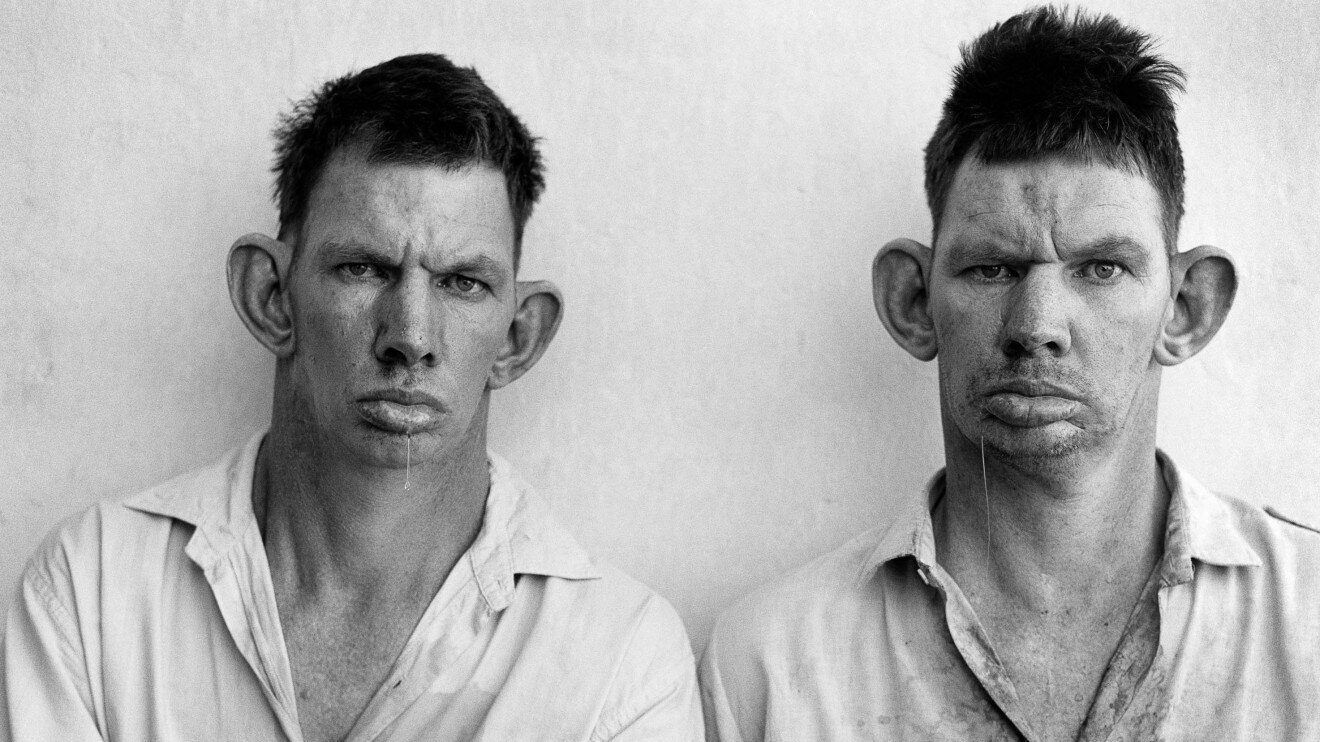
The attention-grabbing image shows the brothers Dresie and Casie. This art photograph, titled "Dresie and Casie," was taken in 1993 and is one of the best-known works by Roger Ballen — a South African photographer of American origin.
The photograph depicts twins from the Western Transvaal (a South African province), whose biography holds no particular interest in itself. Their condition is thought to result from genetic mutations, which could have arisen from radiation exposure, chemical exposure, incest, in-utero infections, or other factors. What is striking is the photographer's work, which created an image of "drooling, hulking, jug-eared imbeciles staring intently and grimly into the lens" — an image that stays forever in the memory of anyone who has seen the photograph.
The artistic concept
Ballen does not reveal the twins' identities. "A great many people contact me wanting to know about them. Not a week goes by without someone calling to suggest putting their faces on a bottle of ketchup or something... I really don't want to talk about them anymore. I've taken thousands of photographs over my whole life, but I'll only be remembered for this one."
Their real life
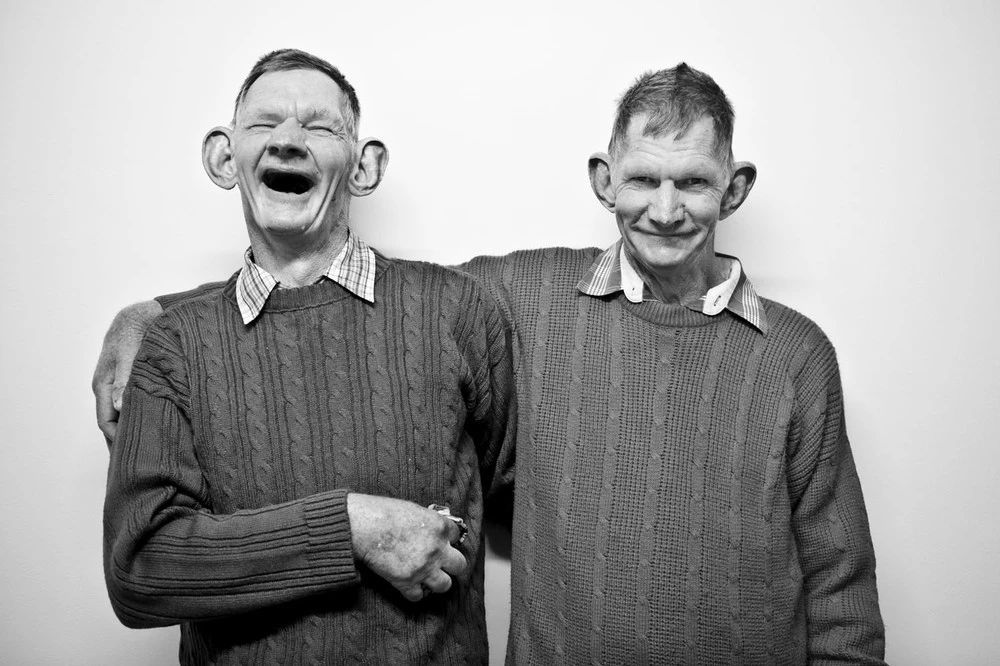
In 2011, the 53-year-old twins Dresie and Casie moved into a care home for people with intellectual disabilities, in a small town in South Africa's North West province. Their brother and his wife, who had previously cared for them in Vryburg, had grown old and realized they could no longer provide the round-the-clock supervision the twins needed.
Both twins are mute and, according to their medical records, "have the mental abilities of five-year-olds." They cannot control their drooling and constantly wipe their chins with handkerchiefs. Despite this, they quickly won over the medical staff — they try to hug the nurses, laugh all day, and react with delight to any social contact. Dresie spends his time knitting, while Casie sweeps the garden paths.
The contrast between reality and image
The very same black-and-white photograph hangs on their closet door. Its composition betrays a professional's work, but the twins — who in real life are gentle and neat — look like suspicious characters in the photo, with dirty clothes and disheveled hair. This photo is the reason Casie and Dresie became the most famous residents of their hometown.
The care home staff believe the twins understand more of the world around them than it might seem. On Sundays, they listen to church services and sing along. When their sister-in-law calls from Namibia, they grow sad and cry, and when they miss their mother, they go up to her photograph and gesture that she has "gone to rest."
Its significance for the novel
Using this image in the context of a novel about Russia in 1993 creates a layered metaphor. Ballen's photograph shows how an artist's vision can transform reality, turning ordinary people into symbols. Much as the novel's author uses the term "imbeciles" to characterize his characters, the photographer created a visual archetype that became a recognizable image in world culture.