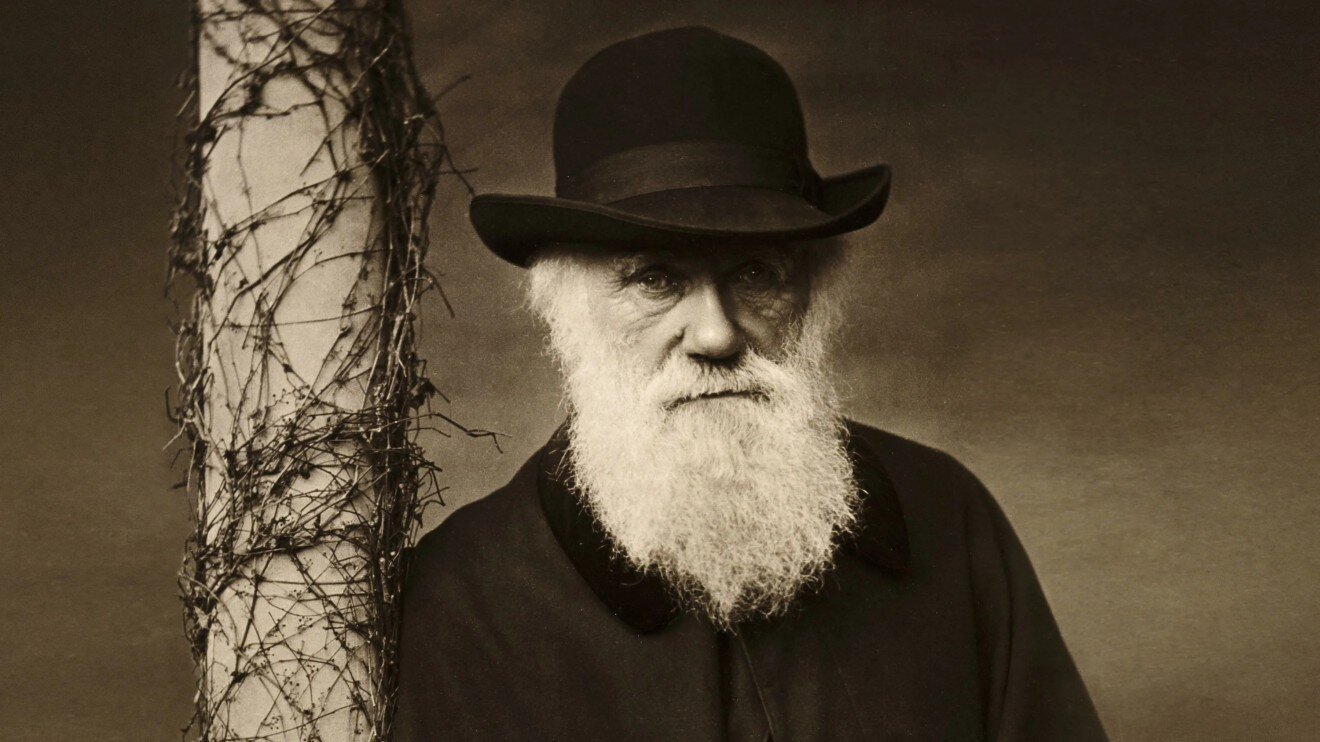
Darwin's theories are a body of scientific concepts developed by the English naturalist Charles Darwin (1809-1882), which revolutionized our understanding of the evolution of life on Earth.
The main tenets of Darwin's theories:
The theory of evolution by natural selection. Published in 1859 in the work «On the Origin of Species by Means of Natural Selection,» this theory holds that:
- More individuals are born in nature than can survive
- A struggle for existence arises among them
- Individuals with variations useful under the given conditions gain an advantage and survive
- Surviving individuals pass these useful traits on to their offspring
- Over many generations, the accumulation of such traits leads to the formation of new species
Sexual selection. In «The Descent of Man, and Selection in Relation to Sex» (1871), Darwin described a mechanism whereby certain traits become fixed in a population not because they improve chances of survival, but because they make an individual more attractive to the opposite sex.
Panspermia. Darwin also considered the hypothesis of a possible extraterrestrial origin of life.
In subsequent years, Darwin's theory of evolution was supplemented by advances in genetics, molecular biology, and other fields, giving rise to the modern synthetic theory of evolution.
In the context of the phrase «If Darwin's theories applied here, I'd have kicked the bucket long ago,» the character is invoking the principle of «survival of the fittest» (a term coined by Herbert Spencer, but often associated with Darwinism). The character considers himself «an outsider in any struggle for a better lot,» meaning he acknowledges his own lack of competitiveness in life's struggle. Under Darwinian natural selection, the individuals best adapted to their environment survive in nature, while the less adapted perish. The character wryly notes that if human society operated strictly by the laws of natural selection, he — as an unfit or insufficiently competitive individual — would have been eliminated from the "game of life" long ago. In doing so, he underscores that human society runs not only on biological laws, but also on social mechanisms that allow even those without superior competitive traits to survive.