A cultural allusion uniting German drama, Soviet theater, and popular memory
The origin of the image
The image of the "land of Never" in Soviet culture is inseparably linked to Bertolt Brecht's play "The Good Person of Szechwan" (German: Der gute Mensch von Sezuan), written in 1941. It was thanks to the legendary Taganka Theatre production, and Vladimir Vysotsky's performance, that this image found its true popularity in the USSR.
"On this day, evil is seized by the throat,
On this day, all good people get lucky,
Master and farmhand walk together to the tavern,
On St. Never's Day, the thin man drinks as guest of the fat one."
These lines, from the "Song of St. Never's Day," performed in the production by Vladimir Vysotsky, became one of the most recognizable fragments not just of the theatrical repertoire, but of Soviet culture as a whole. The song is heard in Scene VI of the play, as the character Yang Sun waits for a wedding that will never take place.
Its Brechtian roots
Bertolt Brecht created the image of "St. Never's Day" as a bitter irony aimed at the ordinary person's unattainable dreams of justice. Within the play, it is a song about the day when all social contradictions will vanish, when "people of hard labor" will finally be allowed to rest.
Brecht's play is a parable about the impossibility of remaining good in a cruel world. Its heroine, Shen Te, is forced to invent an alter ego — her cruel cousin Shui Ta — in order to survive in a society where kindness becomes weakness, and humanity an obstacle to success.
"The good, in our country,
Cannot remain good.
To get a spoon to the bowl,
Cruelty is required.
The good are helpless, and the gods are powerless."
The birth of a legend: the Taganka and the student production
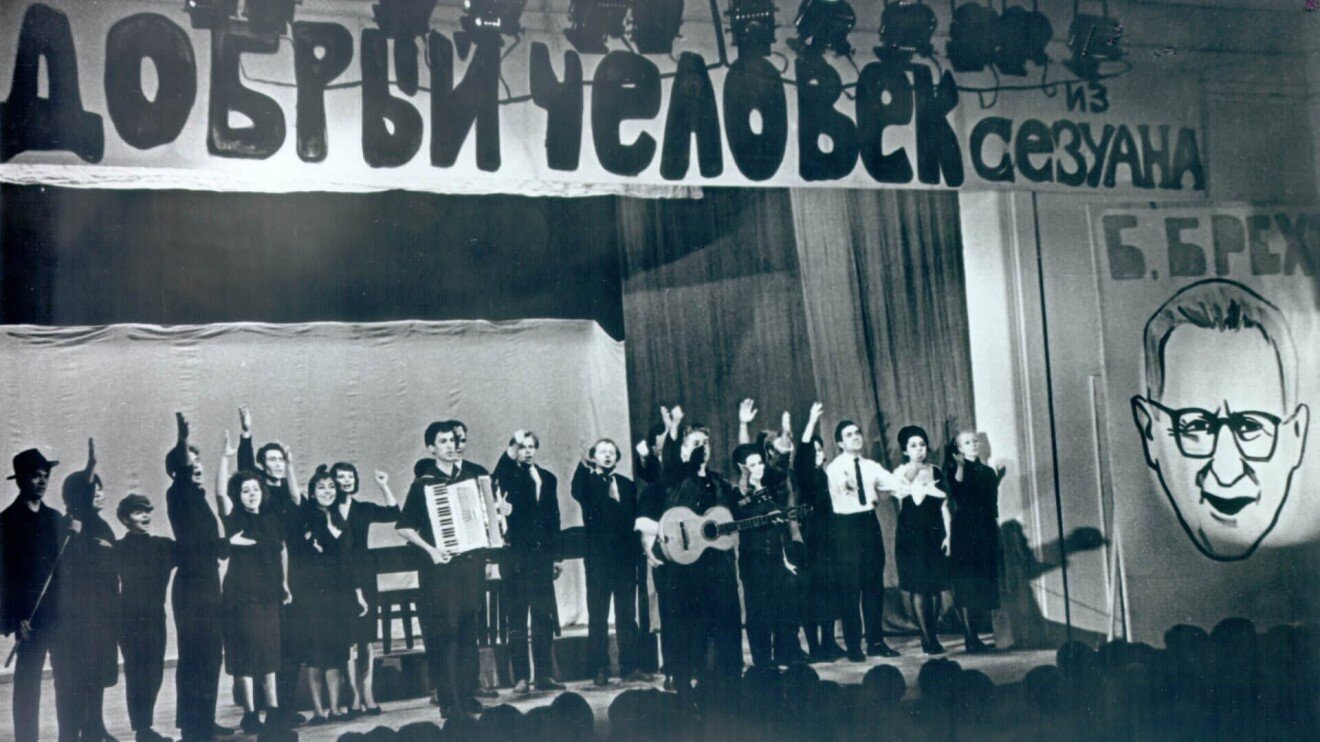
The story of this famous production began in 1963, when Yuri Lyubimov, at the time a teacher at the Shchukin Theatre School, decided to stage "The Good Person of Szechwan" with his third-year students. This student production became an event that overturned ideas about theater in the USSR, and marked the beginning of the Taganka Theatre's history.
Lyubimov himself recalled:
"Moscow is an amazing city — everyone finds out everything by rumor. Word spread that some interesting production was in the works. And since everyone was bored, diplomats included, if something was interesting, that meant there'd be a scandal."
The first showing of the play turned into a genuine theatrical melee. The Shchukin School's hall on the Arbat, built for 240 seats, packed in around 400 people. Audience members sat in the aisles, on the floor; a firefighter came running; the school's director threatened to stop the show. Among the audience were Ilya Ehrenburg, Yevgeny Yevtushenko, Bulat Okudzhava, and Maya Plisetskaya.
The production's music
The score was written by Boris Khmelnitsky and Anatoly Vasiliev. Notably, Vasiliev was not just the composer, but one of the first actors to play Yang Sun — he was only 17 at the time. Vladimir Vysotsky later took over the role, lending the character particular depth and tragedy.
Vysotsky and "St. Never's Day"
Vladimir Vysotsky joined the Taganka Theatre in 1964, and was cast into the production right away. He initially played the Second God, but later took on one of the leading roles — the heartless and cynical Yang Sun.
It was in Vysotsky's performance that the "Song of St. Never's Day" acquired the piercing quality and bitter irony that made it part of the popular culture. Vysotsky didn't simply sing Brecht's song — he filled it with his own understanding of Russian reality, his own pain for the "little man."
"We no longer have the strength to wait,
And that is why they must give us, yes, give us:
to people of hard labor —
St. Never's Day, St. Never's Day,
The day when we shall finally rest!"
In Vysotsky's interpretation, this song rang out like a cry from the soul, a desperate plea for a justice that would never come. The land of Never became a metaphor for every unattainable dream, every promise of a better life that would remain nothing but a promise.
A theatrical revolution
The production of "The Good Person of Szechwan" became a manifesto for a new kind of theater. Lyubimov applied the principles of Brecht's epic theater, in which the actor is not meant to fully transform into the character, but to remain in dialogue with them, keeping a certain distance.
The stage was defined by minimalism: a table, some stools, a couple of signs. To the sound of accordion and guitar, a parable unfolded about good and evil, about the impossibility of remaining humane in an inhumane world. There was no fourth wall — the actors spoke directly to the audience, breaking down traditional theatrical conventions.
Konstantin Simonov, who saw the production, wrote an enthusiastic review in "Pravda": "A young company of theater-school graduates, under the direction of Yuri Lyubimov, who staged this production, has created a work that is lofty, poetic, talented in its acting, and magnificently rhythmic."
From student production to theater
On April 23, 1964, "The Good Person of Szechwan" opened a new theater — the Moscow Drama and Comedy Theatre, soon renamed the Taganka Theatre. Thanks to this production, a struggling theater turned into one of the country's most significant cultural centers.
Future stars passed through this production: Zinaida Slavina (who played the lead role of Shen Te and Shui Ta), Alla Demidova, Valery Zolotukhin, Veniamin Smekhov. Each of them contributed to the production's singular atmosphere.
A cultural code for an era
The image of the "land of Never" became part of the cultural code of the Soviet era, fusing several layers of meaning:
- Social criticism — a dream of a just society that remains only a dream
- Existential longing — an understanding of the tragic impossibility of any ideal
- Folk wisdom — an ironic attitude toward the promises of those in power
- An artistic metaphor — a poetic image of the unattainable
In the context of Soviet reality, "St. Never's Day" took on a particular resonance. It was a veiled critique of a system that constantly promised a bright future but never delivered it. Audiences easily picked up on this subtext, which explains the production's extraordinary success.
Legacy and influence
The production of "The Good Person of Szechwan" had an enormous influence on the development of Soviet theater. It showed that theater could be a place not just for entertainment, but for serious reflection on life, that the stage could become a platform for expressing a civic stance.
Songs from the production, especially "St. Never's Day" as sung by Vysotsky, became part of oral folk culture. People sang them, quoted them; they became a symbol of an era when the intelligentsia sought ways to speak honestly with power and with society.
Brecht in Russia: a paradox of reception
Paradoxically, Bertolt Brecht, a committed Communist who built theater for the working class, remained persona non grata in the USSR for a long time. His plays were almost never staged in the 1920s–1950s, owing to ideological rejection of his artistic methods.
Only during the Khrushchev Thaw, after the playwright's death, did the first significant stagings of his work appear. And it was Lyubimov's student production that became the breakthrough that opened Brecht up to the Soviet audience.
Lyubimov himself admitted: "And because I hadn't seen any [productions] of Brecht, I came to it clean, and what emerged was a kind of Russian version of Brecht. The production was exactly what my intuition and my instinct told me it should be."
Literary echoes
The image of the "land of Never" spread widely through Soviet and post-Soviet literature. Writers used it as a metaphor for the unattainable, a symbol of a place where what is impossible in reality becomes possible.
Writers turned to this image especially often during periods of social upheaval, when the sense of the surreal sharpens, when reality itself takes on a phantasmagoric quality. The land of Never became a way to express a feeling of being lost, cast out of the familiar world.
Conclusion
An allusion to the "land of Never" in contemporary literature is not merely a reference to a well-known song. It is an invocation of an entire cultural stratum, of the collective memory of generations raised in the Soviet era. It is a way of making the eternal questions urgent again — questions of justice, of the possibility of goodness in a world of evil, of the price of humanity.
When a contemporary writer mentions the "land of Never," they draw their character into a dialogue with Brecht and Vysotsky, with Lyubimov and the actors of the Taganka, with an entire cultural tradition that saw theater not as entertainment, but as a way of understanding life.
"The Good Person of Szechwan" is still performed on the Taganka Theatre's stage today, retaining its relevance and its power. The songs from the production continue to be heard, a reminder that the dream of justice, however unattainable, remains part of human nature.