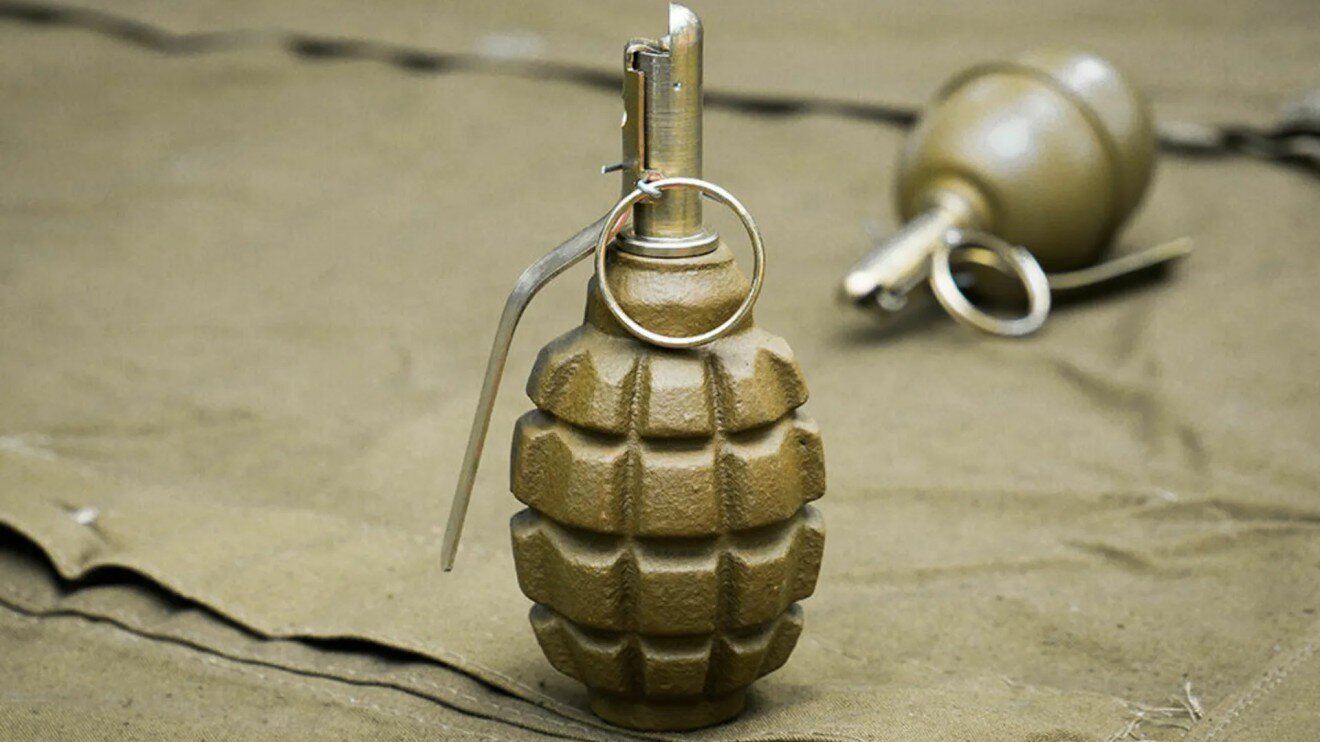
A fragmentation grenade is an offensive or defensive explosive device, designed to injure enemy personnel and damage equipment through fragments of its metal casing at the moment of detonation. It is one of the primary types of hand-held infantry weapon.
The origin of the name, and history
The word "grenade" comes from the German Granate, Italian Granata, and Latin Granatus, meaning "grainy" or "seeded." This is because early grenades resembled the shape and size of a pomegranate, and the fragments scattered by the explosion resembled the seeds inside the fruit.
Originally, "grenades" referred to munitions in the form of a hollow cast-iron sphere, packed with gunpowder, meant to injure personnel near the point of the blast. Until the early 20th century, the term "grenade" covered explosive shells both for hand-throwing and for artillery, up to a caliber of one pood (roughly 196mm).
Historical background
The forerunners of hand grenades were clay vessels filled with lime or an incendiary mixture, used from the 9th century onward. In 1405, Konrad Kyeser von Eichstätt first proposed using a cast-iron casing for grenades. In 1667, England assigned 4 men per company to throw grenades — they were given the name "grenadiers."
Grenades of the modern type were invented during the Russo-Japanese War of 1904–1905, when an urgent need for this kind of weapon emerged for storming and defending trenches. Mass production and widespread use of hand grenades began during the First World War.
Construction and how it works
A modern hand fragmentation grenade consists of three main elements:
- A metal casing — produces the fragments upon detonation
- An explosive charge — drives the blast and shatters the casing
- A fuse (detonator) — initiates the charge's explosion
The grenade casing
The casing is made of metal, and can be smooth or ribbed (a "jacket"). A ribbed surface helps the casing fragment more evenly, into pieces of a set size. In some designs, a supply of ready-made shrapnel elements — small balls, cubes, or other shapes — is packed between the casing and the explosive charge.
Explosives
TNT is most commonly used as the main charge. The amount of explosive varies by grenade type — from 60 grams in defensive grenades to 110–120 grams in offensive ones.
The fuse
Two main detonation principles exist:
| Fuse type | How it works | Used in |
|---|---|---|
| Delayed | Detonates after a set time (4–5 seconds) | Most hand grenades |
| Impact | Detonates on striking an obstacle | Special-purpose grenades |
The delayed-detonation mechanism
Pulling the safety pin and releasing the lever triggers a spring-loaded mechanism. The striker strikes hard against a percussion cap made of an impact-sensitive substance. The exploding cap ignites the powder in the fuse tube, which burns at a rate of about 1 cm per second. This powder needs no oxygen, so a grenade can go off even underwater. When the fire reaches the detonator, the main charge explodes.
Classification of fragmentation grenades
By method of delivery
- Hand-thrown — thrown by hand, a distance of 15–50 meters
- Rifle-launched — fired from rifles, a range of 100–400 meters
- Underbarrel-launched — fired from grenade launchers, up to 2,000 meters
By tactical purpose
| Grenade type | Characteristics | Use case | Example |
|---|---|---|---|
| Defensive | A large kill radius, a powerful charge | Used only from behind cover | F-1 (60g TNT, 600g total weight) |
| Offensive | A smaller kill radius | Can be used in open ground | RGD-5 (110g TNT, 310g total weight) |
By detonation method
- Time-delayed — explode a set time after activation
- Impact — explode on striking an obstacle
Tactical and technical specifications
Throwing range
- A trained soldier can throw a fragmentation grenade 40–50 meters
- An anti-tank grenade — around 20 meters
- An average soldier throws a grenade 25–35 meters
Kill radii
An important distinction!
Kill radius — the zone in which unprotected people are killed with high probability
Fragment scatter radius — the maximum distance fragments can travel
For the F-1 defensive grenade:
- Radius of certain casualties — 5 meters
- Kill radius — 20 meters
- Fragment scatter radius — 200 meters
Injury mechanisms
- Casing fragments — the primary injury mechanism
- Blast wave — effective within a 3–6-meter radius
- Acoustic effect — can cause a concussion
Use in combat
Primary purpose
- Neutralizing enemy personnel under cover
- Engaging enemy groups in open ground
- Flushing out enemies from buildings and structures
- Clearing passages through obstacles
Safety procedures
Basic safety rules
- Defensive grenades are used only from behind cover
- Comrades must be warned before throwing
- Once activated, the grenade should be thrown immediately
- In winter, care must be taken that the grenade doesn't catch on clothing
Alternative uses
Beyond their direct purpose, grenades can be used for:
- Rigging tripwire mines
- Signaling
- Destroying obstacles
- Psychological pressure on the enemy
Well-known grenade models
Soviet and Russian grenades
| Model | Type | Weight | Explosive charge | Features |
|---|---|---|---|---|
| F-1 | Defensive | 600 g | 60 g TNT | Ribbed casing, nicknamed the "lemon" |
| RGD-5 | Offensive | 310 g | 110 g TNT | Smooth aluminum casing |
| RG-42 | Offensive | 420 g | 110-120 g TNT | Cylindrical casing |
| RGD-33 | Universal | 590 g | 120 g TNT | With a wooden handle |
Foreign equivalents
- M26 (USA) — a fragmentation grenade with a ribbed casing
- M67 (USA) — a modern fragmentation grenade
- L2A2 (UK) — a fragmentation grenade
- DM51 (Germany) — a multi-purpose grenade
Common myths
Debunking myths about grenades
Myth: A grenade can be activated by pulling the pin with your teeth.
Reality: The pin has small prongs that must first be straightened out. Trying to pull the pin with your teeth is more likely to cost you your teeth.
Myth: A grenade explodes with a huge fireball and destroys buildings.
Reality: The explosion produces a sharp crack and a small cloud of dust. A fragmentation grenade does not cause significant structural damage.
Myth: A 200-meter kill radius means death for everyone in that zone.
Reality: That is the fragment scatter radius. The radius of certain casualties doesn't exceed 5 meters.
Myth: A modern grenade can be activated silently.
Reality: Activation produces a sound comparable to a pistol shot.
Materials
Modern grenades are made from various materials:
- Steel — the traditional casing material
- Cast iron — used in early models
- Aluminum alloys — to reduce weight
- Plastic — for certain components
Under wartime material shortages, grenades made from non-standard materials are known:
- Concrete — the German Volkshandgranate 45
- Glass — the German Glashandgranate
Training
Several tools are used to teach grenade-handling skills:
- Training grenades — match the shape and weight of live ones, but with no explosive
- Simulation grenades — produce sound and smoke when triggered
- Cutaway models — for studying the internal construction
The psychological factor
For new recruits, throwing a grenade is often a psychological hurdle. Drawing on impressions from films, they overestimate the grenade's destructive power, and can make dangerous mistakes: throwing the pin instead of the grenade, dropping an activated grenade, or freezing in fear.
Conclusion
The fragmentation grenade remains an important part of infantry weaponry, despite the development of other kinds of arms. Its effectiveness at close range, simple design, and relatively low production cost ensure it remains widely used in every army in the world. A proper understanding of how it works, its tactical specifications, and safe-handling rules is the foundation for using this weapon effectively.
"A grenade is a weapon that demands not just physical training, but psychological readiness. Every soldier must clearly understand its capabilities and its limits." — from a manual on small-arms training.